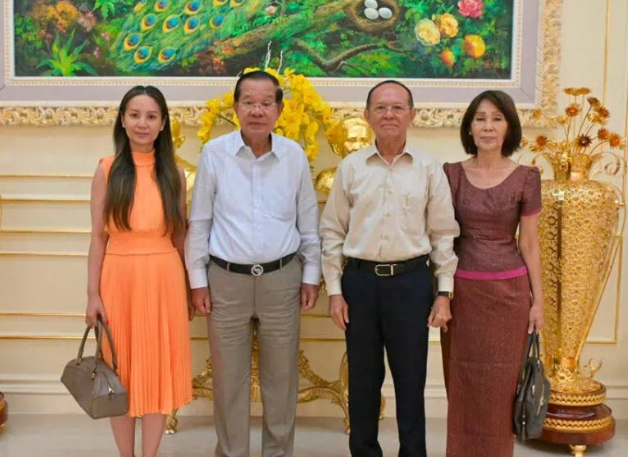
Cambodia's Senate president Hun Sen has extended an olive branch to Kem Sokha, once his fiercest political adversary, by receiving him and his family at his private residence for an extended meeting on Sunday morning. The gathering, which lasted from 9 until noon, marks the latest phase in a dramatic reversal of fortunes for the former opposition leader, who spent years under legal restrictions following his contested 2023 conviction on treason charges. Hun Sen's public acknowledgement of the meeting through social media, coupled with his unusually warm remarks about Sokha's daughter, signals a potential recalibration of Cambodia's political landscape at a moment when restrictions on Sokha's movements and activities have been progressively loosened.
The three-hour conversation between Hun Sen and Sokha represents a continuation of recent diplomatic overtures between the two men. Hun Sen noted in his social media post that Sokha had visited his home several weeks prior, at which point the former opposition leader was preparing to travel to northwestern Banteay Meanchey province to meet with Cambodian military personnel and families displaced by ongoing border clashes with Thailand. This earlier visit appeared to have set the tone for Sunday's more formal gathering, which included Sokha's wife and daughter. The extended duration of their discussion underscores the substantive nature of the engagement, though neither side has disclosed the topics covered during the private conversation.
What emerged most prominently from Hun Sen's public account of the meeting was his specific and laudatory reference to Kem Monovithya, Sokha's daughter, whom he described as "an excellent human resource for the nation." Hun Sen stated that he had devoted considerable time during the meeting to conversations with Monovithya, using language that suggested genuine appreciation for her capabilities and potential. Coming from a political veteran of Hun Sen's stature, such praise carries weight within Cambodian political circles and may signal openness to a future role for Monovithya in national affairs. The compliment becomes particularly significant given her deep association with her father's political movement and her historical prominence in opposition circles.
Monovithya's background makes Hun Sen's remarks noteworthy. She had been closely identified with the Cambodia National Rescue Party, the opposition coalition that her father co-founded and led before its controversial dissolution by Cambodia's Supreme Court in 2017. The CNRP had emerged as a formidable political force, capturing substantial electoral support in the 2013 national election and securing impressive gains in the 2017 commune elections before being dismantled. Monovithya's association with this movement meant she too faced restrictions and scrutiny during the years her father endured house arrest and legal proceedings. Hun Sen's willingness to publicly commend her suggests a willingness to move beyond the adversarial dynamics that characterized their interaction during the height of the CNRP's challenge to ruling party dominance.
Kem Sokha's journey from convicted prisoner to private citizen welcomed in Hun Sen's home has unfolded over a remarkably compressed timeline. In November 2023, Sokha received a conviction and 27-year sentence on charges related to alleged conspiracy with foreign powers—accusations he and international observers have disputed. He remained under house arrest with severe restrictions on his movements and political engagement. In April 2026, Cambodia's Appeal Court upheld the conviction while maintaining the lengthy sentence and imposing an additional five-year ban on overseas travel. However, on May 25, Sokha received a royal pardon that effectively ended his detention and house arrest obligations, though political activity restrictions nominally remained in place.
The pace of Sokha's rehabilitation accelerated further when a royal decree issued on July 24 removed the five-year overseas travel restriction that had been imposed alongside his conviction. Days later, on July 28, Sokha made a significant public appearance by travelling to Banteay Meanchey to visit communities affected by border conflict displacement. During that visit, Sokha carefully framed his actions as those of a private citizen acting on humanitarian grounds rather than as a political figure or representative of state institutions. He indicated that he had discussed the plight of affected Cambodians with international contacts, suggesting that despite formal restrictions on political activity, he maintains capacity to engage on matters of national concern.
The relationship between Hun Sen and Sokha encapsulates Cambodia's recent political transformation. For nearly a decade, they represented the country's principal political divide. The CNRP's emergence as a credible opposition force had challenged the ruling Cambodian People's Party's near-monopoly on power and presented Cambodian voters with a genuine electoral choice. The party's growth in 2013 and 2017 demonstrated significant public appetite for political alternatives, even within Cambodia's tightly controlled electoral environment. However, the 2017 Supreme Court dissolution of the CNRP removed the primary opposition platform and effectively ended Sokha's active political role, a period characterized by mutual antagonism between the two camps.
The current thaw in relations between Hun Sen and Sokha invites speculation about broader implications for Cambodia's political trajectory. Hun Sen's decision to receive Sokha at his home and to publicly praise Monovithya suggests receptivity to renewed political engagement with figures from the dissolved opposition. Whether this represents genuine reconciliation, strategic positioning ahead of future elections, or simply a pragmatic recognition that Sokha's political threat has been sufficiently diminished remains unclear. Neither Hun Sen nor Sokha has announced any formal political agreement, reconciliation framework, or specific prospective roles, leaving observers to interpret the meetings' significance based on tone and symbolism.
For Malaysian and Southeast Asian observers, Cambodia's political rehabilitation of former opposition figures carries relevance to broader regional patterns. Throughout Southeast Asia, questions about how governments manage defeated opposition movements and whether political systems can accommodate diverse viewpoints remain contested. Cambodia's approach of combining legal restrictions with eventual pardons and gradual reintegration differs from authoritarian hardening seen elsewhere, though critics note that prohibitions on political activity persist despite the ceremonial welcome extended to Sokha. The involvement of Monovithya in these recent meetings suggests that Cambodia's political establishment may be exploring avenues for incorporating the next generation of opposition figures into the broader political order, potentially reshaping dynamics around Cambodia's next national elections scheduled for 2028.
The symbolic significance of Hun Sen's hospitality toward Sokha extends beyond Cambodia's borders. The region watches how individual nations manage political competition and reconciliation as indicators of system maturity and stability. Cambodia's gradual easing of restrictions on Sokha, paired with his careful navigation of humanitarian engagement outside formal political channels, and now his acceptance into Hun Sen's private circle, suggests a complex negotiation between maintaining ruling party dominance and accommodating former adversaries within a managed political framework. Whether this signals genuine democratic opening or merely a more subtle form of political control will likely become clearer as Sokha and Monovithya navigate their evolving roles in Cambodian public life.

