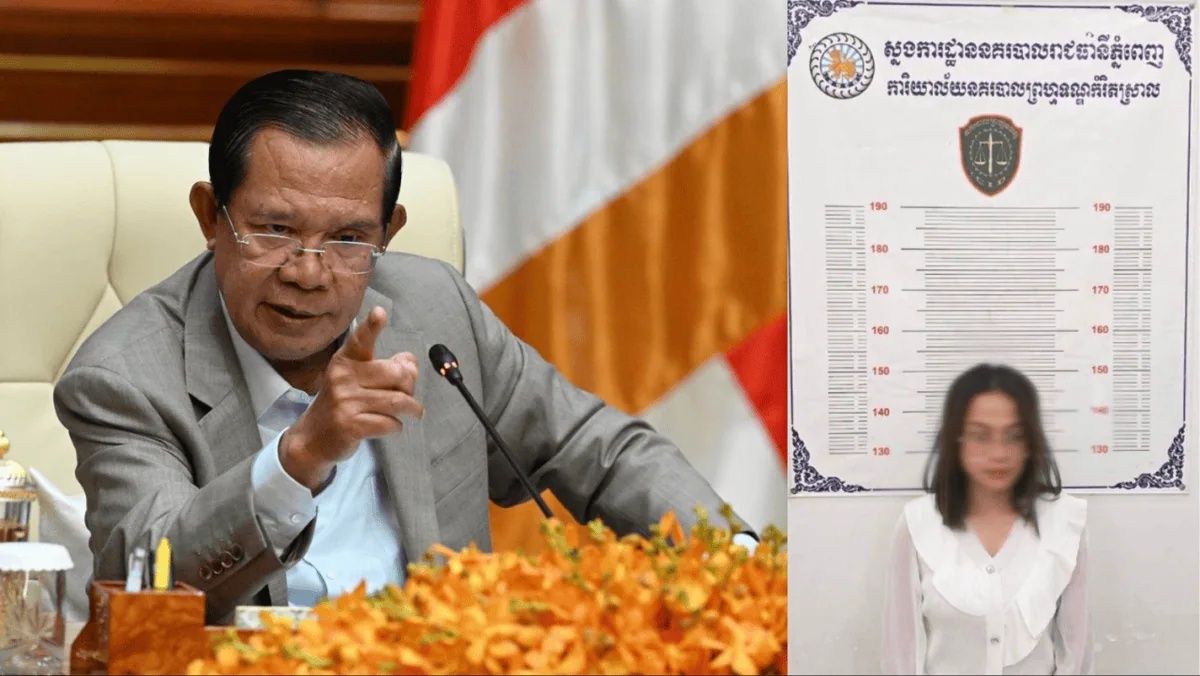
Cambodia's Senate president Hun Sen has tasked the National Council for Women with initiating court proceedings against individuals deemed to have used vulgar and demeaning language that diminishes women's standing and violates Cambodian social norms. During discussions with council representatives on Friday, Hun Sen stressed the government's commitment to preserving what he characterised as core Khmer values through legal mechanisms, marking a significant escalation in state oversight of public speech and social conduct.
The directive emerged following specific incidents that Hun Sen cited as examples of unacceptable public behaviour. He referenced an unidentified woman who had allegedly used profane language to denigrate government bodies and public servants, noting that authorities had already called both the woman and her spouse to issue a written apology. This case, though details remain sparse, appears to have prompted Hun Sen's broader policy shift toward institutionalised legal responses to perceived breaches of social propriety.
A second case involving a woman identified as Chenda Sovannary demonstrated how minor commercial disputes can escalate into matters of perceived national concern under Cambodia's expanding social governance framework. Sovannary reportedly engaged in heated language with a soldier during a disagreement over a mobile phone transaction. Hun Sen used the incident to illustrate his point that regardless of circumstance, insulting any person—whether a military member, construction worker, or ordinary civilian—constitutes grounds for legal intervention and judicial remedy.
The Senate president's rhetoric regarding such cases emphasises preservation of dignity across all social strata. His statements suggest a philosophy where protecting social cohesion justifies active state intervention in regulating speech and conduct. Hun Sen drew parallels to commercial social media platforms, which operate content moderation systems based on community standards, implying that governmental oversight of public discourse follows similar logic and serves comparable societal purposes. This framing attempts to position legal action as neutral administration rather than political suppression.
Implementation of Hun Sen's directive will require substantial coordination across multiple state institutions. The National Council for Women has received instructions to work alongside the Ministry of Interior, Ministry of Information, Ministry of Culture and Fine Arts, and Ministry of Post and Telecommunications. This multi-agency approach suggests the government envisions a comprehensive monitoring and enforcement infrastructure capable of identifying alleged transgressions across both physical spaces and digital platforms, particularly social media outlets like Facebook where public discourse occurs increasingly.
The Senate president explicitly addressed potential criticism by contending that these measures do not constitute authoritarian overreach or rights curtailment. Instead, Hun Sen framed legal action against offensive speech as necessary protection of national dignity and social harmony. This distinction—between restricting freedoms and safeguarding values—represents a rhetorical strategy common in Southeast Asian governance, where governments justify regulatory measures by appealing to cultural preservation and social stability rather than acknowledging control mechanisms.
For Malaysia and other Southeast Asian nations, Cambodia's approach reflects broader regional trends toward expanded state involvement in regulating public discourse and social behaviour. Several Southeast Asian governments have progressively implemented laws targeting offensive speech, online harassment, and conduct deemed threatening to social cohesion or national dignity. Cambodia's particular emphasis on gender-specific language and women's values adds a distinctive dimension, framing women's protection as justification for broadened speech regulation rather than addressing underlying issues of gender-based discrimination or violence.
The practical implications of Hun Sen's directive remain unclear, particularly regarding enforcement thresholds and judicial interpretation. Questions persist about how courts will distinguish between protected speech and actionable insults, who determines whether language genuinely violates social values, and whether the system will function equitably across different social strata. Historical patterns in Cambodia and similar jurisdictions suggest that such mechanisms may be applied selectively, with enforcement varying based on political considerations and social status.
From a regional perspective, Cambodia's development of state-monitored social conduct standards contributes to an evolving landscape where Southeast Asian governments increasingly assert authority over citizens' public expressions and social interactions. The involvement of multiple ministries suggests institutional capacity-building specifically designed to monitor and regulate civilian behaviour through integrated governmental mechanisms. Malaysian observers particularly should note how such frameworks, once established, tend to expand in scope and application over time.
The role assigned to the National Council for Women raises additional considerations regarding the instrumentalisation of gender and women's issues for broader social control objectives. While ostensibly protecting women's dignity, the framework may equally serve to police women's own speech and conduct, constraining their agency under the guise of safeguarding their values. This paradox illustrates how governance mechanisms framed around protective rhetoric can simultaneously restrict the groups they claim to benefit.
Cambodia's emphasis on monitoring Facebook and other social platforms indicates growing state attention to digital spaces as domains requiring comparable regulatory oversight as physical public areas. As digital literacy and social media penetration expand across Southeast Asia, similar governmental initiatives may emerge in neighbouring countries, potentially establishing precedents for internet regulation justified through social protection arguments rather than explicit censorship rationales.
Hun Sen's directive ultimately represents a particular model of state-society relations where governmental institutions actively enforce behavioural standards and linguistic norms across the population. Whether this approach genuinely enhances social cohesion or primarily extends state control over public discourse remains contested, but its adoption signals a particular regional trajectory regarding the relationship between government authority and individual expression in contemporary Southeast Asia.

