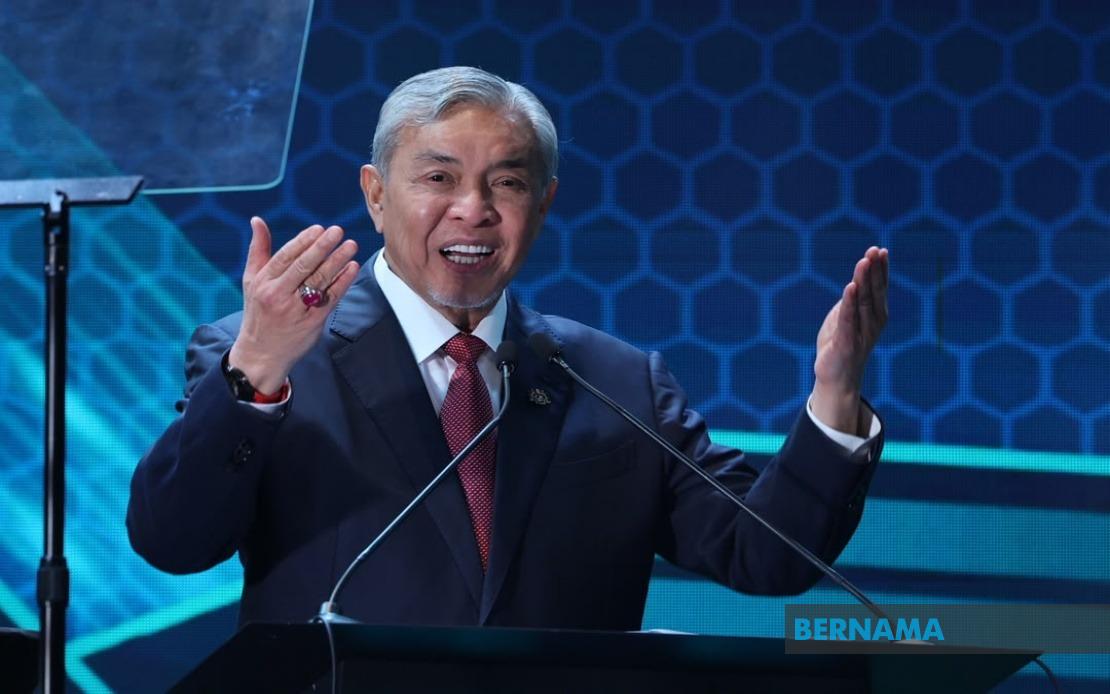
Malaysia's Immigration Department must undergo a fundamental reimagining of its role, moving beyond traditional border control to become an active catalyst for national economic competitiveness and security, according to Deputy Prime Minister Datuk Seri Dr Ahmad Zahid Hamidi. Speaking at the 2026 Immigration Day celebration in Cyberjaya on July 21, Ahmad Zahid presented a comprehensive four-point mandate designed to steer the department towards greater relevance, public trust and operational excellence. The framework represents an acknowledgment that immigration policy sits at the intersection of economic opportunity and national protection, requiring coordinated strategy rather than ad hoc responses.
The strategic compass Ahmad Zahid outlined encompasses four interconnected priorities: positioning the Immigration Department as a facilitator of economic growth; strengthening national security and sovereignty through modern enforcement methods; accelerating digital transformation and service delivery innovation; and embedding integrity, professionalism and humanitarian principles throughout the institution. These elements are not meant to operate independently but rather as an integrated system where each reinforces the others. The Deputy Prime Minister emphasised that fragmented transformation efforts and isolated initiatives would prove insufficient, stressing instead the necessity for a unified direction that translates into every policy decision, operational system and frontline action taken by department personnel.
On the economic dimension, Ahmad Zahid challenged the conventional perception of immigration authorities as gatekeepers primarily concerned with restriction and control. Instead, he advocated for the department to recognise how bureaucratic inefficiencies directly undermine Malaysia's competitive position in attracting foreign investment and global talent. Drawing a pointed comparison with the United Arab Emirates, he highlighted how that nation has successfully integrated immigration policies with broader strategies to retain and attract high-value investors and skilled workers through mechanisms such as the Golden Visa programme, which offers residency periods extending to ten years. The UAE's approach has translated into substantial economic returns, generating a record RM196.6 billion in foreign direct investment during 2025, positioning the country as the ninth most attractive foreign investment destination globally for the fourth consecutive year. This benchmark suggests that Malaysian policymakers view expedited, streamlined immigration procedures not as security compromises but as essential competitive tools in an era where talent and capital flow readily to jurisdictions offering frictionless entry.
The national security dimension of Ahmad Zahid's mandate reflects an evolving threat landscape that differs markedly from security challenges of a decade past. Traditional border control, which once centred on physical inspection and document verification, has become inadequate against transnational criminal networks that operate with increasing sophistication and organisation. Migrant smuggling syndicates have evolved into hierarchical enterprises with complex supply chains, while human trafficking operations employ deceptive tactics that confound conventional detection methods. These threats transcend geographical boundaries and operate across time zones, requiring security agencies to adopt intelligence-driven, data-informed approaches rather than reactive enforcement protocols. The Deputy Prime Minister called for the Immigration Department to transition from responding to identified violations toward predictive, anticipatory security postures enabled by advanced technological systems.
Digital transformation and technological innovation form the third pillar of Ahmad Zahid's strategy, representing a recognition that modern governance demands sophisticated data architecture and analytical capability. The vision encompasses deployment of big data analytics, artificial intelligence systems, predictive algorithms, digital identity frameworks, biometric technologies and smart border infrastructure that collectively enable faster decision-making with greater accuracy and security. The underlying philosophy rejects the notion that technological adoption merely accelerates existing processes; instead, Ahmad Zahid articulated a vision where technology fundamentally changes how the department thinks about its mission, enabling it to act with greater precision and deliver services comparable to international standards. This transformation addresses a persistent challenge in Southeast Asian public administration—the tendency to digitise legacy processes rather than redesigning them for contemporary requirements.
The integrity and professionalism component addresses internal institutional culture and individual officer conduct. Ahmad Zahid explicitly urged Immigration Department personnel to adhere rigorously to established procedures, exercise sound judgement in decision-making and demonstrate the moral courage to act ethically even when other incentives might exist. This emphasis reflects ongoing concerns about corruption and misconduct within immigration agencies across the region, where officers' discretionary authority over visa approvals, permit issuance and deportation decisions creates opportunities for bribery and patronage. By elevating integrity as a strategic pillar rather than treating it as peripheral to core functions, the Deputy Prime Minister signalled that institutional credibility and public trust are inseparable from operational effectiveness.
The timing and scope of Ahmad Zahid's pronouncements carry particular significance for Malaysia's broader regional positioning. As Southeast Asian nations compete intensely for foreign direct investment, skilled migration and regional economic influence, immigration policy increasingly becomes a competitive differentiator. Countries like Singapore have long understood that efficient immigration administration supports economic dynamism, while bureaucratic friction in immigration processes can redirect talent and investment flows to competing jurisdictions. Malaysia's recognition of this dynamic through its Deputy Prime Minister suggests a more sophisticated understanding of how institutional performance in immigration affects macroeconomic outcomes. This alignment between security concerns and economic facilitation represents a departure from zero-sum framing where immigration oversight is viewed solely through a restrictive lens.
The four-point mandate also reflects transnational security cooperation imperatives specific to Southeast Asia. The region confronts shared challenges including maritime people smuggling networks, cross-border trafficking operations and coordinated irregular migration flows that no single country can address unilaterally. Ahmad Zahid's emphasis on closer cooperation among national enforcement agencies implies recognition that effective immigration control requires coordination across customs, law enforcement, intelligence and border security bodies. This institutional integration becomes more feasible when immigration authorities operate within a framework that balances security demands with economic facilitation, as agencies share compatible objectives rather than viewing immigration through conflicting mandates.
The presentation of this mandate at the 2026 Immigration Day celebration, attended by senior government officials including Chief Secretary to the Government Tan Sri Shamsul Azri Abu Bakar and Immigration Director-General Datuk Zakaria Shaaban, underscores governmental commitment to institutional transformation. The public articulation of strategic direction by the Deputy Prime Minister provides political cover and organisational legitimacy for departmental reforms that might otherwise face resistance from entrenched interests or conservative constituencies. By framing immigration modernisation as aligned with national security strengthening rather than as liberalisation, Ahmad Zahid created rhetorical space for operational changes that might otherwise encounter opposition from those viewing any regulatory relaxation with suspicion.
The implications of this strategic reorientation extend beyond the Immigration Department itself, signalling broader government thinking about how institutional design can simultaneously serve security and economic objectives. This integrated approach contrasts with conventional bureaucratic siloing where security agencies and economic promotion authorities operate with minimal coordination or shared metrics. For Malaysia, where economic growth has moderated and regional competition for investment intensifies, positioning immigration administration as an economic asset represents acknowledgment that competitiveness depends on institutional effectiveness across multiple government functions, not merely in dedicated economic development agencies. The Deputy Prime Minister's characterisation of a transformed Immigration Department as a potential symbol of public trust and strategic institution reflects aspirations to rebuild confidence in government capability following years of institutional scandals and performance concerns.
The reference to the department becoming a bulwark of national sovereignty while serving as a catalyst for economic competitiveness encapsulates the sophisticated framing Ahmad Zahid employed. These objectives are presented not as tensions requiring compromise but as mutually reinforcing priorities achievable through technological sophistication, professional excellence and strategic direction. This messaging represents an implicit critique of previous immigration administration approaches that treated security and economic facilitation as opposing imperatives requiring zero-sum trade-offs. Whether the department can successfully operationalise this four-point mandate depends significantly on resource allocation, training investment and leadership commitment to implementing promised reforms beyond rhetorical endorsement. The coming years will reveal whether this high-level strategic pronouncement translates into substantive institutional change that measurably improves both security outcomes and economic facilitation metrics.

