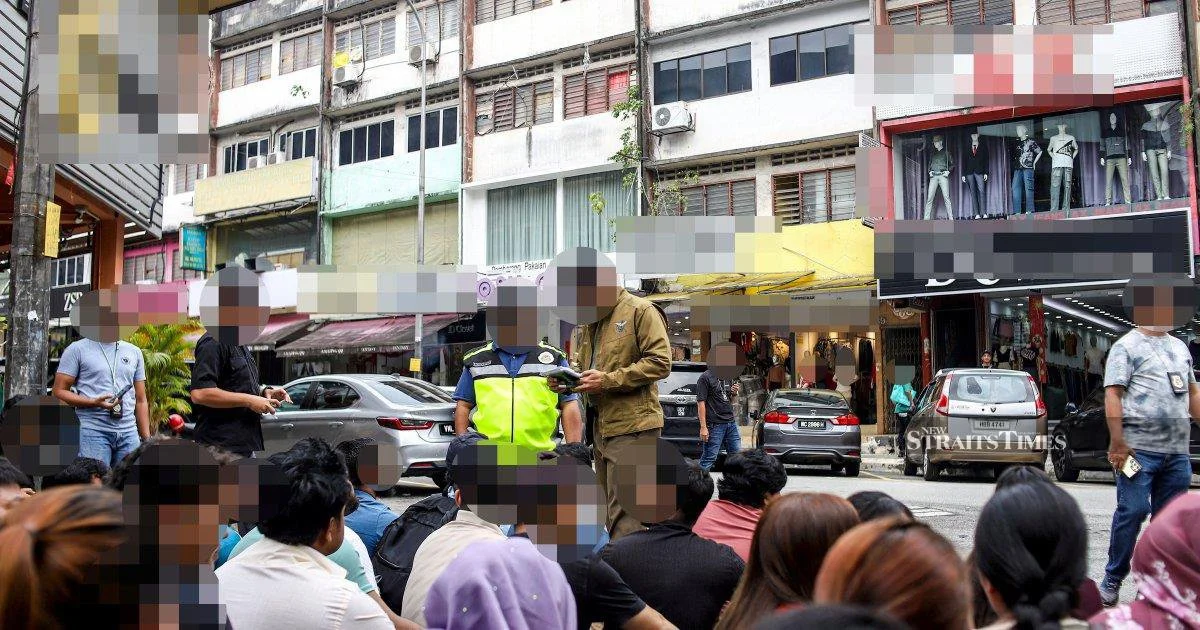
Immigration authorities have intensified their border control efforts with a significant enforcement operation targeting undocumented workers in Kuala Lumpur's bustling Jalan Kenanga wholesale clothing precinct. The raid, conducted during daylight hours, resulted in the apprehension of 111 individuals without valid documentation, marking another substantial success in the authorities' continued crackdown on irregular migration networks operating within the capital's commercial zones.
The Jalan Kenanga district, long established as Southeast Asia's premier wholesale clothing hub, has increasingly become a focal point for immigration enforcement activities. The area's dense concentration of retailers, warehouses, and small manufacturing operations creates complex employment ecosystems where undocumented workers frequently find opportunities, often working under exploitative conditions with minimal labour protections. The scale of this operation underscores the persistent challenge authorities face in maintaining immigration compliance across Malaysia's informal economic sectors.
Undocumented migration remains a persistent issue throughout Southeast Asia, with Malaysia serving as a primary destination for irregular workers from neighbouring countries and beyond. These individuals typically arrive through porous borders or overstay valid visitor permits, subsequently integrating into labour markets where demand for low-wage workers remains consistently high. The wholesale and retail sectors, particularly in concentrated commercial districts like Jalan Kenanga, represent attractive destinations for undocumented workers seeking employment opportunities, regardless of legal status.
The operation reflects immigration authorities' strategic approach to targeting specific high-density commercial zones identified as harbouring substantial undocumented populations. Rather than pursuing dispersed enforcement actions, authorities have increasingly concentrated resources on identified migration hotspots where irregular workers congregate. This focused strategy aims to maximise enforcement impact whilst concentrating resources on areas with documented patterns of irregular employment activity.
For employers operating within Jalan Kenanga and similar commercial districts, the raid carries significant implications. Malaysian labour law imposes strict penalties on businesses knowingly employing undocumented workers, including substantial fines and potential criminal prosecution. The enforcement action serves as a sharp reminder that regulatory compliance regarding worker documentation remains a priority concern for authorities, with periodic raids designed to sustain compliance pressure on business operators throughout the district.
The apprehended individuals will face standard immigration processing procedures, including documentation verification and deportation arrangements. Immigration detention facilities typically process large numbers of undocumented migrants following enforcement operations, creating capacity pressures on institutional resources. Deportation arrangements involve coordination with countries of origin, a process that can extend over weeks or months depending on documentation availability and diplomatic procedures.
This enforcement activity occurs within Malaysia's broader context of managing migration pressures across Southeast Asia. The region experiences complex migratory flows driven by substantial economic disparities between origin and destination countries, limited formal labour migration pathways, and persistent demand for undocumented workers within informal economy sectors. Malaysia's geographic position and relative economic development continue attracting irregular migrants despite comprehensive immigration enforcement apparatus.
The Jalan Kenanga operation also highlights the interconnected nature of enforcement challenges across Malaysia's urban commercial infrastructure. The wholesale clothing district connects to broader supply chain networks extending throughout Southeast Asia, with workers frequently shifting between locations and employment sectors. This mobility creates ongoing enforcement complexities, as authorities must maintain consistent vigilance across multiple commercial zones simultaneously to sustain compliance pressures.
Regional analysts note that enforcement operations of this scale, whilst demonstrating authorities' commitment to immigration control, address symptoms rather than underlying causes driving irregular migration. Substantial economic wage differentials between Malaysia and origin countries continue providing powerful incentive structures for irregular migration. Until origin countries achieve significantly improved economic development and employment opportunities, irregular migration pressures will likely persist despite intensified enforcement activities.
The raid also reflects evolving strategies within Malaysia's immigration enforcement apparatus, increasingly emphasising coordination between federal and state authorities, intelligence-led operations targeting identified migration networks, and commercial zone surveillance. These sophisticated enforcement approaches demonstrate investment in modern migration management infrastructure, contrasting with historical enforcement models relying primarily on reactive responses to detected violations.
Looking forward, the Jalan Kenanga operation will likely prompt renewed employer compliance initiatives within the district, with businesses potentially implementing enhanced documentation verification procedures. However, sustained compliance depends on maintaining consistent enforcement pressure, as commercial incentives for hiring undocumented workers—who typically accept lower wages and fewer benefits—remain substantial without continuous regulatory vigilance.
The apprehension of 111 undocumented migrants in a single operation illustrates the significant scale of irregular worker populations embedded within Malaysia's commercial sectors, particularly in high-density commercial districts. Whilst individual enforcement operations generate headlines, migration experts emphasise that comprehensive solutions require addressing underlying economic factors driving irregular migration alongside sustained enforcement efforts throughout Malaysia's commercial infrastructure.

