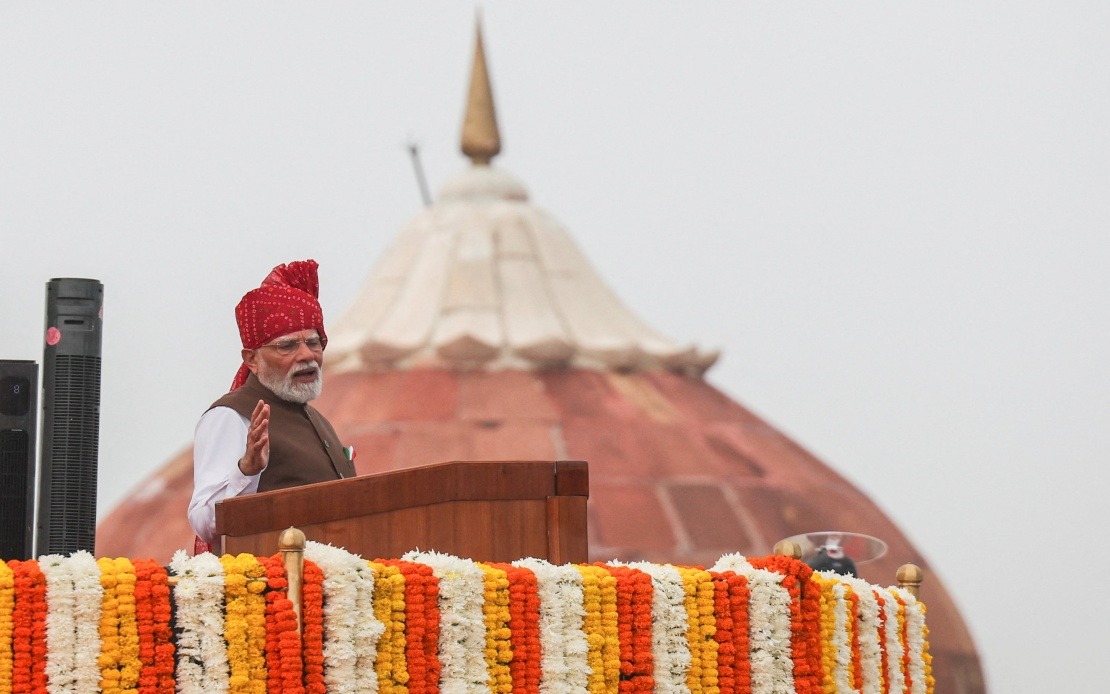
Prime Minister Narendra Modi delivered a sweeping vision for India's technological and economic independence during his Independence Day address at the Red Fort in Delhi, signalling a decisive pivot toward domestic capability-building across critical strategic sectors. The comprehensive push for self-reliance, which Modi framed as essential to India's transformation into a developed nation by 2047, encompasses semiconductors, nuclear power generation, renewable energy expansion and advanced military manufacturing. This long-term strategic orientation reflects New Delhi's determination to reduce external dependencies in industries deemed vital to national security and economic resilience.
Semiconductor manufacturing has emerged as a centrepiece of India's industrial ambitions. With three fabrication plants already operational, Modi announced expectations that five to eight additional facilities will commence production within the next seven to eight years, marking a significant expansion of India's domestic chip-making capacity. This trajectory positions India to challenge established semiconductor hubs and promises to address chronic supply vulnerabilities that have complicated the country's tech sector growth. For Southeast Asian manufacturers competing in global electronics markets, India's semiconductor expansion represents both competition and potential supply-chain diversification opportunities that regional players may leverage.
Nuclear energy constitutes another cornerstone of India's self-reliance blueprint. The government aims to achieve 100 gigawatts of nuclear capacity by 2047, a target that requires sustained investment and technological advancement. A significant breakthrough was achieved this year when India successfully mastered fast-breeder reactor technology and enhanced its nuclear fuel self-sufficiency, reducing dependence on foreign uranium supplies. Within the current decade alone, Modi announced plans to commission five new nuclear reactors, representing a tangible acceleration of India's atomic energy programme. This development carries implications for the broader South Asian region's energy security and climate commitments, as nuclear expansion could reduce India's coal dependence and greenhouse gas emissions.
Renewable energy transitions have already demonstrated remarkable momentum under Modi's administration. India has expanded solar power generation from just 2 gigawatts twelve years ago to 160 gigawatts currently, a nearly eightfold increase that underscores the country's commitment to clean energy deployment. This expansion reflects both technological improvements and policy incentives that have attracted private investment into solar infrastructure. As India continues scaling renewable capacity, the trajectory suggests increasing regional manufacturing of solar equipment and associated supply chains may develop within South Asia, potentially reshaping energy infrastructure investment patterns across Southeast Asia.
Hydrocarbon exploration represents a less celebrated but strategically important dimension of India's self-reliance drive. The government has allocated 850 billion rupees, equivalent to approximately US$8.9 billion, for offshore oil and gas exploration in territories previously deemed commercially unviable. Modi characterised these areas as ninety-nine percent no-go zones, indicating that technological advances and changed economic calculations now make their development feasible. Success in these exploration efforts could enhance India's energy independence and reduce exposure to volatile global petroleum markets, thereby stabilising domestic energy costs and industrial competitiveness.
Military manufacturing capabilities feature prominently in Modi's self-reliance framework, reflecting broader geopolitical considerations in South Asia and the Indian Ocean region. The Prime Minister specifically highlighted the need for indigenous development of advanced drones, counter-drone systems and hypersonic defence technologies. These weapons platforms represent cutting-edge military technology crucial for regional deterrence and power projection. India's push to domesticate such capabilities reduces reliance on foreign defence suppliers and enables faster customisation of systems to regional threat environments. Malaysian defence planners monitoring regional military modernisation trends will note this Indian emphasis on indigenous weapons development as part of broader Asian strategic autonomy narratives.
Underpinning these sectoral initiatives is a philosophical message about consumer behaviour and national consciousness. Modi appealed to Indian citizens to prioritise domestically manufactured goods, even when global alternatives appear cheaper or more readily available. This cultural dimension of self-reliance aims to build consumer preference for Indian products and strengthen domestic industries through guaranteed demand. The argument presented—that purchasing foreign goods fails to test and build national capabilities—reflects economic nationalism that extends beyond mere protectionism into a broader vision of societal transformation. Such messaging resonates across many developing economies where similar tensions between immediate consumption efficiency and long-term capability development persist.
The 2047 timeline holds symbolic significance as it marks India's centenary of independence, lending aspirational weight to the self-reliance programme. By anchoring development goals to this landmark date, Modi invokes nationalist sentiment while establishing concrete targets for technological advancement and industrial maturity. For regional observers, this extended time horizon suggests India's commitment to sustained investment and policy continuity across multiple electoral cycles, indicating that self-reliance remains a core strategic pillar rather than temporary political positioning.
These initiatives carry substantial implications for Southeast Asian economies operating within regional supply chains and competing for foreign investment. India's expansion of semiconductor manufacturing could alter component sourcing decisions for companies across the region, while nuclear energy growth might influence regional electricity pricing and industrial competitiveness. Additionally, India's military technology development reflects broader Asian trends toward technological autonomy that may accelerate military modernisation competition affecting regional security dynamics and defence spending priorities. Malaysian policymakers monitoring these developments should consider how India's self-reliance drive reshapes competitive advantages in critical sectors and how regional economies can leverage opportunities within emerging Indian supply chains while managing increased competition from larger Indian manufacturing bases.

