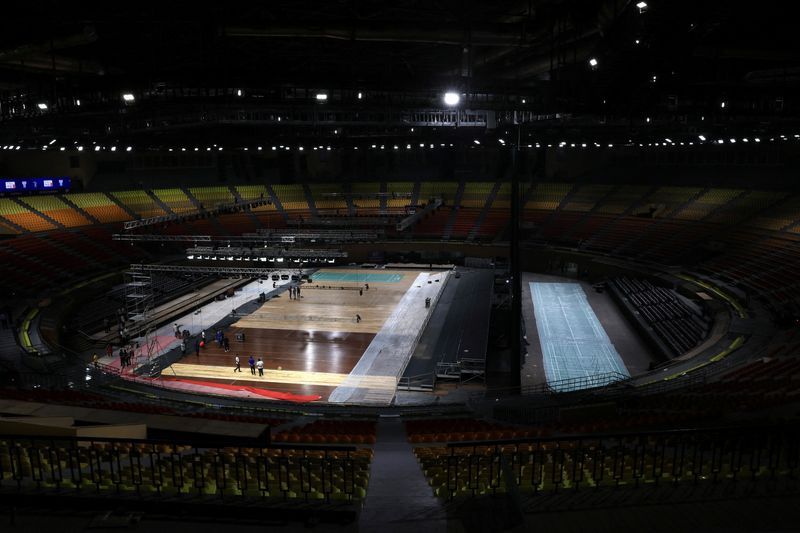
New Delhi will employ an unconventional workforce when the Badminton World Federation's World Championships commence next week: a team of skilled practitioners trained in the art of mimicking langur monkey calls. The move underscores India's determination to deliver a seamless international sporting spectacle while managing an unexpected challenge posed by the capital's notorious primate population.
The deployment of these specialist communicators addresses a persistent urban menace in India's major cities. Rhesus monkeys roam freely across New Delhi, frequently infiltrating office buildings and public spaces where they harass pedestrians and residents. Unlike their smaller cousins, langurs—distinctive primates with black faces and larger frames—serve as a natural deterrent. Urban administrators across India have long enlisted langurs as a practical, if somewhat unusual, solution to monkey management, positioning them strategically in government and corporate offices to patrol territories and discourage rhesus incursions.
The Badminton Association of India turned to this time-tested method after an uncomfortable encounter during this year's Indian Open. A rhesus monkey was spotted wandering through the spectator gallery at the Indira Gandhi Indoor Stadium, an incident that left organisers red-faced and raised questions about the venue's preparedness for hosting elite international competition. The episode galvanised officials to implement comprehensive animal management protocols ahead of the world championships.
Zafar, one of the hired mimics, represents a family tradition spanning three generations of monkey management. During a stadium demonstration for media representatives, he displayed his mastery of langur vocalisation, showcasing the hooting calls that send rhesus monkeys fleeing. His explanation to reporters revealed the underlying principle: rhesus monkeys harbour genuine fear of langurs, making vocal mimicry an effective non-violent deterrent. Zafar emphasised that the objective centres on prevention rather than harm—creating conditions where monkeys choose to avoid the area entirely.
Beyond his technical expertise, Zafar's background illustrates how India has developed informal but sophisticated systems for managing human-wildlife conflict in densely populated urban centres. Having worked across multiple government offices, he understands the delicate balance required: maintaining effective deterrence while respecting animal welfare principles. This approach reflects broader patterns in South Asian urban management, where creative, low-cost solutions often prove more practical than conventional Western-style infrastructure or technological fixes.
The animal challenge extends beyond primates to encompass Delhi's substantial pigeon population. During the Indian Open, matches were disrupted on two separate occasions when birds soiled the playing surface, prompting complaints from athletes regarding hygiene standards. These incidents threatened India's credibility as an international sports host at a moment when the nation seeks to project competence and professionalism to global audiences.
Addressing the pigeon problem required different tactics. Organisers applied non-toxic gel across stadium roof sections and ventilation ducts—a substance commonly deployed on Indian railway infrastructure to prevent birds from roosting in sensitive areas. The substance creates an uncomfortable surface without inflicting injury, encouraging pigeons to relocate while avoiding animal cruelty accusations that could undermine India's image internationally.
These preparations carry significance beyond badminton. India is positioning itself as a premier sports destination, having been awarded hosting rights for the 2030 Commonwealth Games and actively campaigning to secure the 2036 Olympics. The Badminton World Federation championships represents a high-profile test case, allowing India to demonstrate that it can manage complex logistical and environmental challenges while delivering world-class facilities and experience. Badminton World Federation officials visiting the venue have reportedly approved current arrangements, signalling organisers' success in addressing earlier deficiencies.
Sanjay Mishra, the Badminton Association of India's secretary general, acknowledged previous shortcomings while emphasising remedial action. He stated that lessons learned from the Indian Open informed the current comprehensive approach, with India's sports ministry investing substantially in facility improvements. The synergy between ministry support and BAI initiative reflects government commitment to maintaining India's emerging reputation as a capable host of major international sporting events.
From a Southeast Asian perspective, India's pragmatic approach to wildlife management at sporting venues offers relevant lessons. The region's rapid urbanisation creates similar challenges, where wildlife increasingly encroaches on human-dominated spaces. India's combination of traditional knowledge (langur deployment, monkey mimicry) with modern solutions (non-toxic deterrents, comprehensive planning) demonstrates how developing nations can address infrastructural and environmental constraints creatively rather than simply replicating expensive Western models.
The deployment of monkey whisperers also speaks to India's broader challenge of balancing development, international credibility, and coexistence with urban wildlife. Rather than implementing heavy-handed animal control measures that might attract international criticism, India has chosen approaches that demonstrate environmental sensitivity while achieving practical results. This calculus reflects the political importance of hosting major international events for nations seeking to enhance their global standing.
Looking forward, these crowd management and animal control measures will likely become routine features of India's major sporting events. The Badminton World Championships will generate valuable data and experience that can be applied to Commonwealth Games preparations and potential Olympic hosting. The world championships thus represent not merely a badminton competition but a strategic opportunity for India to refine the systems and protocols necessary for hosting the planet's largest sporting spectacles while managing the unique environmental and urban challenges that accompany rapid metropolitan development.

