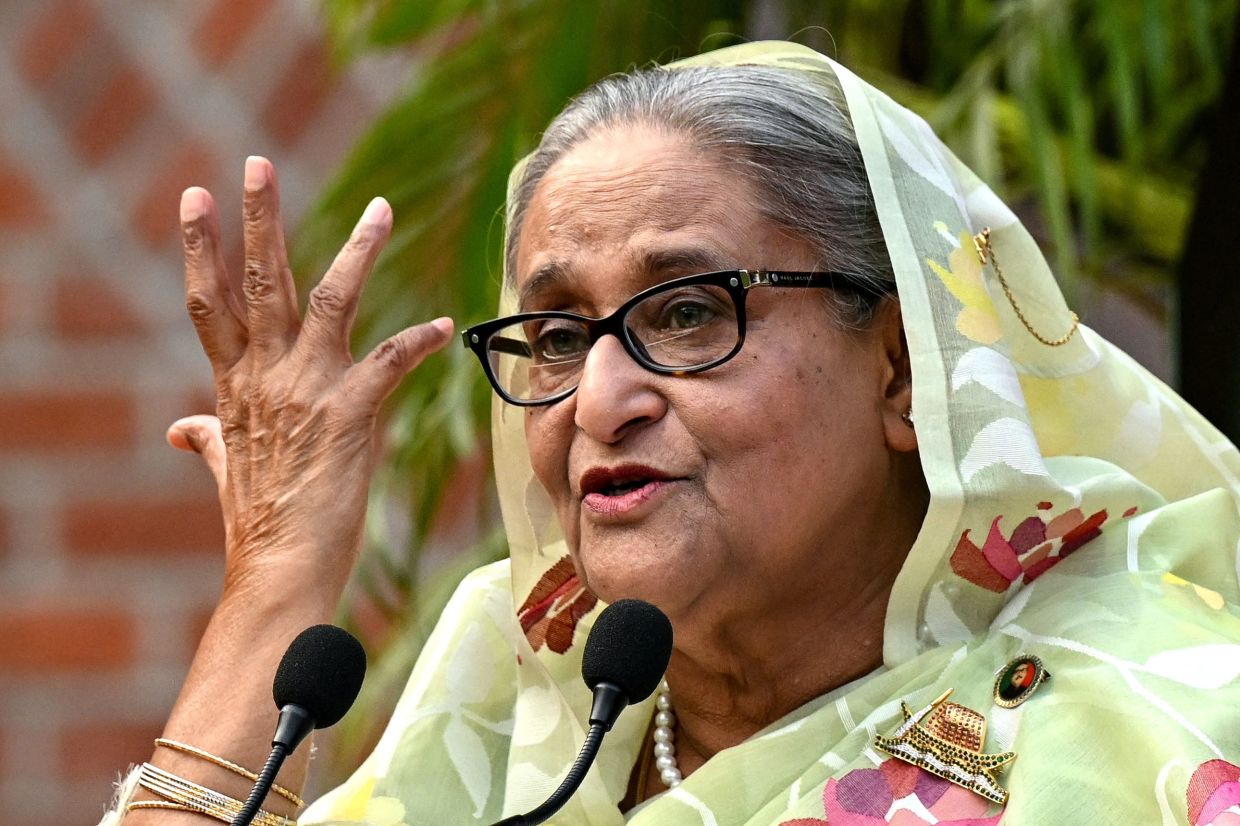
India's foreign ministry has moved to distance the New Delhi government from a forthcoming virtual address by Bangladesh's exiled former Prime Minister Sheikh Hasina, emphasising that the event remains a purely private affair with no state involvement whatsoever. The clarification comes amid mounting tensions between the two South Asian neighbours over the opposition leader's continued presence on Indian soil and her political activities from across the border.
Speaking at a regular media briefing, Indian foreign ministry spokesperson Randhir Jaiswal stated unambiguously that the government neither organised nor endorsed the Wednesday event at the Foreign Correspondents' Club of South Asia in New Delhi. The address marks the second anniversary of the student-led uprising that swept Hasina from power in 2024, a watershed moment that fundamentally reshaped Bangladesh's political landscape and prompted the former premier to seek refuge in India. Jaiswal's remarks represent New Delhi's attempt to navigate a delicate diplomatic situation in which it faces pressure from Dhaka while respecting the established rights of those on Indian territory.
Hasina, now 78 years old, has maintained a comparatively low public profile since fleeing Bangladesh, making this virtual appearance her first significant public statement since her departure. She is scheduled to participate alongside her son, Sajeeb Wazed Joy, and other speakers at the event organised by the foreign correspondents' club. Although aides have kept the substance of her remarks confidential, Hasina indicated in discussions with Reuters last month that she and senior party colleagues intend to return from exile around December and face Bangladesh's courts, a decision that would serve as a crucial test of how the new government responds to its most formidable political opponent and the Awami League party she leads.
Bangladesh's response to the planned address reveals the acute sensitivities surrounding Hasina's exile and her continued political voice. Information Adviser Zahed Ur Rahman issued a pointed warning to the country's media, making clear that any coverage of Hasina's speech would contravene a December 2024 order issued by Bangladesh's International Crimes Tribunal. That ruling explicitly prohibits media outlets and social media platforms from publishing, broadcasting, or otherwise disseminating any statements, interviews, audio recordings, or video messages attributed to the former prime minister. The restriction represents an extraordinary measure to contain her political influence and reshape public discourse in Bangladesh during its post-uprising transition.
Hasina currently faces a death sentence handed down in 2025 on charges related to crimes against humanity, stemming from her government's violent response to the student demonstrations that ultimately toppled her administration. She has rejected the verdict as legally invalid, contending that the proceedings lack legitimacy and proper judicial foundation. Her defiant stance reflects broader disputes over how Bangladesh should account for the tumultuous events of 2024 and whether Hasina bears personal responsibility for the security forces' actions during the crisis.
The timing of Bangladesh's concerns with India carries particular significance given the ongoing diplomatic relationship between Dhaka and New Delhi. Bangladesh has repeatedly pressed India to extradite Hasina, a demand complicated by New Delhi's constitutional and legal frameworks governing extradition. At the same time, Bangladesh's State Minister for Foreign Affairs Shama Obaed Islam has conveyed formal complaints to Indian counterparts regarding political activities by Hasina and other senior Awami League figures conducting opposition work from Indian territory. These representations highlight the strain that Hasina's presence imposes on bilateral relations.
Bilateral ties have undeniably suffered since Hasina's ouster, though recent months have witnessed cautious signals from both governments about stabilising the relationship. Prime Minister Tarique Rahman's administration, which assumed office following February's election in Bangladesh, has indicated a pragmatic willingness to improve ties with India despite ongoing disputes. Yet the convergence of Hasina's planned speech, the media ban, and India's formal disclaimer suggests that fundamental tensions persist beneath the surface of cordial diplomatic language.
Hasina's inner circle has responded to Bangladesh's restrictions with defiance. Abu Obaidha Arin, a senior aide, declared that the New Delhi event would proceed as planned and asserted that Dhaka's "efforts to silence dissent cannot extinguish voices" beyond the country's borders. This rhetoric encapsulates the polarised nature of Bangladesh's political environment, where competing narratives about accountability, justice, and legitimate political opposition remain sharply contested. The aide's statement underscores that Hasina's supporters view the tribunal order and media restrictions as politically motivated suppression rather than legitimate legal measures.
India's careful positioning reflects the complexity of harbouring a high-profile political exile while maintaining functional relationships with her home country. New Delhi has historically provided refuge to opposition figures from the region, a tradition rooted in principle yet increasingly tested by contemporary interstate dynamics. By emphasising the private nature of the foreign correspondents' club event, India attempts to shield itself from accusations of directly facilitating political opposition activity whilst acknowledging the reality that private institutions operating within Indian territory enjoy considerable autonomy.
The virtual address represents more than a symbolic moment in Bangladeshi politics. It signals that Hasina's political movement, though operationally constrained, retains organisational capacity and international platforms. For Bangladesh's government, the speech threatens to amplify alternative narratives about the uprising, the transition, and Hasina's role in the turmoil, particularly among diaspora communities and international observers who may view the media restrictions as excessive. For India, managing the optics of the event without appearing to capitulate to Bangladesh's pressure demonstrates the intricate balancing required in regional diplomacy.
As the Wednesday event approaches, it encapsulates several interlocking challenges facing South Asia's bilateral relationships. The question of how states should treat exiled political leaders, the tension between free speech and national security concerns, and the proper mechanisms for transitional justice all converge around Hasina's planned remarks. Bangladesh's comprehensive media ban suggests that officials fear the impact of her narrative, even when filtered through a virtual platform and constrained audience. This anxiety itself reveals the contested nature of recent events in Bangladesh and the difficulty of establishing consensus about how the country should move forward.

