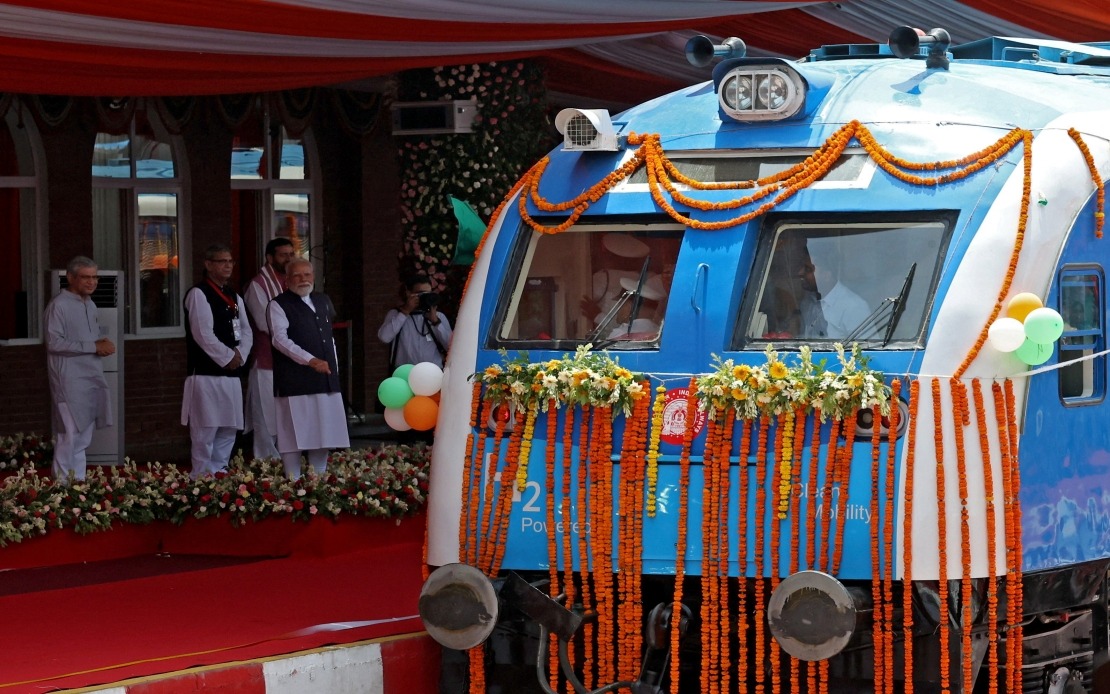
India has taken a significant step toward sustainable transportation by launching its first hydrogen-powered train, a project flagged off by Prime Minister Narendra Modi on Friday. The 10-coach train will operate on the 89-kilometre route connecting Jind and Sonipat in the northern state of Haryana, representing a watershed moment for the country's railway sector and positioning India among an exclusive group of nations pioneering hydrogen-based rail infrastructure.
This inaugural service marks the first deployment of indigenously developed hydrogen fuel cell technology in Indian railway operations, a distinction that underscores the country's growing technical capabilities in clean energy applications. The development carries particular significance for Southeast Asia and the broader region, as India's success in implementing this technology could catalyse similar initiatives across neighbouring economies seeking to decarbonise their transportation networks.
At the core of the hydrogen train system sits a 1,200-kilowatt Proton Exchange Membrane Fuel Cell, or PEMFC, which generates electricity through an electrochemical reaction between hydrogen and oxygen molecules. This technological approach eliminates the combustion process entirely, replacing it with a clean chemical transformation that produces only water vapour and heat as byproducts. For railway operators accustomed to diesel locomotives that emit substantial greenhouse gases and particulate matter, this represents a fundamental shift in how trains can be powered.
The advantages of hydrogen propulsion extend beyond environmental considerations. Diesel trains contribute significantly to India's transportation-related emissions, and the railway sector has long been identified as a key area for decarbonisation under national climate commitments. By replacing diesel with hydrogen fuel cells, India can reduce its carbon footprint while simultaneously improving air quality in regions where trains operate—a benefit that resonates particularly with urban and semi-urban communities along rail corridors.
The newly launched train has been certified to operate at speeds up to 75 kilometres per hour in regular service, though its design permits acceleration to 110 kilometres per hour. This operational specification suggests a practical approach to deployment, prioritising safety and reliability during the initial phases of operation. The measured performance parameters reflect lessons learned from hydrogen train programmes elsewhere, where gradual implementation has proven more effective than rapid scaling.
India's entry into the hydrogen train market places it alongside established players including China, Germany, Japan, and the United States—nations that have already integrated hydrogen rail technology into their transportation systems. Germany, for instance, has operated hydrogen trains on regional routes for several years, while Japan and China have pursued their own hydrogen rail initiatives as part of broader clean energy strategies. This global context highlights how hydrogen propulsion has transitioned from experimental technology to a practical, deployable solution for railway operators seeking alternatives to fossil fuels.
The implications for Malaysian and Southeast Asian readers are substantial. As the region grapples with urban congestion, air pollution, and climate change impacts, successful demonstrations of hydrogen rail technology in comparable emerging economies provide actionable models. Malaysia's own rail expansion plans, including the Klang Valley Double Track Project and proposed high-speed rail corridors, could potentially incorporate hydrogen propulsion in future phases should the technology prove cost-effective and operationally robust on Indian routes.
However, hydrogen rail adoption faces significant infrastructure challenges that extend beyond train engineering. Establishing hydrogen production, storage, and distribution networks requires substantial capital investment and coordination across multiple sectors. India's initial deployment on a single 89-kilometre route should be viewed as a pilot project that will generate crucial data on operational costs, maintenance requirements, hydrogen supply logistics, and passenger acceptance. These real-world insights will prove invaluable as the country considers expanding the technology to other rail corridors.
The technological sophistication of the PEMFC system underscores India's expanding expertise in fuel cell engineering, an area where many developing nations have historically lagged behind industrialised countries. By nurturing domestic capability in this field, India positions itself to export knowledge and potentially technology to regional partners, creating economic opportunities alongside environmental benefits. This aligns with broader trends in Southeast Asia where clean energy transitions are increasingly viewed as economic opportunities rather than purely environmental imperatives.
Looking forward, the success of this hydrogen train will likely determine whether Indian Railways pursues wider implementation. The railways ministry will monitor fuel consumption rates, hydrogen supply reliability, maintenance schedules, and operational costs over the coming months. Should the pilot programme deliver favourable results, subsequent phases could expand hydrogen propulsion to more routes, potentially including longer-distance corridors where fuel cell technology's range and refuelling capabilities become decisive advantages.
The launch also reflects India's strategic positioning within global clean energy transitions. As international climate agreements tighten and nations face pressure to decarbonise transport sectors, early movers in hydrogen technology gain competitive advantages in both technology development and international partnerships. For Malaysia and other Southeast Asian nations monitoring India's progress, this development signals that hydrogen rail remains a viable, albeit demanding, pathway toward sustainable transportation futures.

