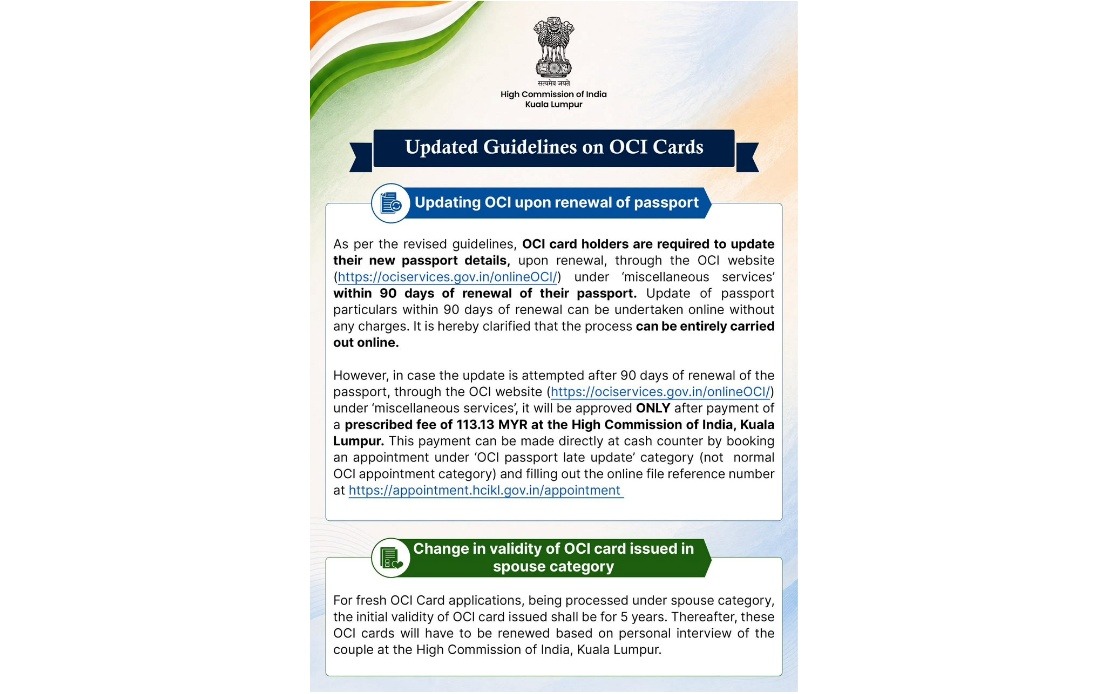
The Indian High Commission in Kuala Lumpur has rolled out streamlined yet stricter procedures for Overseas Citizen of India card maintenance, creating a structured timeline that overseas Indians in Malaysia must now observe when renewing their travel documents. The revised framework, announced through official social media channels, establishes clear pathways for administrative compliance while introducing financial penalties for delayed actions—a shift reflecting New Delhi's push toward digital-first processing across its diaspora services worldwide.
OCI cardholders who renew their passports face a critical 90-day compliance window. Within this period, they must log into the dedicated OCI portal and navigate to the "miscellaneous services" section to register their updated passport particulars. This entirely online process carries no associated charges, making it accessible for the vast Malaysian Indian community without additional out-of-pocket expenses. The High Commission has emphasised that the procedure requires no physical office visit during this initial grace period, catering to busy professionals and families who may struggle with traditional appointment-based systems.
The financial incentive structure becomes apparent for those who miss the deadline. Any passport detail updates submitted after the 90-day threshold triggers a prescribed processing fee of RM113.13, payable at the High Commission's cash counter in Kuala Lumpur. This represents a notable departure from the zero-fee online convenience offered to compliant applicants. Those seeking late updates must first secure an appointment specifically under the "OCI passport late update" category—distinct from routine OCI appointments—and provide their online file reference number to facilitate processing. The tiered approach effectively rewards timely compliance while monetising administrative burden for procrastinators.
For the broader Malaysian-Indian diaspora, understanding these deadlines carries practical significance. Many OCI cardholders combine Malaysian residency with frequent travel to India for business, family, or ancestral connections. Passport renewal often occurs during routine international travel or administrative cycles, and failure to update OCI records within the prescribed window could complicate visa issuance or create discrepancies during immigration checks. The 90-day window therefore demands calendar awareness and proactive engagement with digital systems—a reasonable but easy-to-overlook requirement that could trap the administratively inattentive.
A second major revision concerns OCI cards granted under the spouse category, addressing a specific demographic within Malaysia's Indian population. Previously, such cards maintained indefinite validity or longer renewal periods. Under the new framework, freshly processed spouse-category OCI applications receive initial validity of only five years. This shortened duration means couples must engage more frequently with the High Commission's renewal procedures than before. More significantly, each renewal requires a personal interview of both spouses at the High Commission premises in Kuala Lumpur—a requirement that introduces interpersonal verification and potentially tightens scrutiny of spousal relationships.
The spouse-category reform reflects broader policy concerns around OCI status verification and fraud prevention. Marriages sometimes serve as administrative conveniences rather than genuine family arrangements, and mandatory joint interviews enable officials to assess the authenticity of relationships and ensure continued eligibility. For genuinely married couples, the requirement poses minimal hardship but does necessitate coordinated travel to Kuala Lumpur every five years, representing a modest administrative burden. For applicants with unstable marital situations, the requirement creates practical complications—separation or divorce necessitates immediate notification and status clarification.
These guidelines carry implications that extend beyond mere procedural housekeeping. They signal India's modernisation of consular services, with emphasis on digital-first processing and reduced physical office interactions. The OCI portal now functions as the primary interface for administrative actions, reflecting global trends toward e-governance. For Malaysia-based Indians, this digitisation offers convenience but also demands technological familiarity and reliable internet access. Those less comfortable with online systems may require assistance from family members or professional consultants, potentially creating new service dependencies.
The High Commission's communication strategy—utilising social media platforms for announcement—further indicates India's shift toward digital-native outreach. However, the policy's success depends on awareness permeation across the diaspora. Many OCI cardholders may remain unaware of these revisions, particularly older community members or those less engaged with official channels. Grassroots dissemination through Indian community organisations, temples, and business networks will likely determine compliance rates. Educational gaps could result in widespread late-fee payments and interview delays during renewal cycles.
For Malaysia's broader immigration and administrative context, these Indian consular reforms offer comparative perspective. As Southeast Asian nations increasingly digitise consular services, India's OCI modernisation represents a functional model—combining online convenience with offline verification mechanisms. Malaysian officials monitoring diaspora management and consular efficiency may find lessons applicable to overseas Malaysian citizen services. The balance between user-friendly digital access and sufficient friction for fraud prevention reflects sophisticated policy design.
The practical timeline for implementation matters considerably. OCI cardholders with imminent passport renewals must immediately familiarise themselves with the updated procedures to avoid unexpected fees. Those currently within the 90-day window from recent passport renewals should prioritise online updates before deadlines expire. The spouse-category changes apply prospectively to new applications and future renewals, giving existing cardholders time for adjustment. However, clarity regarding transition provisions for cardholders already holding spouse-category OCI cards remains important.
Comprehensive information about these revised guidelines is available through two primary channels: the official OCI portal and the High Commission's dedicated appointment website. Both platforms provide detailed procedural guidance, fee structures, and appointment availability. Malaysian OCI cardholders should bookmark these resources and set calendar reminders aligned with their passport renewal dates. Sharing information across family networks and community groups amplifies awareness and reduces administrative friction across Malaysia's significant Indian diaspora population.
The revised OCI framework ultimately represents maturation of India's overseas citizen administration. Rather than loosely enforced guidelines, the High Commission now imposes clear timelines, differentiated fee structures, and verification protocols. For compliant cardholders, the system offers convenience and cost savings. For the non-compliant, it introduces financial consequences and administrative complexity. This structured approach should gradually improve record accuracy and administrative efficiency while requiring Malaysian OCI holders to engage more systematically with their official status maintenance obligations.

