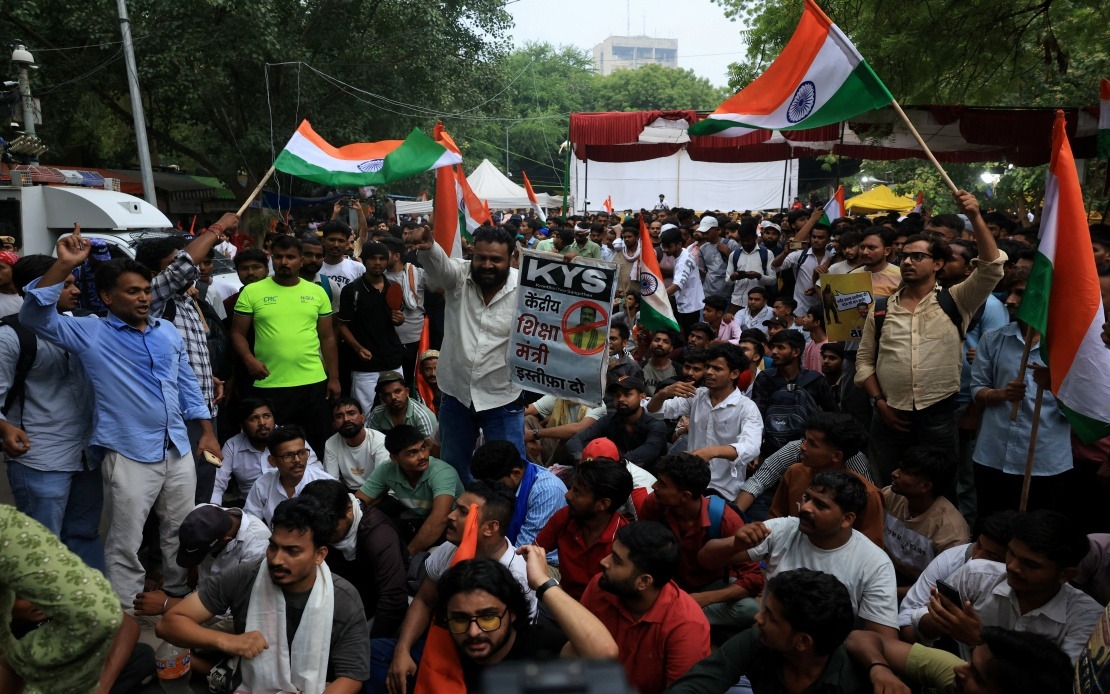
A mass demonstration unfolded in New Delhi on Monday as thousands of protesters converged on the nation's capital, seeking to advance toward the parliament building to voice demands for systemic changes to India's academic infrastructure. The grassroots movement, which has mobilised millions of online adherents, organised the march during a politically significant moment—coinciding with the opening of the Monsoon Session of the Indian Parliament. The timing appeared deliberate, designed to draw maximum attention from policymakers as they began their legislative agenda.
The protest action, formally termed "Sansad Chalo" or "march to parliament," encountered immediate resistance from law enforcement authorities who had imposed stringent restrictions on public assemblies throughout central New Delhi. As demonstrators attempted to breach police cordons and advance toward the parliament complex, officers deployed standard crowd-management protocols to disperse the gathering and prevent access to the legislative precinct. The confrontation highlighted the tension between citizens exercising democratic rights and state authorities prioritising security and public order during parliamentary proceedings.
This youth-led movement represents a significant shift in Indian activism, leveraging digital platforms and online networks to mobilise constituencies traditionally underrepresented in conventional political discourse. The fact that organisers claim millions of followers across social media underscores how contemporary protest movements operate through decentralised, technology-enabled channels rather than traditional hierarchical organisations. The movement's focus on educational reform reflects broader anxieties among young Indians regarding university curricula, employment readiness, and the relevance of higher education to contemporary labour markets—concerns that resonate increasingly across South Asia and Southeast Asia as regional economies undergo rapid transformation.
The substantive grievances behind the protest merit examination. India's education system has long faced criticism for emphasising rote memorisation over critical thinking, producing graduates inadequately equipped for modern employment sectors. The movement's demands likely encompass curriculum overhaul, improved teaching methodologies, greater access to quality education in rural and underprivileged regions, and stronger links between academic training and industry requirements. Such reforms have proved elusive despite repeated political commitments, suggesting that youth frustration stems from accumulated disappointment with incremental change.
Prime Minister Narendra Modi's departure from the parliament complex during the unfolding protest was documented by media observers, though the precise timing and circumstances remained unclear. His exit via convoy as police managed surrounding crowds underscored security concerns and the potential disruption posed by large-scale demonstrations proximate to the legislative seat. The optics of such departures inevitably become fodder for political narrative—whether interpreted as prudent precaution or perceived evasion of protester engagement.
The authorities' response involved significantly enhanced security protocols across multiple strategic locations throughout New Delhi's central administrative zone. The heightened vigilance reflected not merely concern over Monday's demonstration but broader anxiety about potential further mobilisation by this newly-prominent movement. Police and paramilitary deployments were positioned to prevent renewed attempts to reach parliament and maintain order in sensitive government districts. Such measures, while standard in managing large crowds, inevitably constrain public movement and raise civil liberties considerations regarding the right to peaceful assembly.
The Monsoon Session's timing added political complexity to the moment. Parliamentary proceedings typically address legislation prioritised for the monsoon sitting, and the juxtaposition of youth demands for educational transformation with the parliament's legislative agenda created an implicit challenge to the government's education policy framework. Whether parliament members would directly address the protesters' concerns or proceed with scheduled business would signal government responsiveness to grassroots pressure.
For Southeast Asian observers, including Malaysian policymakers and educators, the Indian demonstration carries instructive implications. Similar concerns about educational relevance, graduate employability, and system modernisation feature prominently across the region. The ability of youth movements to mobilise rapidly through digital networks represents a political phenomenon that transcends borders, and governments throughout the region are grappling with how to respond constructively to such activism. The question of whether dialogue and substantive reform can address grievances before frustration crystallises into wider political alienation remains pertinent across South and Southeast Asia.
The protest also illuminates broader patterns of Indian youth engagement with democratic processes. Rather than withdrawing from institutional politics, this generation is attempting to influence parliament directly through public demonstration. The movement's scale—drawing thousands to the capital and mobilising millions online—indicates substantial youth dissatisfaction with the status quo. Whether such energy translates into sustained political participation, policy influence, or evolves into different forms of activism will shape Indian education debates for years ahead.
The incident underscores the delicate balance democracies must navigate between enabling legitimate protest and maintaining public order. India's response—deploying measured crowd-control measures rather than aggressive suppression—contrasts with more repressive approaches elsewhere, yet still limited the protesters' ability to directly petition parliament. Whether the movement succeeds in securing substantive educational reforms will depend on subsequent political engagement, the government's receptiveness to youth grievances, and the movement's capacity to translate street mobilisation into concrete policy change.

