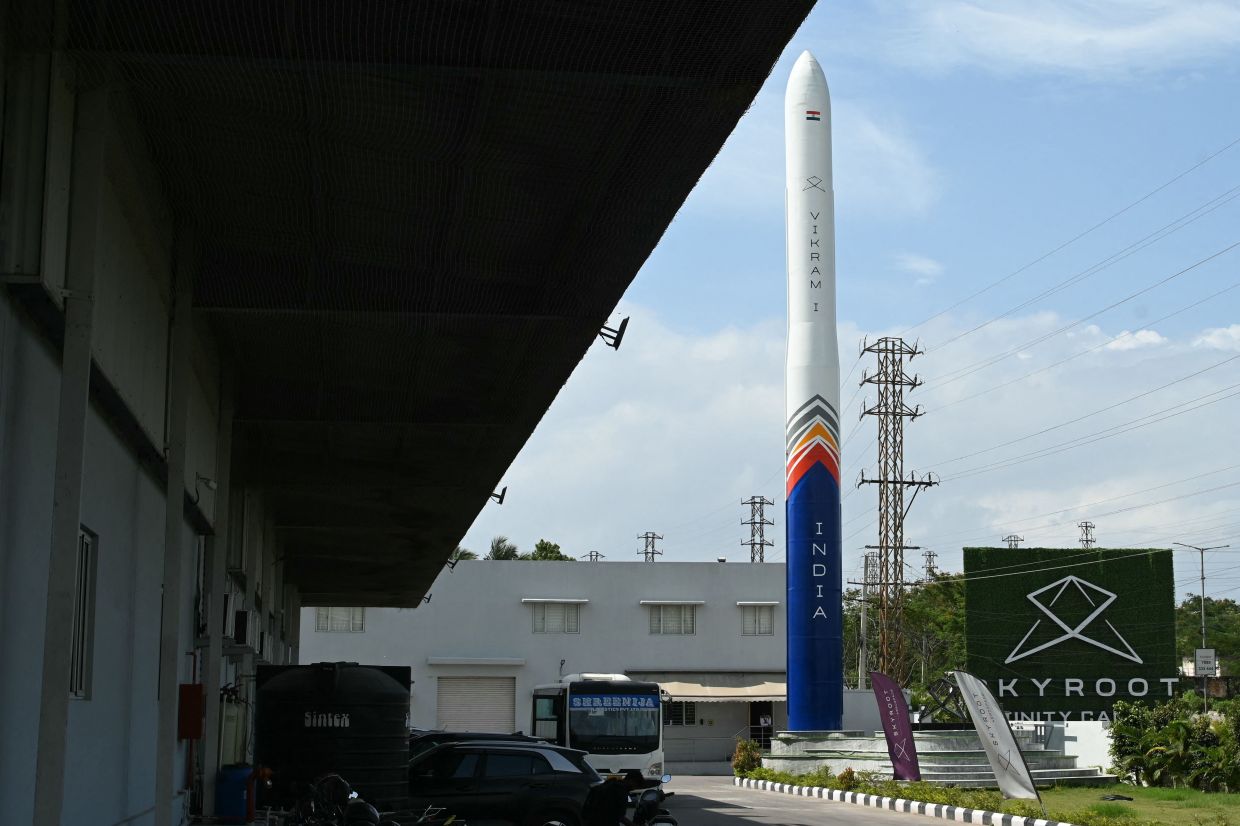
India stands at an inflection point in its space ambitions. While the country has already demonstrated capabilities rivalling global powers—landing rovers on the Moon, reaching Mars, and deploying hundreds of satellites—the imminent launch of Skyroot Aerospace's Vikram-1 rocket signals a fundamental transformation in how space exploration and commercial activity will be organised domestically. Scheduled to lift off from Sriharikota sometime between July 12 and August 4, this maiden test flight represents India's transition from a state-led space programme to one increasingly powered by entrepreneurial drive and private capital.
The infrastructure supporting India's space ambitions has matured substantially since the government opened the sector to private investment in 2020. That decision has catalysed an explosion of commercial interest, with more than 400 space startups now operating across the country. The Indian space economy, currently valued at $8.4 billion, has become a magnet for venture capital and technology talent. This growth reflects not merely the recognition of space's commercial potential but also the strategic importance New Delhi places on maintaining technological sovereignty and building capability across sectors that increasingly determine geopolitical influence.
India's established achievements in space exploration provide the foundation upon which this private sector boom rests. In 2014, India became the first Asian nation to place a spacecraft in Mars orbit, a feat that demonstrated technical prowess and engineering capability. More recently, the Chandrayaan lunar programme has delivered measurable successes. Following a failed 2019 landing attempt, the 2023 Chandrayaan-3 mission succeeded in deploying a rover on the lunar surface, making India the fourth nation globally to achieve an unmanned Moon landing, after Russia, the United States, and China. These accomplishments have generated both domestic confidence and international credibility that provide a springboard for private enterprise.
Looking forward, India's space aspirations extend well beyond Earth's immediate vicinity. The Indian Space Research Organisation is preparing a fourth Chandrayaan mission scheduled for 2027 that will attempt to retrieve samples from the lunar surface—a capability possessed by only a handful of nations. A Venus orbit mission is planned for 2028. Concurrently, the Aditya solar mission continues monitoring the Sun's outer atmosphere and space weather phenomena. These initiatives demonstrate that India's space programme balances near-term commercial objectives with long-term scientific exploration that builds technological depth and generates knowledge assets.
The commercial satellite market has become a particular focus for Indian space capabilities. Since establishing itself as a cost-efficient launch provider, ISRO has accumulated an impressive operational record. The organisation has successfully deployed more than 430 foreign satellites and earned over $600 million in revenue, while simultaneously launching more than 144 domestic satellites. This dual capacity—serving international clients while advancing national objectives—has become a cornerstone of India's space strategy. To sustain this momentum, New Delhi is expanding the launch infrastructure at Sriharikota on the southeast coast in Andhra Pradesh and constructing a second spaceport at Kulasekarapattinam in Tamil Nadu. These facilities will provide redundancy and capacity to support projected growth.
The Department of Space has articulated an ambitious vision for India's role in the global space ecosystem. Government projections forecast that India's space industry will expand to $44 billion by 2033 and $100 billion by 2040. These figures reflect not speculation but rather structured planning based on growing demand for satellite services, launch capacity, and space-derived applications. For Malaysian readers and Southeast Asian stakeholders, this expansion carries implications. India's emergence as a major space power and satellite launch provider will reshape regional dynamics and create both competition and cooperation opportunities for nations pursuing their own space capabilities and satellite-based services.
Beyond ISRO's government operations, India's private space sector has attracted entrepreneurial talent and investment capital. Skyroot Aerospace represents the flagship entrant with the Vikram-1 rocket, which has been engineered to deliver small satellites into low-Earth orbit—a capability increasingly valuable for communications, Earth observation, and emerging applications. Alongside Skyroot, other ventures are staking claims across the space value chain. Pixxel is building observation satellites for agriculture and environmental monitoring applications. Bellatrix Aerospace is developing satellite propulsion systems, while Agnikul Cosmos manufactures small satellite launch vehicles distinguished by engines produced through three-dimensional printing technology. This ecosystem diversity suggests that Indian space entrepreneurship is not concentrating in a single company but rather distributing across multiple specialised ventures.
India's civil and defence space sectors maintain substantial overlap, a characteristic that shapes both technological development and strategic positioning. Multiple government and private companies supply both civilian and military requirements, including launch rockets, propulsion systems, satellites, avionics, and guidance systems. The Indian Space Research Organisation has publicly acknowledged active coordination with the Defence Research and Development Organisation and maintains close associations with the BrahMos missile programme, a collaborative venture between India and Russia. This integration means that advances in space technology simultaneously strengthen military capabilities, particularly India's growing missile and military drone programmes.
International collaboration has accelerated India's technological progress and expanded its reach. Beyond relationships with Russia on manned spaceflight preparations, India maintains partnerships with the National Aeronautics and Space Administration (NASA), the European Space Agency, and bilateral relationships with France, Germany, Italy, Japan, and Saudi Arabia. These partnerships provide both technological access and diplomatic influence. For countries in Southeast Asia, India's dual role—as both a space power and a defence-conscious nation—presents opportunities for cooperation on civilian space applications while also reflecting India's broader strategic positioning in the region and globally.
The convergence of India's space aspirations, private sector dynamism, and strategic priorities suggests that the Vikram-1 launch will mark not an endpoint but rather a beginning. Successful deployment of a privately developed orbital rocket would validate the business models and technologies underpinning India's commercial space ventures. It would simultaneously demonstrate that opening space sectors to private participation accelerates innovation and capability development. For India, these developments reinforce claims to great power status and technological leadership. For Southeast Asia and the broader region, India's expanding space capabilities and commercial offerings present a new constellation of partners, services, and competitive dynamics that merit close attention as space-based services become increasingly central to economic and security concerns.

