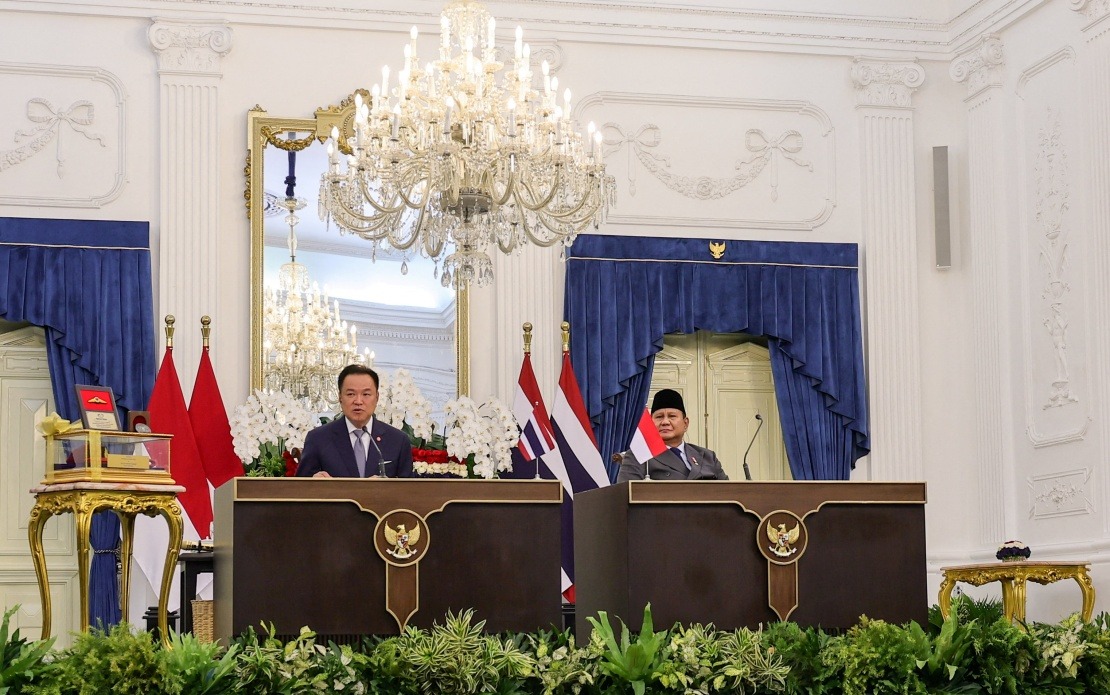
Indonesia and Thailand have jointly committed to strengthen ASEAN's role in stabilising Myanmar, pledging to advance the Five-Point Consensus through dialogue and humanitarian channels. The undertaking emerged during the second Leaders' Consultation between Indonesian President Prabowo Subianto and visiting Thai Prime Minister Anutin Charnvirakul at Jakarta's Merdeka Palace, underscoring the centrality of regional unity to resolving the protracted Myanmar crisis that has destabilised Southeast Asia for nearly three years.
Prabowo emphasised that maintaining ASEAN cohesion remains fundamental to restoring sustainable peace in Myanmar. The Indonesian leader acknowledged that both nations would intensify collaborative efforts to position ASEAN as a constructive force capable of facilitating inclusive dialogue and ending the cycle of violence that has displaced millions and restricted humanitarian aid flows into the country. This framing reflects Jakarta's broader regional strategy of leveraging ASEAN mechanisms rather than allowing external powers to dictate terms on Myanmar's future.
Beyond Myanmar, the two nations identified transnational crime as an increasingly urgent security challenge demanding coordinated action. The scourge of online fraud syndicates, which have operated with relative impunity across Southeast Asia's porous borders, prompted both leaders to agree on enhanced intelligence-sharing protocols and joint financial tracking mechanisms. Indonesia has emerged as a particularly vulnerable source country for scam victims, with criminal networks based in third countries exploiting its citizens through sophisticated deception schemes that often entrap individuals into prolonged captivity.
The establishment of a Transnational Referral Mechanism represents a practical institutional innovation designed to streamline victim identification and repatriation. Prabowo acknowledged Thailand's assistance in facilitating the return of nearly 1,000 Indonesian nationals rescued from scam operations, demonstrating the tangible benefits of bilateral cooperation when security agencies prioritise victim protection alongside criminal prosecution. This mechanism signals both countries' recognition that addressing transnational crime requires victim-centred approaches rather than purely enforcement-focused strategies.
Anutin brought substantive defence proposals to the table, signalling Thailand's willingness to deepen military-industrial collaboration with Jakarta. The proposal to supply 36 amphibious wheeled armoured vehicles reflects broader defence industry integration within Southeast Asia, where intra-regional procurement increasingly substitutes for external suppliers. Such arrangements strengthen supply chain resilience while generating employment and technological transfer within the region, though they require careful management to prevent security dilemmas between neighbouring states.
The Thai premier outlined expanded cooperation frameworks encompassing regular joint military training, enhanced information-sharing protocols, and coordinated maritime security operations. These mechanisms address shared vulnerabilities in patrolling vast ocean expanses against smuggling networks and unauthorised maritime activity. The Indian Ocean region's strategic importance for global trade flows amplifies the significance of Indonesia-Thailand maritime coordination, particularly as major sea lanes pass through waters both nations influence or monitor.
Combating online scam operations emerged as the cooperation framework's most pressing priority, reflecting the operational sophistication of international criminal networks that transcend traditional law enforcement boundaries. These organisations employ encrypted communications, layered money transfers across multiple jurisdictions, and wage psychological manipulation at industrial scale. Intelligence sharing between Jakarta and Bangkok enables authorities to map syndicate structures and disrupt operations at critical chokepoints, though success requires sustained political commitment and adequate resourcing of specialised units.
Anutin's inaugural Jakarta visit as Thailand's 32nd prime minister carries symbolic weight, marking the first Thai prime ministerial trip to Indonesia in 15 years. This extended absence reflects the diplomatic friction that accumulated during previous Thai administrations' varied approaches to Myanmar policy and ASEAN consensus-building. Anutin's willingness to travel to Jakarta early in his tenure signals Bangkok's desire to recalibrate Thailand's regional positioning, particularly following recent shifts in Thai domestic politics that have elevated new power brokers.
For Malaysian readers, these Indonesia-Thailand initiatives carry implications for regional stability and law enforcement. The transnational scam networks targeting Indonesians also operate within Malaysian territory, employing local facilitators and exploiting Malaysia's financial system's accessibility. Stronger Jakarta-Bangkok cooperation on victim repatriation and criminal prosecution could generate momentum for broader ASEAN-wide mechanisms that benefit Malaysian citizens ensnared in similar schemes. Additionally, enhanced Indonesian-Thai maritime coordination affects Malaysian waters and fishing rights, necessitating consultations with Malaysia to prevent overlapping enforcement activities that could create tensions.
The defence cooperation announcements reflect Southeast Asia's ongoing hedging strategy amid great power competition. By deepening bilateral ties while maintaining ASEAN frameworks, Indonesia and Thailand position themselves as self-reliant actors rather than clients of external powers. This approach appeals to nationalist constituencies while demonstrating commitment to regional solutions for regional problems, though it requires substantial defence expenditure that both nations can ill afford given competing development priorities and post-pandemic fiscal constraints.
Looking forward, the success of these initiatives depends on institutional embedding and consistent implementation across political cycles. Indonesia's recent leadership transition and Thailand's ongoing political flux mean that strategic partnerships require more than ceremonial endorsements—they demand permanent bureaucratic structures, dedicated budgets, and regular high-level oversight. ASEAN's historical weakness in translating bold statements into sustained action remains a cautionary backdrop, suggesting that while Jakarta and Bangkok's commitment appears genuine, converting pledges into measurable security outcomes will prove considerably more demanding.

