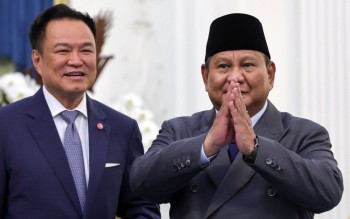
Indonesia has set its sights on dramatically expanding economic ties with Thailand, targeting US$20 billion in annual bilateral trade by 2030 through a newly adopted strategic roadmap. The ambitious framework was formally adopted on Monday during a leaders' consultation at Jakarta's Merdeka Palace between President Prabowo Subianto and Thai Prime Minister Anutin Charnvirakul, marking a significant escalation in economic cooperation between Southeast Asia's two largest economies by population.
Anutin's visit to Jakarta represents his first official trip to Indonesia since assuming office as Thailand's 32nd prime minister in September 2025, and constitutes the first official visit by a Thai premier to Indonesia in over a decade and a half. The visit underscores the renewed momentum in bilateral relations, which were elevated to a Strategic Partnership status during Prabowo's reciprocal visit to Bangkok in the previous year. This second leaders' consultation demonstrates the institutionalisation of high-level dialogue between the two nations, creating a structured mechanism for addressing shared economic and strategic interests.
Central to the partnership framework is the establishment of the Joint Trade Commission, a first-of-its-kind mechanism in the relationship designed to systematically identify business opportunities and dismantle trade barriers that have historically constrained commerce between the two countries. During his remarks at the joint press conference, Prabowo highlighted how this institutional innovation would facilitate both government and private sector engagement, creating dedicated channels for resolving trade frictions and fostering commercial expansion. The JTC's inaugural meeting is expected to convene at the commerce minister level, with Thailand already signalling readiness to host the inaugural session.
Thailand's current position as Indonesia's fourth-largest trading partner within ASEAN underscores the unrealised potential in their commercial relationship. Given that both nations rank among the region's economic powerhouses, the existing trade volumes have not reflected the true scale of their respective economies or their complementary strengths. Anutin acknowledged this gap explicitly, arguing that the two countries possess sufficient economic heft to substantially increase bilateral commerce and should pursue more ambitious partnership objectives than have historically been pursued.
Food security emerged as a cornerstone of the bilateral framework, reflecting both nations' shared vulnerabilities in sustaining agricultural output amid climate pressures and rising global demand. Thailand has committed to maintaining its role as a dependable supplier of high-quality rice to Indonesia, addressing Indonesian food import needs that have become increasingly critical given population growth and domestic production constraints. Simultaneously, Thailand seeks expanded market access for its own agricultural products, including meat, dairy goods, and agricultural machinery, creating a complementary trade dynamic that could benefit Thai exporters while diversifying Indonesian import sources.
A particularly significant component of the food security arrangement concerns urea fertiliser. Thailand currently imports approximately 60,000 tonnes of Indonesian urea annually, but Anutin has expressed intentions to dramatically escalate this volume to several hundred thousand tonnes. This expansion would represent a substantial revenue opportunity for Indonesian fertiliser producers and reinforce supply chain integration across the two nations. The ambition to increase fertiliser trade reflects recognition that agricultural productivity in both countries depends on reliable inputs, and bilateral sourcing provides greater security than reliance on distant suppliers.
The partnership roadmap also prioritises energy cooperation through a dedicated Indonesia-Thailand Energy Forum designed to fortify energy security while accelerating the regional transition toward sustainable power generation. Both governments and private enterprises are expected to collaborate on this agenda, combining policy frameworks with commercial incentives. This dimension proves particularly relevant for Malaysia and the broader Southeast Asian region, as energy transition challenges affect all ASEAN members, and coordinated approaches between major economies can establish regional precedents for renewable energy deployment and grid integration.
Digital economy development forms another pillar of the strategic roadmap, with particular emphasis on promoting local currency transactions to streamline bilateral trade and investment procedures. By reducing reliance on third-country currencies and associated transaction costs, the two nations can enhance the efficiency and attractiveness of commerce between them. This initiative also reflects broader ASEAN aspirations to strengthen intraregional financial integration and reduce dependency on major global currencies, a concern that resonates across the association.
The halal industry represents an often-overlooked area of strategic advantage for both Indonesia and Thailand, with the roadmap envisioning collaborative development of regional and global halal value chains. Both nations possess significant Muslim populations and established halal certification capabilities, positioning them to jointly capture growing demand from Islamic markets globally. Critically, the partners agreed to renew their mutual recognition agreement on halal certification before its November expiration, preventing any disruption to trade flows dependent on these certifications.
Beyond government-to-government accords, the bilateral visit generated several significant commercial agreements. These include a tourism and connectivity partnership between the Tourism Authority of Thailand and TransNusa, enhancing travel and transport links between the two countries. An organic waste processing initiative between Bio-Axel and Pro Konsilium signals emerging cooperation in circular economy solutions, an area gaining policy priority across ASEAN as nations pursue sustainable development objectives.
The education memorandum of understanding represents investment in human capital development, recognising that long-term competitive advantage and innovation capacity depend on skilled workforces. Enhanced educational exchanges and institutional partnerships can facilitate technology transfer, knowledge sharing, and the development of professionals capable of managing complex cross-border operations.
For Malaysia and other ASEAN members, the Indonesia-Thailand strategic expansion carries important implications. Enhanced integration between these two regional heavyweights could reshape intra-ASEAN trade dynamics and establish models for deeper bilateral cooperation. The emphasis on energy transition, digital integration, and supply chain resilience addresses challenges affecting all member states. Simultaneously, the ambitious trade target of US$20 billion by 2030 reflects confidence in ASEAN's economic trajectory and the willingness of major economies to commit substantial resources toward deepening integration within the association.
The roadmap's success will depend on effective implementation by both governments and genuine engagement by private sectors in both countries. The JTC mechanism, if properly resourced and empowered to resolve disputes expeditiously, could serve as a template for other bilateral relationships. Conversely, if the partnership remains primarily symbolic without tangible dismantling of trade barriers or substantive commercial integration, the ambitious targets may prove elusive. The coming months will reveal whether this strategic framework generates the operational momentum required to transform bilateral economic relations.

