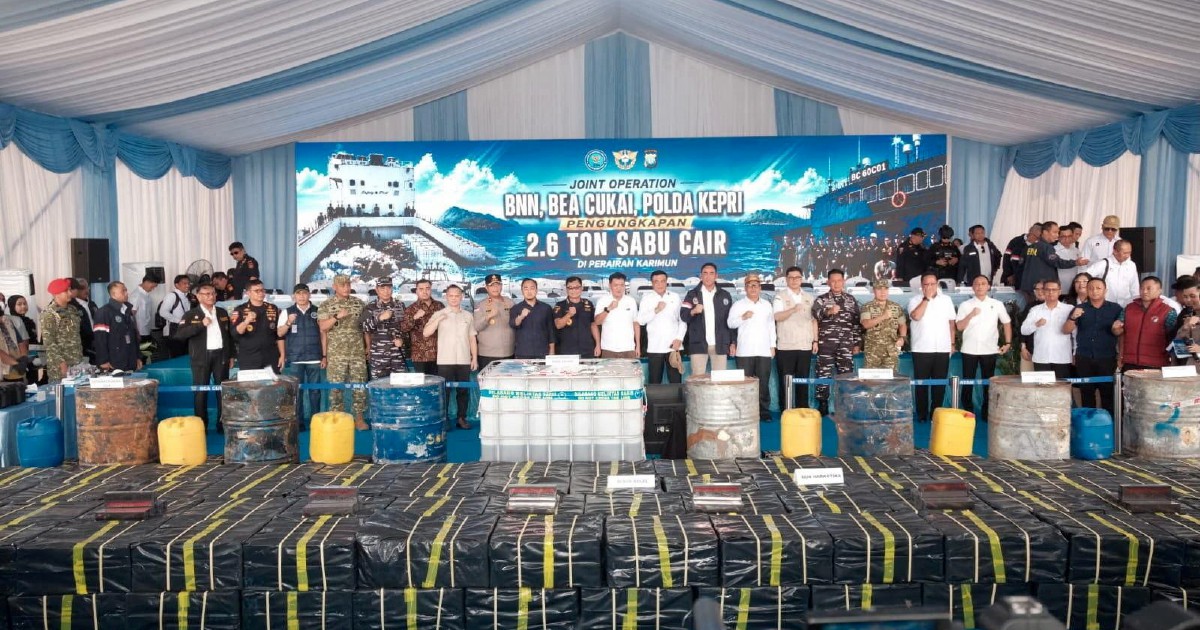
Indonesian law enforcement has made a substantial breakthrough in combating transnational drug trafficking, announcing the arrest of 10 Myanmar nationals connected to the interception of 2.6 metric tonnes of liquid methamphetamine discovered aboard a vessel registered in Tanzania. The operation, detailed at a press conference by Indonesian authorities on Friday, underscores the country's intensifying efforts to dismantle sophisticated smuggling routes that exploit maritime corridors across Southeast Asia.
The seizure of such a large quantity of liquid methamphetamine—a highly concentrated and easily transportable form of the drug—represents one of Indonesia's most significant narcotics interdictions in recent memory. Liquid methamphetamine has become an increasingly prevalent problem throughout the region, as traffickers favour this format for its density and reduced detection risk compared to crystalline varieties. The discovery of this shipment aboard a Tanzanian-flagged vessel suggests the involvement of international criminal networks that exploit flags of convenience and maritime ambiguity to evade detection by coastal authorities.
Indonesia's role as a critical nexus in Southeast Asian drug trafficking cannot be overstated. Positioned along major shipping routes between production centres in Myanmar and consumption markets across the region and beyond, the archipelago has become both a transit point and a target destination for methamphetamine distributors. The arrest of the 10 Myanmar nationals indicates direct involvement of traffickers operating from the source region, suggesting this was not merely a random interdiction but rather a carefully orchestrated enforcement operation targeting a specific smuggling conspiracy.
The use of flag-of-convenience vessels—ships registered to nations with minimal maritime oversight—is a well-documented strategy employed by international drug syndicates. Tanzania, despite its geographic distance from the trafficking route, represents exactly the type of registry that provides anonymity and complicates coordination between regional law enforcement agencies. This legal loophole in international maritime law has become a persistent challenge for Indonesia and its neighbours, requiring increasingly sophisticated intelligence capabilities to identify and intercept such shipments.
Myanmar's position as a major methamphetamine production hub has intensified dramatically over the past decade, with production facilities concentrated in border regions controlled by armed groups and criminal organisations. The involvement of Myanmar nationals in this particular case reflects the supply chain's direct connection to production sites, suggesting the arrested individuals may have been involved in organising the shipment at its source rather than merely executing transport logistics. Understanding these organisational hierarchies is critical for Indonesian authorities seeking to disrupt trafficking networks rather than simply removing individual shipments from circulation.
The liquid form of the drug presents unique challenges for law enforcement and border authorities. Unlike crystalline methamphetamine, which can be detected through standard visual inspection and some conventional screening technologies, liquid formulations may more easily evade certain detection methods. The fact that Indonesian authorities successfully identified and seized this substantial quantity demonstrates either exceptional intelligence work preceding the interception or the deployment of advanced detection capabilities at ports or maritime checkpoints.
This enforcement action carries significant implications for Indonesia's broader counter-narcotics strategy. The arrest of 10 suspects potentially provides investigators with crucial intelligence regarding trafficking organisational structures, distribution networks, and financial flows. Interrogations may reveal details about wholesale pricing, customer bases, and the identity of higher-level operatives directing these operations from within Myanmar and potentially other countries.
Regional drug trafficking has escalated into a security concern extending beyond traditional law enforcement boundaries. The sophistication evident in this operation—international coordination, maritime logistics, and the sheer volume involved—mirrors patterns observed in organised crime enterprises that often intersect with terrorism financing and other transnational crimes. Indonesia's success in this interdiction may encourage neighbouring countries to enhance their own maritime surveillance capabilities and intelligence-sharing mechanisms.
The timing of this announcement reflects Indonesia's commitment to maintaining high-profile drug enforcement operations, particularly as methamphetamine consumption has become endemic across Southeast Asia. Malaysia, Thailand, and Vietnam have all reported surging addiction rates and associated social problems, making source-country enforcement increasingly important for regional stability. Indonesian success in disrupting supply chains potentially has cascading benefits across the entire region by constraining product availability and elevating street-level prices.
Challenges remain significant, however. The profitability of methamphetamine trafficking—driven by enormous price differentials between production and consumption regions—ensures that traffickers will continue adapting their methods and routes. The arrest of these 10 individuals, while meaningful, likely represents only a fraction of the criminal apparatus involved in moving drugs through Indonesian territory. Sustained enforcement pressure requires continued investment in maritime surveillance, port security, and international law enforcement cooperation.
Indonesia's maritime domain covers vast territories that remain difficult to patrol comprehensively, creating persistent vulnerabilities that criminal organisations exploit. This particular seizure may reflect successful intelligence work rather than routine patrols, suggesting that proactive investigation and international collaboration remain essential components of counter-trafficking strategy. Moving forward, regional mechanisms facilitating real-time information exchange and coordinated enforcement operations will prove crucial for addressing the methamphetamine crisis affecting Southeast Asia.

