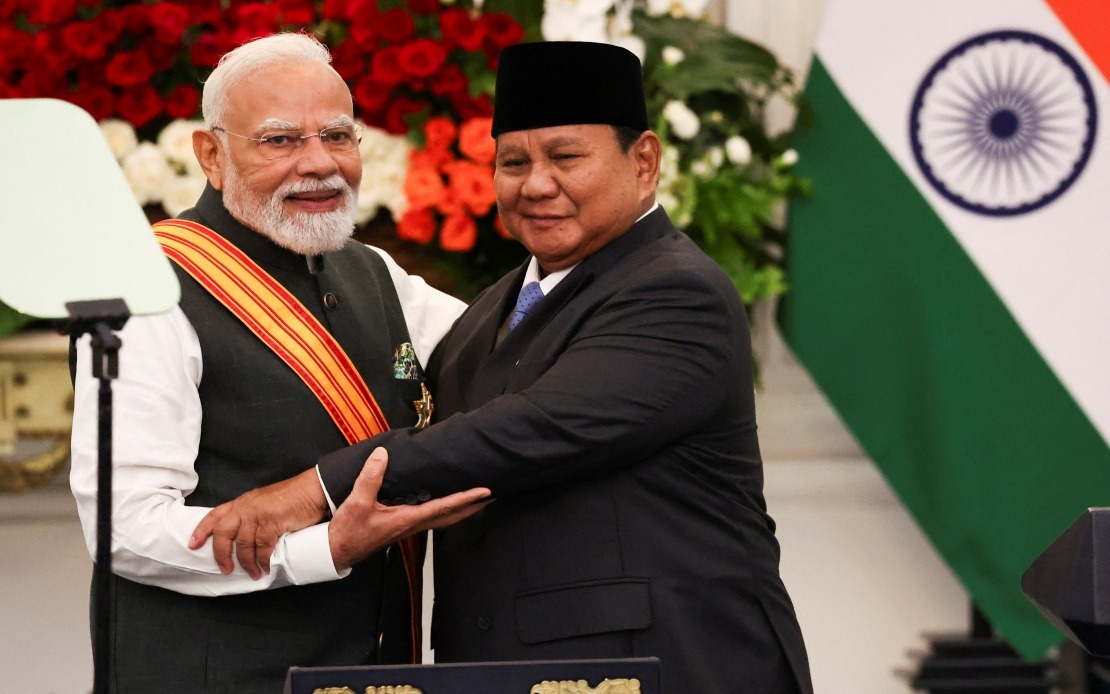
President Prabowo Subianto of Indonesia conferred the country's highest state honour on Indian Prime Minister Narendra Modi during an official state visit on July 7, underscoring the deepening relationship between two of Asia's major democracies and signalling a commitment to intensified regional cooperation. The ceremonial award, presented at the Merdeka Palace in Jakarta, represents a significant diplomatic gesture that elevates India's standing within Indonesia's immediate strategic framework and reflects the mutual investment both capitals have made in bilateral relations over recent years.
Prabowo framed the honour as recognition of Modi's personal leadership qualities and his instrumental role in elevating Indonesia-India ties to the level of a Comprehensive Strategic Partnership. In remarks delivered alongside the Indian premier, the Indonesian president emphasised that the award acknowledged Modi's sustained efforts to forge deeper institutional and people-to-people connections between the two nations. Beyond diplomatic protocol, the presentation carried substantive meaning—Prabowo specifically highlighted India's tangible contributions to Indonesia's development agenda, indicating that New Delhi's partnership extends beyond rhetoric to concrete developmental cooperation that resonates with Jakarta's modernisation priorities.
The state visit itself represents a reciprocal gesture, with Modi's presence in Jakarta returning the courtesy of Prabowo's earlier trip to India. This pattern of high-level exchanges demonstrates a deliberate cadence of engagement designed to maintain momentum in bilateral relations and provide regular opportunities for strategic dialogue. Such sustained engagement at the presidential level is notably significant in Southeast Asia's current geopolitical context, where middle powers like Indonesia increasingly calibrate their international partnerships to balance competing pressures and opportunities from major powers.
Historical precedent lends additional weight to the honour. Prabowo drew explicit parallels between Modi's recognition and the earlier conferment of the same award to Jawaharlal Nehru, India's founding prime minister, whose visionary leadership helped establish Indonesia-India relations and whose role in founding the Non-Aligned Movement aligned with Indonesia's own principles during the Cold War era. By invoking Nehru's legacy, Prabowo positioned Modi within a continuum of transformative Indian leadership and suggested that contemporary India-Indonesia cooperation carries echoes of the ideological alignment that characterised the earlier relationship between the two nations' founding leaders.
The Indonesian president characterised Modi's visit as a historic milestone, language typically reserved for moments anticipated to reshape bilateral dynamics or resolve longstanding disagreements. This framing suggests that both governments view the current phase of engagement as potentially transformative, moving beyond routine diplomatic contact toward the realisation of shared strategic objectives. For Malaysia and other Southeast Asian states observing from the sidelines, such high-profile endorsements carry implications for regional alignment and the practical distribution of influence within ASEAN and the broader Indo-Pacific.
Prabowo's expression of appreciation for India's support regarding Indonesia's permanent membership in BRICS merits particular attention for regional observers. Indonesia's advancement within this influential grouping of developing economies carries consequences for Southeast Asia's voice in global affairs and its positioning relative to established Western-led institutions. India's backing for this aspiration indicates coordination between New Delhi and Jakarta on issues extending well beyond bilateral relations into the architecture of global governance and the future composition of multilateral decision-making forums.
The Indonesian president emphasised the civilisational foundations underlying contemporary state relations, describing India as a long-standing friend connected through deep historical and cultural affinities. This invocation of shared heritage and civilisational kinship reflects a rhetorical strategy that legitimises contemporary strategic cooperation by rooting it in centuries-old connections. For Malaysia, which itself maintains significant cultural and historical ties with India, this emphasis on enduring civilisational bonds offers a model for how Southeast Asian nations conceptualise their relationships with major Asian powers—not merely as transactional partnerships but as expressions of deeper regional identity and shared values.
Prabowo's commitment to preserving the friendship through ongoing cooperation suggests that both nations view their partnership as requiring active cultivation and institutional investment. The deliberate language around protection and preservation indicates awareness that external pressures and competing attractions might otherwise erode the relationship. This attentiveness to maintenance reflects mature statecraft and contrasts with relationships that rely primarily on inertia or temporary alignment around immediate interests.
The bilateral meeting at Merdeka Palace, streamed live via YouTube, represented a deliberate choice to make the engagement publicly visible and to communicate its significance to domestic audiences in both nations. In an era of digital diplomacy, such transparency serves multiple purposes—it demonstrates to citizens that their leaders command international respect, it signals to regional observers the depth of bilateral commitment, and it creates public record of policy positions enunciated during high-level meetings.
For Southeast Asian nations including Malaysia, the India-Indonesia strategic partnership carries indirect significance. Indonesia's status as ASEAN's largest economy and most populous nation means that its foreign policy trajectories influence regional dynamics substantially. When Indonesia elevates its partnership with India through ceremonial honours and sustained high-level engagement, it implicitly shapes the context within which other Southeast Asian states calibrate their own India relationships. This demonstration effect operates alongside more direct mechanisms of influence, quietly signalling to other regional actors that deepening ties with India serves Indonesia's interests and may merit emulation.
The Comprehensive Strategic Partnership framework anchoring the bilateral relationship suggests that India and Indonesia have moved beyond traditional diplomatic courtesies toward institutionalised cooperation spanning defence, economic, cultural, and technological domains. The breadth of this partnership architecture indicates that both nations recognise mutual benefits extending across multiple sectors rather than concentrated in single areas of traditional interest like maritime security or trade.
Modi's state visit and the honour conferred upon him represent culmination of gradual strengthening in India-Indonesia relations over recent years, though they also mark a beginning rather than endpoint for expanded cooperation. Both governments have signalled through ceremonial and substantive actions their intention to deepen engagement further, suggesting that the coming years will witness intensified institutional coordination and expanded people-to-people exchanges. For Malaysia observing these developments, the trajectory of India-Indonesia relations offers insights into how major powers and regional states are reconfiguring partnerships in response to evolving geopolitical circumstances and shared strategic interests in maintaining stability across the Indo-Pacific region.

