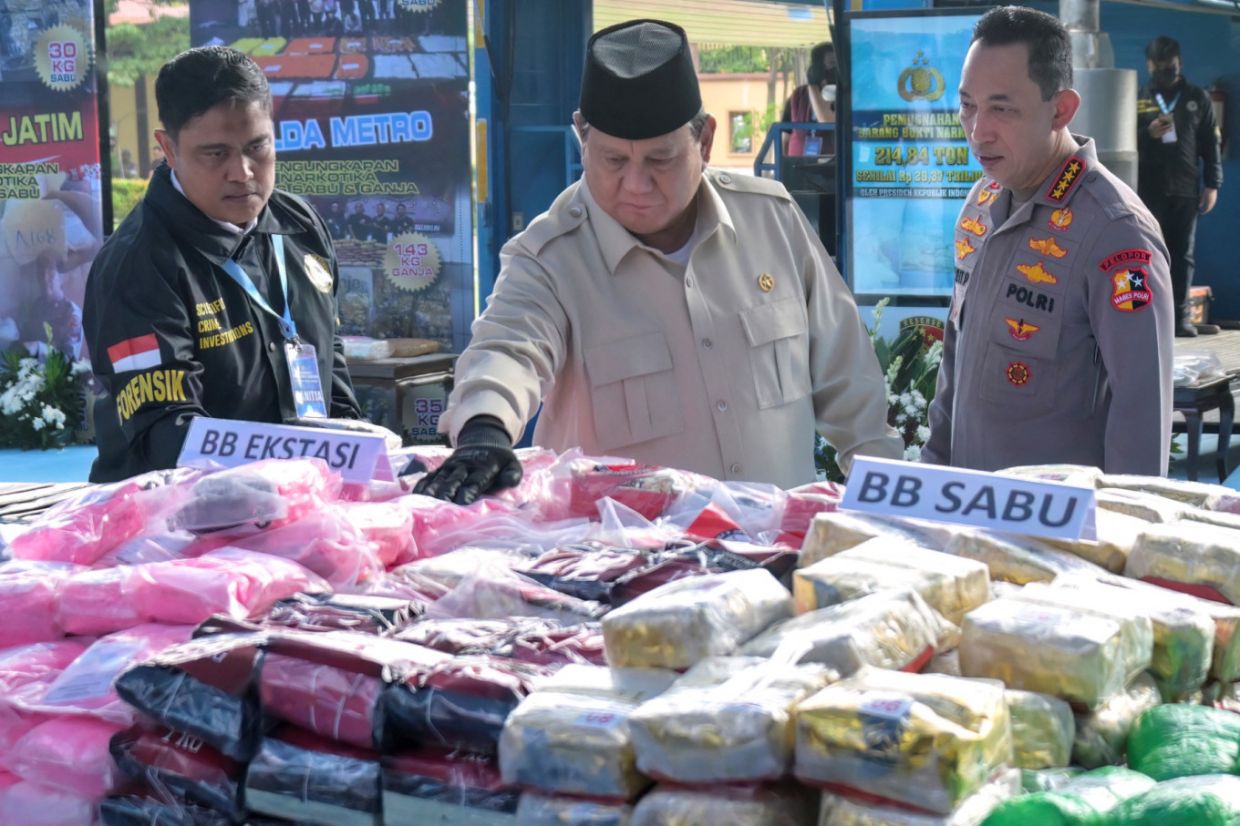
Indonesia has successfully intercepted a Tanzanian-flagged vessel carrying 2.6 tonnes of liquid methamphetamine in waters off Riau province, marking one of the nation's most significant drug seizures in recent years. The operation, conducted jointly by the National Narcotics Agency and customs officials, resulted in the arrest of ten crew members, all Myanmar nationals, and underscores the persistent challenge of transnational narcotics trafficking through Southeast Asian waters.
The interception occurred late Monday near Bengkalis in Riau province following intelligence that suggested the vessel, operating under an assumed identity as the MV Rain Maker, was travelling from Sarawak through the Andaman Sea with a cargo of controlled substances destined for Indonesian distribution networks. The National Narcotics Agency had received prior warning of the shipment's suspected route and coordinated closely with maritime customs authorities to position enforcement assets along likely trafficking corridors. The precision of the intelligence and rapid response capability demonstrated by Indonesian agencies reflects growing investment in regional drug enforcement infrastructure.
Inspection of the vessel revealed the methamphetamine stored within eight water barrels and a water tank, a concealment method that has become increasingly common among trafficking organisations seeking to evade detection at sea. The liquid formulation represents a significant operational shift for regional smugglers, as it allows for greater volumetric efficiency and reduced detection risk compared to crystal methamphetamine. Law enforcement officials noted that sniffer dogs also discovered more than 1.5 million illegal cigarettes aboard the vessel, suggesting the ship may have been involved in multi-commodity smuggling operations that funded or subsidised the narcotics trafficking enterprise.
The August bust represents the second major seizure involving a Tanzanian-flagged vessel intercepted in regional waters this month, indicating a possible pattern in trafficking methodologies or flag-state exploitation. Earlier on August 8, Indonesian authorities had apprehended a separate ship sailing through waters adjacent to the Riau Islands, near Singapore, and confiscated 1.3 tonnes of ketamine from that vessel. Eight crew members—seven from Myanmar and one from Taiwan—were arrested in that operation, suggesting trafficking networks may be systematically deploying vessels of similar registry to obscure ownership and operational control.
The frequency and scale of recent seizures along Indonesia's maritime approaches reflect the vulnerability of regional sea lanes to transnational criminal networks. The Andaman Sea and approaches to the Riau Islands represent critical chokepoints for trafficking routes that connect production centres in the Golden Triangle region, spanning Myanmar, Laos, and Thailand, to consumer markets throughout Southeast Asia and beyond. Indonesia's geographic position as both a potential transit point and consumer market has made it a priority target for trafficking organisations seeking to establish distribution networks.
Myanmar's prominence among arrested crew members across recent seizures raises concerns about the involvement of that nation's maritime industry in facilitating drug trafficking. The use of foreign flagged vessels—particularly those from jurisdictions with weaker maritime oversight regimes—combined with multinational crews, reflects deliberate operational security practices designed to obscure liability and complicate international legal accountability. The presence of Myanmar nationals in multiple seizures suggests organised groups operating from that country may be directly orchestrating maritime trafficking operations or providing crew recruitment services to broader trafficking syndicates.
Indonesia maintains amongst the world's most stringent anti-narcotics legislation, with capital punishment available as a penalty for major trafficking offences. However, the country has upheld an unofficial moratorium on executions in drug cases for several years, reflecting shifting international perceptions regarding capital punishment and potentially signalling a reorientation toward alternative enforcement approaches. Notwithstanding this restraint, Indonesia's conviction rates and lengthy prison sentences continue to provide significant deterrent value within regional trafficking calculations, though the persistence of large shipments suggests such penalties have not eliminated trafficking incentives entirely.
The National Narcotics Agency's successful operations demonstrate technical capability and interagency coordination, yet the volume of drugs seized suggests enforcement remains reactive rather than preventative. The seizure of 2.6 tonnes follows last year's record bust of two tonnes of crystal methamphetamine discovered aboard a fishing vessel sailing from the Andaman Sea toward Batam Island, indicating that trafficking organisations continue attempting operations of comparable scale despite heightened enforcement awareness. The repetition of successful seizures at similar volumes raises the possibility that organised networks accept current enforcement rates as an operational cost and continue supplying markets accordingly.
Regional cooperation presents both opportunity and challenge for Indonesian enforcement authorities. Intelligence sharing with Thai, Malaysian, and Singaporean authorities could improve prevention capabilities, yet jurisdictional complexity and varying enforcement priorities across nations constrain integrated approaches. The arrest of a Taiwan national in the August ketamine seizure underscores how trafficking networks recruit operatives across Asia-Pacific, complicating bilateral responses and requiring sophisticated international legal coordination. Future effectiveness may depend increasingly on developing comprehensive maritime domain awareness systems and sustained intelligence partnerships with major regional partners, potentially including coordinated patrols or joint task forces targeting known trafficking zones.

