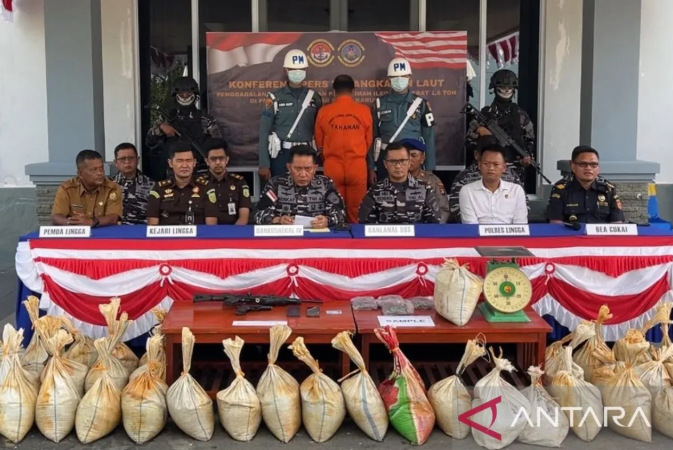
The Indonesian Navy has successfully prevented a significant quantity of illegally mined tin sand from reaching Malaysian shores, uncovering what officials suspect is part of a larger smuggling network operating across the maritime region. During a series of coordinated enforcement operations spanning early August, naval forces recovered approximately 75.7 tonnes of tin sand that had been extracted without proper authorization from the Bangka Belitung Islands, an archipelago situated off Sumatra's eastern coastline. The confiscated material carries an estimated value of Rp76.04 billion, equivalent to roughly US$79,300, underscoring the economic stakes involved in the region's illicit mineral trade.
The enforcement action began unfolding when personnel from the Indonesian Navy detected suspicious activity at a jetty facility in East Belitung on August 2. What initially appeared to be a routine intercept—a truck transporting approximately eight tonnes of tin sand—soon revealed itself to be merely the surface of a far more extensive operation. Vice Admiral Denih Hendrata, commanding the Indonesian Fleet Command, directed his forces to pursue the investigation beyond this initial seizure, recognizing patterns that suggested coordinated illegal extraction and export activities. This strategic decision to widen the investigation proved prescient, as subsequent operations uncovered significantly larger stockpiles at multiple sites throughout the region.
Over the span of several days, naval raids methodically dismantled the operation's infrastructure across the Bangka Belitung Islands. Following the initial eight-tonne discovery, searchers located approximately 50 tonnes of tin sand concealed within Lenggang village on August 3, demonstrating the operation's established storage capacity. A third raid yielded another ten tonnes, carefully packaged in 200 individual sacks to facilitate eventual transport, while a fourth operation on August 8 captured an additional five tonnes. The phased nature of these discoveries suggests a systematic distribution network that was stockpiling material for regular shipments, rather than a spontaneous trafficking incident.
Vice Admiral Denih emphasized during a press conference in Tanjungpandan, the capital of Belitung, that the investigation had transcended the initial seizure phase and had evolved into a comprehensive effort to trace the entire supply chain. He explained that investigators were expanding their inquiries across five separate locations, indicating that the smuggling apparatus extended beyond the immediate sites where tin sand was discovered. This geographical spread suggests involvement of multiple actors at various points in the supply chain—from illegal mining operations to storage facilities to transport hubs. The methodical expansion of the investigation reflects the Navy's commitment to identifying not merely the contraband itself, but the network of individuals and organizations facilitating its movement.
One critical aspect of the ongoing investigation involves determining the precise mineral composition and quality of the recovered material. Authorities have commissioned laboratory analysis to establish the exact tin content and characteristics of the seized sand, a process essential for understanding the material's intended market and potential economic value. Such technical analysis can also provide clues regarding the extraction methods employed and the specific mining sites from which the material originated, potentially enabling authorities to address the supply side of the illegal mining problem.
A significant complication in this enforcement matter is the apparent absence of suspects in custody or even identification at the time authorities made their initial announcement. While Vice Admiral Denih did not indicate whether arrests had been made, he acknowledged the investigative challenges inherent in dismantling smuggling networks that typically involve multiple complicit parties operating across jurisdictional boundaries. The deliberate discretion regarding suspect identification may reflect ongoing operational sensitivity, with investigators still working to map the broader network before making high-profile arrests that might alert remaining participants to the authorities' awareness.
The potential Malaysian dimension of this case introduces a complex international dimension that transcends standard law enforcement procedures. Vice Admiral Denih acknowledged that cross-border cooperation would be essential for tracing the smuggling network to its ultimate destination and identifying the recipients awaiting delivery in Malaysia or other countries. The question of whether the tin sand would have proceeded directly to Malaysian buyers or been transshipped through intermediate markets remains part of the active investigation. Interstate collaboration mechanisms between Indonesia and Malaysia will likely prove crucial for establishing the complete chain from illegal extraction through distribution.
The Bangka Belitung Islands carry particular significance in Indonesia's tin industry, having historically been a major production center. The emergence of large-scale illegal mining operations in this region reflects broader challenges facing Indonesia's mineral extraction sector, where the gap between formal, regulated production and informal, unauthorized mining continues to widen. The proximity of these islands to Malaysian territorial waters and shipping lanes makes them a natural transshipment point for smugglers seeking to move contraband to Southeast Asian destinations. This geographic reality creates ongoing pressure on enforcement authorities to maintain vigilant border protection.
The tin smuggling route through the Bangka Belitung Islands also reflects global market dynamics affecting the commodity. Tin prices and demand fluctuations in international markets incentivize illicit miners to maximize extraction regardless of regulatory constraints. Malaysian industrial demand for tin—particularly from electronics manufacturing sectors located in northern Peninsular Malaysia—creates substantial pull factors for smuggled material seeking lower-cost sources. The value represented by 75.7 tonnes demonstrates that the profit margins available to smugglers justify the organizational complexity and enforcement risks involved in moving contraband across maritime boundaries.
Looking forward, the investigation's expansion and the involvement of multiple agencies suggest Indonesian authorities are treating this case with heightened priority. The determination to uncover the complete network rather than settling for the commodity seizure alone indicates a strategic shift toward dismantling supply chains rather than merely intercepting shipments. Such an approach, if sustained with adequate inter-agency coordination and adequate resourcing, could provide meaningful disruption to organized smuggling operations that have flourished in Indonesian waters. The investigation will likely produce important intelligence regarding trafficking patterns, key participants, and organizational structures that can inform future enforcement strategies across the archipelago.

