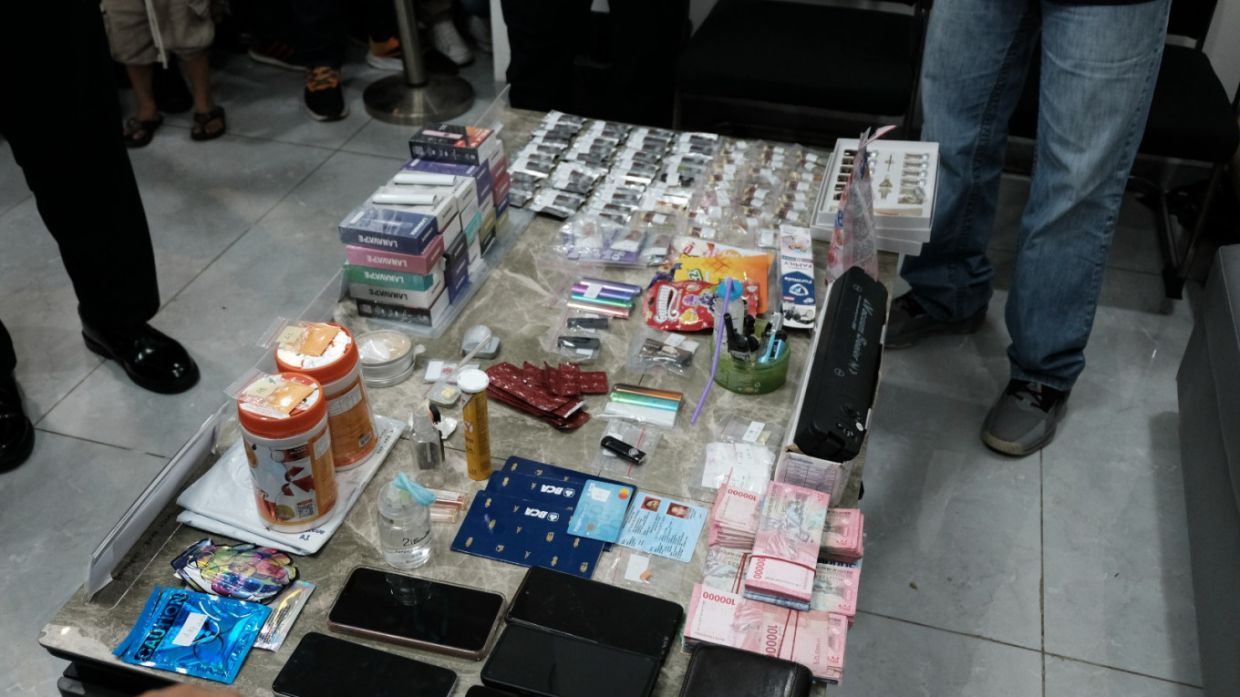
Indonesian law enforcement agencies have successfully broken up an organised drug trafficking network with Malaysian connections that was operating across the Riau Islands. The National Narcotics Agency (BNN) and the Customs and Excise Directorate General, working in coordination, launched a coordinated enforcement action that resulted in the arrest of six Indonesian suspects and the placement of two Malaysian nationals on Indonesia's wanted list. The dismantled syndicate represents a significant blow to cross-border narcotics smuggling operations that have long plagued the Malaysia-Indonesia maritime frontier.
The investigation began when Customs officials at Soekarno-Hatta International Airport intercepted a suspicious parcel originating from Malaysia in what appeared to be routine screening. The package had been deliberately mislabelled as an Orange Fiber Xtra food supplement to evade detection, a common tactic employed by sophisticated trafficking networks to circumvent border controls. Subsequent laboratory analysis at the Customs and Excise Laboratory in Jakarta revealed the deception immediately: the parcel contained substantial quantities of MDMA, ketamine, and other controlled narcotics. This initial discovery proved to be the critical thread that unravelled the entire operation.
Following the airport seizure, BNN and Customs personnel initiated a coordinated tracing operation that rapidly expanded in scope. Officers apprehended a suspect identified as BAP on Wednesday whilst he was collecting the intercepted package in Batam. Upon interrogation, BAP provided leads that enabled authorities to swiftly locate and detain three additional individuals at a hotel in Baloi: ED, who allegedly placed the original order; NC; and TFS. The rapid succession of arrests demonstrates the effectiveness of joint inter-agency cooperation and the intelligence-gathering capabilities of Indonesian law enforcement when operations are properly coordinated.
The network's operational sophistication extended beyond simple smuggling. Investigators discovered that the syndicate employed a complex distribution model involving multiple facilities across Batam. A raid on an apartment owned by TFS in Teluk Tering and a shophouse in the Sakura Garden area of Batu Ampar—where suspects AJ and DA were apprehended—revealed an extensive repackaging and preparation operation. Officers employed a sniffer dog from the Batam Customs Office during the Batu Ampar raid, underscoring the professional nature of the enforcement response. At these locations alone, authorities recovered dozens of electronic cigarette pods containing etomidate, methamphetamine, Happy Five tablets, and suspicious beverages labelled as Happy Water drinks.
The scale of drug seizures confirms the network's significance as a regional trafficking hub. In total, authorities confiscated over one kilogramme of MDMA, 50 grams of methamphetamine, approximately 26 grams of ketamine powder, 86 Happy Five tablets, and 10 ecstasy pills. Most notably, officers secured 170 vape cartridges containing etomidate—a pharmaceutical anaesthetic increasingly diverted for recreational drug use—alongside 12 additional vials of concentrated etomidate weighing 226 grams collectively. The seizure of 88 vape devices, nine water pipes used for methamphetamine consumption, precision digital scales, and plastic sealing equipment reveals a production and distribution chain fully equipped for large-scale operations. Officers additionally recovered four vehicles including a Toyota Alphard van and a Chery SUV, suggesting the network maintained a logistics capability.
The syndicate's deceptive practices highlight evolving smuggling methodologies that threaten regional border security. Rather than attempting to move narcotics in unmarked containers, the network deliberately concealed drugs within legitimate-appearing food packages and dietary supplements, then resealed them using specialised plastic equipment to restore authenticity. This approach exploits the difficulty customs officers face when screening vast quantities of food imports whilst maintaining processing efficiency. The strategy proved partially successful, with the Batam Centre International Ferry Terminal subsequently recording a separate interception of 48 etomidate cartridges from a Malaysian passenger identified as PS arriving from Stulang Laut International Ferry Terminal in Johor Bahru—suggesting the network may have operated multiple smuggling routes.
The pursuit of the two Malaysian nationals identified as SL and WKC represents the investigation's ongoing dimension. These individuals have been designated as principal suppliers to the syndicate, indicating their residence in Malaysia and their role coordinating shipments into Indonesian territory. Their placement on Indonesia's wanted list signals a formal extradition request may be forthcoming, though Malaysian cooperation in cross-border narcotics matters remains subject to diplomatic protocols and existing bilateral agreements. The fact that Malaysian nationals were identified as primary suppliers underscores how Malaysia's geographic position and developed maritime infrastructure can be exploited by transnational criminal networks seeking to exploit both countries' markets.
BNN deputy for enforcement, Inspector General Aswin Sipayung, characterised the operation as demonstrating the sophisticated organisational capacity of contemporary drug syndicates. From illegal seaport smuggling through systematic repackaging to final distribution across the Riau Islands, the network exhibited operational discipline and structural compartmentalisation. Batam Customs and Excise Office head Agung Widodo framed the enforcement action in public health terms, estimating that the operation prevented potential drug-related harms to approximately 6,770 individuals whilst averting estimated rehabilitation costs of Rp10.8 billion (US$599,000). This framing reflects Indonesian policymakers' increasing emphasis on quantifying enforcement's societal benefits beyond simple drug seizure metrics.
The criminal charges against detained suspects invoke Indonesia's stringent narcotics legislation. Under Article 114(2) in conjunction with Article 132(1), and Article 112(2) in conjunction with Article 132(1) of Law No. 35/2009 on Narcotics, convicted defendants face minimum imprisonment of five years extending to capital punishment, alongside maximum financial penalties of Rp10 billion. These severe sentencing provisions, particularly the death penalty possibility for trafficking charges, reflect Indonesia's zero-tolerance stance toward large-scale narcotics operations. For Malaysian readers, such penalties underscore the dramatically heightened legal jeopardy individuals face when crossing into Indonesian jurisdiction on narcotics-related matters.
This case illuminates the persistent vulnerability of the Malaysia-Indonesia border to organised drug trafficking despite substantial law enforcement investment. The Batam operation, situated directly across from Malaysia's southern coast, has historically served as a transhipment hub for drugs destined for Indonesian consumption and regional distribution. The network's reliance on Malaysian suppliers suggests that despite Malaysia's own intensive drug enforcement efforts, significant production or import capacity remains accessible to criminal networks. For Malaysian policymakers, the case reinforces that unilateral enforcement efforts prove insufficient; effective border security requires sustained intelligence-sharing, coordinated operations planning, and resource commitment from both nations.
The investigation's connection to a recently raided drug manufacturing facility in Batam remains under investigation, potentially indicating a larger criminal enterprise than initially evident. If the dismantled trafficking network operated in conjunction with local production facilities, the case would represent disruption of a vertically integrated operation spanning both supply and distribution functions. Such vertical integration reflects evolution in regional drug trafficking from simple smuggling operations toward sophisticated criminal enterprises resembling legitimate multinational corporations in their organisational complexity. The ongoing investigation may ultimately establish connections exceeding initial arrest parameters, expanding understanding of Batam's role within regional narcotics markets.

