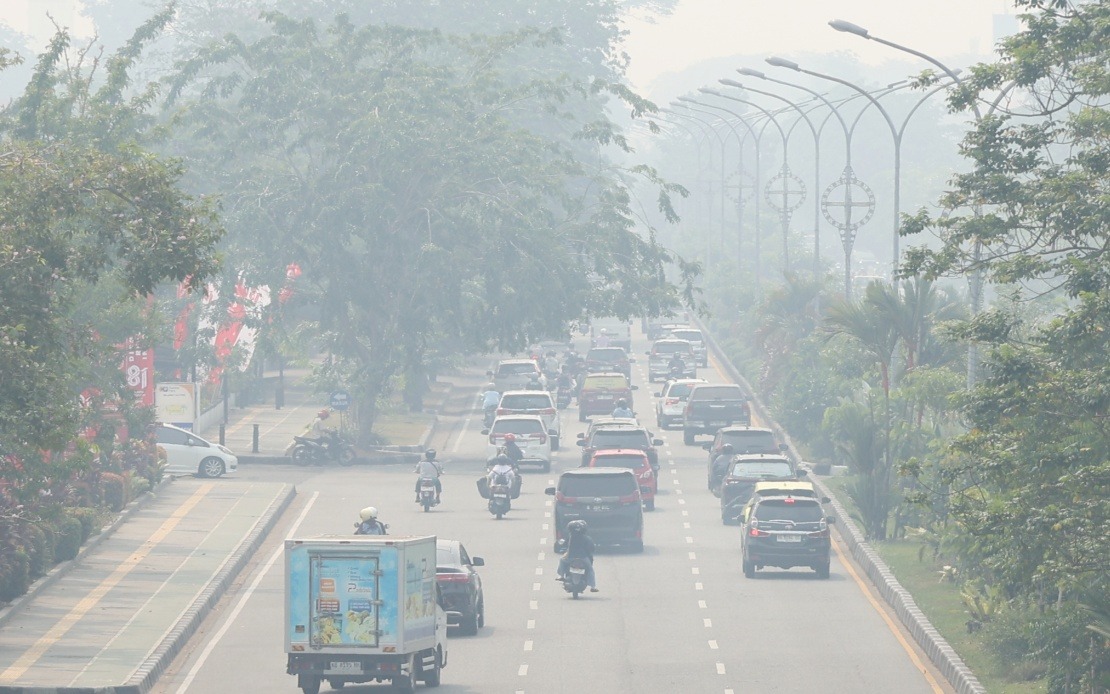
Indonesia is grappling with a deepening air quality crisis as uncontrolled forest and land fires continue to engulf vast swathes of Sumatra and Kalimantan, sending hazardous levels of pollution across the archipelago. The Air Pollutant Index has surged to an alarming 573 in Jekan Raya, a subdistrict within Palangka Raya in Central Kalimantan, according to readings from 17 monitoring stations recorded on Wednesday morning. The readings, confirmed by the Health Ministry's Environmental Health Director Then Suyanti, represent a critical threshold at which outdoor exposure poses immediate health risks to the general population.
The hazardous conditions extend well beyond Central Kalimantan's epicentre. Muaro Jambi Regency in Jambi province also registered a hazardous API reading of 302, while multiple other locations across the region recorded very unhealthy air quality indices between 201 and 300. These included Pelalawan in Riau, Penukal Abab Lematang Ilir and Ogan Ilir in South Sumatra, Southeast Pontianak in West Kalimantan, and both Gunung Mas and Katingan in Central Kalimantan. The geographic spread of severe pollution indicates that the fire emergency has transcended localized incident status and evolved into a regional environmental catastrophe affecting multiple provinces simultaneously.
Public health authorities have issued stark guidance to residents. At hazardous pollution levels, Indonesian health officials explicitly recommend that all population groups avoid outdoor activities entirely, effectively confining residents to indoor environments. For those in very unhealthy air quality zones, authorities counsel against prolonged outdoor exposure, particularly warning vulnerable populations including children, the elderly, and those with pre-existing respiratory conditions. The stringency of these recommendations underscores the immediate and tangible health consequences of sustained exposure to smoke-laden air at these concentrations.
The Ministry of Health has begun mobilizing a coordinated response to mitigate the public health fallout. A formal circular is in preparation and expected to be issued within two days by the ministry's secretary-general, introducing emergency protocols aimed at protecting citizens during the crisis. Among the anticipated measures is permission for educational institutions to transition to distance learning when air quality deteriorates beyond safe thresholds, acknowledging that schools cannot safely operate under hazardous conditions. These administrative measures represent an attempt to maintain essential services while minimizing the population's exposure to dangerous air.
The scale of human impact from the crisis is unprecedented. Approximately 3.4 million residents across seven provinces face varying degrees of air pollution exposure, spanning both Sumatra and Kalimantan. The affected provinces include Riau, Jambi, and South Sumatra on Sumatra island, alongside West, Central, East, and South Kalimantan. All seven provinces have formally declared an emergency alert status, indicating official recognition of the severity though not yet the highest emergency response designation. Agus Jamaludin, the Health Ministry's Head of Health Crisis Centre, expressed cautious hope that intensified firefighting operations would gradually suppress the fires and subsequently reduce the transboundary haze affecting the broader region.
Casuality reports remain limited but concerning. Health authorities documented 42 individuals sustaining minor burn injuries related to the fires, while two serious cases requiring hospitalization emerged in South Kalimantan. Remarkably, no deaths or mass evacuations have been reported, though the situation remains fluid and subject to rapid deterioration. To manage the health emergency across the affected territories, the ministry has deployed 321 health personnel distributed throughout the seven provinces, establishing rapid response capacity to address fire-related injuries and smoke-inhalation cases.
Satellite monitoring data reveals the extraordinary scope of active fire activity across the Indonesian archipelago. The Forestry Ministry's surveillance as of Tuesday evening detected 805 high-confidence hotspots and 11,313 medium-confidence hotspots nationwide, indicating that ignition sources remain geographically dispersed and numerous. Within the six priority provinces designated as crisis zones, South Sumatra leads with 239 high-confidence hotspots, followed by Central Kalimantan with 113, South Kalimantan with 89, and West Kalimantan with 86. Jambi and Riau contribute only seven and one high-confidence hotspots respectively, suggesting the fire activity concentrates in the southern regions of both major islands.
The distribution of medium-confidence hotspots paints a different picture of fire risk concentration. West Kalimantan contains the largest count at 2,447 such hotspots, marginally exceeding Central Kalimantan's 2,168. South Sumatra follows with 1,161, South Kalimantan with 710, while Riau and Jambi each register 199 and 197 respectively. The prevalence of medium-confidence hotspots—fires detected by satellite but not yet confirmed—suggests significant potential for fire expansion if weather conditions worsen or prevention efforts falter. This imbalance between detected and medium-confidence hotspots indicates that comprehensive fire suppression remains incomplete across the region.
For Malaysia and other Southeast Asian nations, the Indonesian crisis holds particular significance. The transboundary nature of haze pollution means that regional air quality can deteriorate substantially when Indonesian fires rage unchecked. Historical precedent, including the severe 1997-1998 haze crisis, demonstrates how Indonesian fires can render air quality hazardous across neighbouring countries, disrupting commerce, tourism, and public health across the region. Malaysian authorities and citizens should monitor Indonesian fire developments and air quality indices closely, as shifting wind patterns could transport particulates northward across the Strait of Malacca within days.
The underlying causes of Indonesia's recurring fire crisis warrant examination. Many fires occur in degraded peatlands and palm plantations where vegetation has been cleared or modified, making ignition and rapid spread more likely. The combination of seasonal drought conditions, industrial land-use practices, and insufficient enforcement of fire prevention regulations creates an environment where fires propagate rapidly across vast territories. Until Indonesia implements comprehensive land management reforms addressing underlying vulnerability factors, annual fire seasons will continue generating regional air quality emergencies that extend far beyond Indonesian borders, affecting the wellbeing of millions across Southeast Asia.

