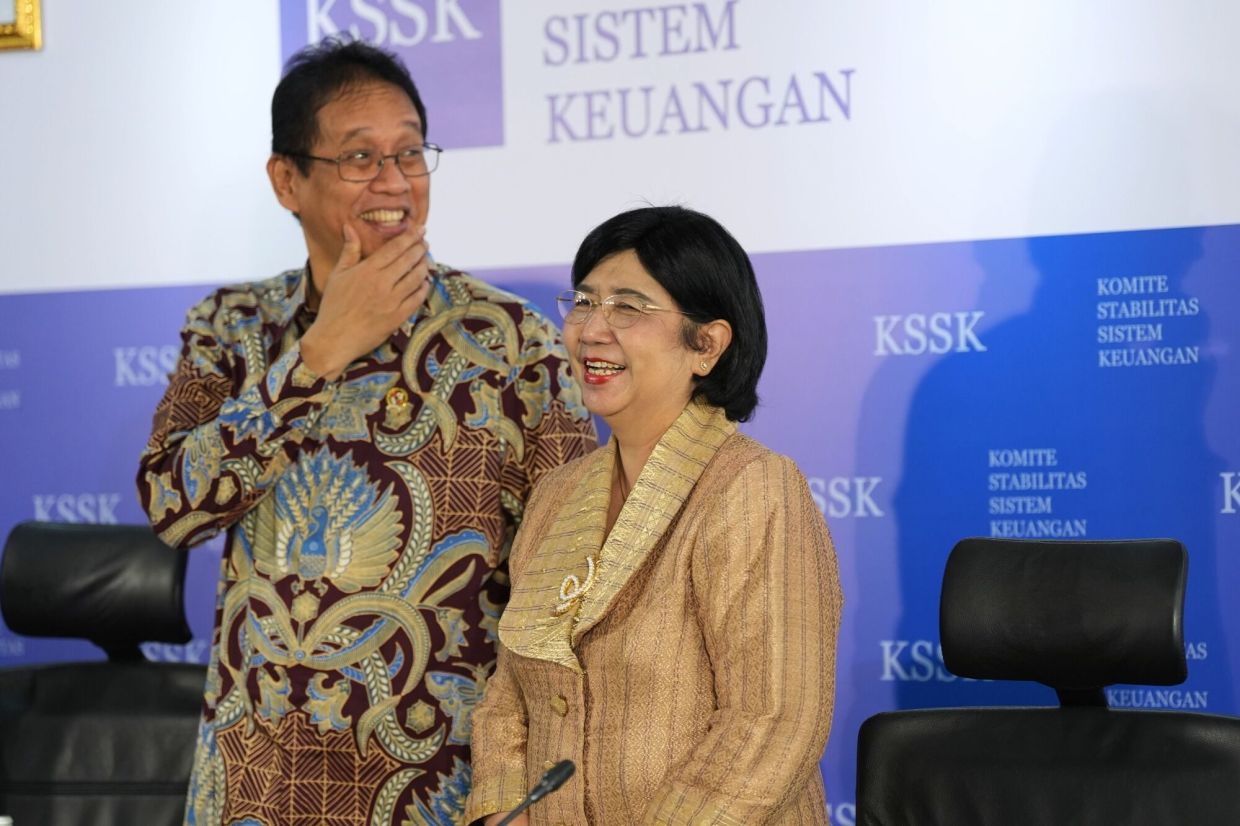
Destry Damayanti's appointment as acting governor of Bank Indonesia two weeks ago signalled a potential shift in how the central bank will engage with the government. Within hours of her appointment, she visited Finance Minister Purbaya Yudhi Sadewa's office before heading to see President Prabowo Subianto, a deliberate move that underscored her intention to coordinate closely on monetary and fiscal matters. The two officials subsequently appeared together at a public briefing, projecting collegial warmth that starkly contrasted with the more formal, distance-keeping approach of her predecessor, Perry Warjiyo, whose interactions with the finance minister typically occurred in larger settings at the presidential palace or regulatory committees rather than in private, bilateral meetings.
Prabowo has now formally nominated Destry as the sole candidate for the permanent governor position, a selection that reflects his apparent desire to find a middle ground between appointing a market-savvy economist and installing someone aligned with his economic vision. That vision centres on accelerating growth to 8 percent by 2029, a target that will require supportive monetary conditions and active coordination between the central bank and fiscal authorities. Destry, who served as Warjiyo's deputy since 2019, brings technical expertise and established relationships within both government and financial circles. Yet her primary challenge will be demonstrating to international investors that she can pursue the president's ambitions without sacrificing the institutional credibility and autonomy that have anchored Indonesia's financial stability in recent years.
The investment community has responded cautiously but positively to her appointment. When her nomination was announced on Monday, the rupiah strengthened to its highest level in a month and outperformed most other Asian currencies, suggesting that markets view her as a continuity figure who may improve dialogue between monetary and fiscal policymakers. Economists at Citigroup Inc. noted that enhanced communication between the central bank and government could yield benefits, though they cautioned that the broader institutional environment remains fluid. Her nomination requires parliamentary approval before she can assume the role permanently.
However, Destry takes over at a particularly fragile moment for Indonesia's currency. The rupiah has depreciated roughly 6 percent against the dollar this year, making it Asia's worst performer, driven in part by investor anxiety over President Prabowo's populist policy initiatives from the past year. His administration has committed substantial resources to free school meal programmes and expanded state involvement in commodity markets, measures that have unsettled foreign investors concerned about fiscal sustainability and market discipline. Rating agencies Fitch Ratings Inc. and Moody's Ratings have placed Indonesia's sovereign credit on negative watch, citing policy uncertainty, although S&P Global Ratings has maintained a stable outlook.
The external environment compounds these domestic challenges. Rising global interest rates and a strengthening United States dollar continue to exert downward pressure on emerging-market currencies, including the rupiah, even as domestic inflation remains relatively contained. Under Warjiyo's leadership, Bank Indonesia deployed a diverse toolkit to address these competing pressures. The central bank has raised its benchmark interest rate three times since May, intervened directly in foreign exchange markets to support the rupiah, and employed non-rate instruments to sustain credit growth and economic activity. The question now is whether Destry will maintain this disciplined approach or whether the close relationship she is cultivating with the finance minister will eventually push her toward easier monetary conditions.
Investor scrutiny will focus on several critical indicators of the central bank's resolve. First, observers want to see whether Bank Indonesia will continue raising rates if inflation or currency weakness demand it, rather than succumbing to government pressure for looser policy to support growth. Second, they will assess whether liquidity management decisions continue to reflect genuine monetary and financial-stability assessments or gradually become subordinated to growth objectives. Irman Faiz, chief economist at PT Bank Danamon, emphasised this distinction in his recent commentary, arguing that while coordination between the central bank and government is necessary and beneficial, monetary policy decisions must ultimately reflect the central bank's own analysis of inflation dynamics, exchange-rate stability and systemic financial risks. As he put it, coordination is appropriate, but policy subordination is not.
Destry's professional credentials are substantial. She earned a bachelor's degree in economics from the University of Indonesia and a master's degree in regional science from Cornell University, providing her with both local expertise and international academic experience. Before joining Bank Indonesia, she served as chief economist at PT Bank Mandiri, one of the country's largest banks, and held a commissioner position at the Indonesia Deposit Insurance Corp., an institution previously headed by Finance Minister Purbaya. This background means she is not an outsider to the nexus of government and financial decision-making; indeed, her prior connections to Purbaya through the deposit insurance corporation suggest existing rapport that could facilitate closer working relationships.
Her profile also extends into the investor relations sphere. Destry has a track record of regular engagement with the international analyst and investor community on central bank policy matters, suggesting she understands the importance of maintaining credibility with external stakeholders. This familiarity with international financial markets may help her navigate the tricky balance between responding to domestic political expectations and satisfying overseas investors who increasingly scrutinise central bank independence as a proxy for overall governance quality in developing economies.
Yet as Fakhrul Fulvian, chief economist at PT Trimegah Sekuritas Indonesia, has noted, the central bank's next phase of work must extend beyond merely defending the stability achieved over recent years. The immediate priority remains preventing further rupiah depreciation and anchoring inflation expectations, but longer-term success will require translating that stability into an improved liquidity environment for the broader financial system, a more normalised yield curve, stronger transmission of monetary policy signals into lending decisions by commercial banks, and restored private-sector confidence in investment opportunities. These objectives require both technical competence and political space—and whether Destry can secure both remains uncertain.
The appointment reflects deeper tensions within Indonesia's institutional architecture. Prabowo's ambition to achieve rapid growth sits uneasily with the orthodox monetary discipline that maintains currency stability and investor confidence. Destry must convince both audiences that she can deliver: faster growth for the government and her political superiors, and sound money for overseas investors and international creditors. Her friendliness toward Finance Minister Purbaya, while potentially smoothing day-to-day coordination, creates a risk that observers—particularly outside Indonesia—may view her as politically captured rather than genuinely independent. Managing this perception while actually governing will define her tenure.

