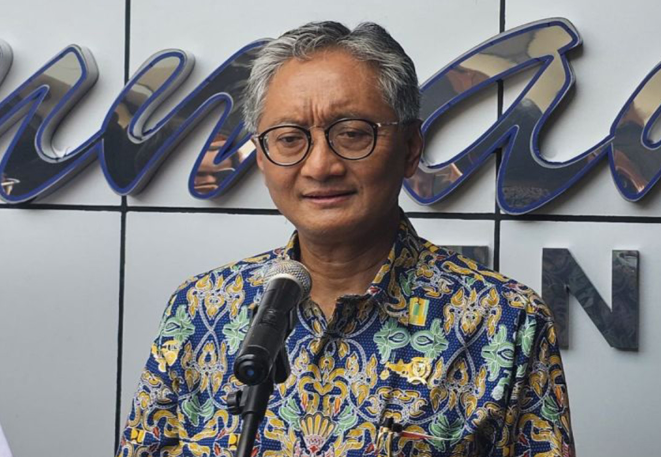
Indonesia's Public Works Ministry is reeling from internal discord sparked by the unauthorised circulation of an official document revealing that Public Works Minister Dody Hanggodo planned to bring his wife Irma Hermawati and daughter Aurellia Tsabitha Meidirama on a government trip to New York in July. The disclosure has prompted intense public scrutiny and raised fresh questions about ministerial accountability, departmental morale, and the broader governance challenges facing Indonesia's infrastructure sector.
The contentious document, signed by ministry secretary-general Apri Artoto on June 29, detailed plans for eight delegates to travel to the United States from July 13 to 19 for a United Nations-organised meeting scheduled for mid-month. The inclusion of Hanggodo's family members triggered immediate criticism across social media platforms and sparked allegations that state resources were being misappropriated for private purposes. The proposed journey was subsequently abandoned amid the mounting backlash.
Following the document's viral circulation earlier this month, social media erupted with claims that Hanggodo had retaliated by transferring several officials to regional postings, predominantly in locations outside Java. These assertions of vindictive personnel movements have added another layer of tension to an already fractious institutional environment. When confronted by journalists on Wednesday, Hanggodo acknowledged the transfers but categorically rejected suggestions that they constituted payback for the leak, instead framing them as routine administrative decisions within his purview.
Hanggodo's defence proved dismissive of critics' concerns. "I have 38,600 employees, why shouldn't I be allowed to reassign them?" he told reporters through Kompas.com, suggesting that such movements represented standard managerial prerogatives. However, this rationale has done little to assuage mounting worries about workplace stability and departmental cohesion. During a July 7 press briefing, Apri provided a different justification for the family members' inclusion, arguing that their participation was necessary to facilitate visa applications through the Foreign Ministry, while pledging that public funds would not cover their attendance. The secretary-general vowed to identify whoever leaked the document and indicated that severe legal consequences awaited any official found responsible.
The turmoil represents merely the latest chapter in a prolonged period of organisational upheaval within the ministry. Since assuming office in October 2024, the 60-year-old Hanggodo—an engineer with business connections to South Kalimantan entrepreneur Andi "Haji Isam" Syamsuddin Arsyad and a Democratic Party politician—has orchestrated extensive personnel restructuring. Social media compilations have documented more than 100 employee transfers throughout his tenure, affecting everyone from senior director generals to junior civil servants. In May alone, Hanggodo appointed seven high-ranking officials, including Apri as secretary-general, displacing his predecessor Wida Nurfaida after she held the position for less than twelve months.
For Malaysian observers, these developments underscore challenges that resonate across Southeast Asia's infrastructure ministries, where political appointees often clash with entrenched bureaucratic interests. The frequency and scale of Hanggodo's reshuffles have sparked genuine alarm among Indonesian legislators. During June parliamentary proceedings, Yasto Soepredjo Mokoagow of the House of Representatives Commission V, the body overseeing infrastructure matters, raised serious concerns about the psychological toll on ministry staff. The PDI-P politician warned that demotions and disciplinary actions had created pervasive anxiety, ultimately threatening programme implementation and project delivery.
Hanggodo has justified his aggressive restructuring campaign by invoking the concept of a "deep state" embedded within the ministry—a characterisation he has compared to termites systematically destroying institutional foundations. He contends that rooting out this alleged entrenched resistance justifies the widespread personnel movements. This narrative, however, sits uneasily alongside mounting evidence of systemic vulnerabilities within the ministry that require more than organisational shuffling to address.
The ministry's credibility has been further damaged by an ongoing corruption investigation into water resources projects. In June, the Jakarta High Prosecutor's Office formally named several suspects, including former water resources director general Dwi Purwantoro and former acting irrigation and swamp director Yosiandi Radi Wicaksono. Hanggodo publicly committed to supporting law enforcement actions against his subordinates and promised not to shield wrongdoers, yet questions persist about whether aggressive personnel transfers might inadvertently hinder investigators' access to institutional knowledge or complicate accountability efforts.
Beyond the statistical catalogue of transfers and investigations, recent social media circulation of video footage revealing Hanggodo's interactions with subordinates has humanised the institutional tensions. One recording from an April school construction site visit in East Java captured the minister sharply rebuking an employee, pointing a finger while dismissing the official's explanation as "dumb excuses." Such moments, magnified across digital platforms, reinforce impressions of an increasingly hostile workplace culture rather than a ministry undergoing necessary structural reform.
For regional stakeholders and development partners, including those from Malaysia and other ASEAN countries who engage with Indonesia's infrastructure sector, these dynamics raise uncomfortable questions about project continuity, decision-making stability, and the coherence of long-term planning. When institutional turbulence reaches this magnitude—combining political controversy, mass personnel movements, formal investigations, and visible leadership conflicts—the capacity to execute complex infrastructure initiatives inevitably suffers. The challenge confronting Indonesia extends beyond resolving the immediate travel document scandal or identifying the leak's source; it requires restoring institutional trust and demonstrating that governance reform serves public interests rather than factional advantage.

