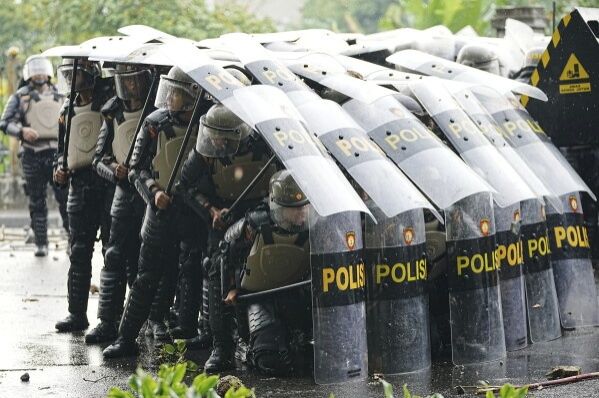
The institutional balance underpinning Indonesia's law enforcement apparatus has come under severe strain following dramatic police operations in Jakarta that uncovered tens of millions of dollars in seized assets and prompted an unexpected military response. The sequence of events—beginning with coordinated raids across the capital and culminating in armed military personnel stationed at a high-ranking official's residence—has exposed fault lines between security agencies at a moment when public trust in institutions is already fragile. Senior government officials, including President Prabowo Subianto, have attempted to contain the fallout, though their measured statements have done little to dispel concerns about whether Indonesia's institutions can function with genuine independence.
The police operations themselves were presented as straightforward evidence-gathering exercises tied to three distinct corruption and money-laundering investigations. Authorities conducted raids across Jakarta and surrounding areas, recovering physical assets that reflect the scale of suspected illicit accumulation. In one location in South Jakarta, investigators accessed a specially constructed two-meter-tall safe within a restaurant, extracting rupiah and foreign currencies totalling more than $3 million. The operation extended to an adjacent money-changing business, suggesting a possible network for asset movement and currency conversion. These searches are framed as connected to suspected irregularities in coal supply arrangements to power plants, allegations that carry particular weight given the recent electricity disruptions that have affected the nation's economic performance.
The discovery at the residence of Deputy Attorney General for Special Crimes Febrie Adriansyah intensified scrutiny considerably. Investigators located 74 kilograms of gold bars alongside cash and foreign currencies stored in seven suitcases within a locked safe, bringing the total value of assets found at that location to approximately $26.3 million. Febrie's position as head of the Attorney General's Office unit overseeing high-profile corruption cases made the raid especially sensitive. His portfolio encompasses major investigations into state enterprises including Timah, Pertamina and Garuda Indonesia, as well as inquiries touching on figures associated with President Prabowo Subianto himself, including probes related to the administration's free-meals program. The convergence of his prominent prosecutorial role and the scale of assets discovered at his property created immediate questions about potential conflicts of interest and institutional credibility.
What transformed the raids from significant law enforcement action into a broader institutional crisis was the subsequent military deployment to Febrie's Jakarta residence. Armed military personnel arrived at the property following the police searches, reportedly stationed there at the request of the Attorney General's Office and justified under legal protections for prosecutors. This move signalled a rupture between police and military leadership, or at minimum a perceived need to shield the prosecutor from ongoing investigation. The military's public messaging attempted damage control, with spokespersons insisting the deployment did not constitute interference with investigative processes and affirming support for law enforcement operations. Yet the very presence of armed troops at a location central to a corruption inquiry created an appearance of institutional protection that undermined claims of impartiality.
Febrie's response on Friday acknowledged his ownership of the residence but categorically denied any connection to the seized assets, effectively suggesting they had been planted or belonged to unidentified third parties. He acknowledged the Attorney General's Office respects investigative procedures while awaiting police conclusions, simultaneously invoking the presumption of innocence to deflect media speculation. His statement urged public restraint in drawing connections between individuals and alleged criminality based on preliminary reporting, positioning the legal process as requiring patience and institutional trust. This defensive posture, combined with the military's protective positioning, created the appearance of a senior official sheltering behind institutional shields while investigation proceeded.
The police operations also encompassed allegations reaching beyond coal procurement into other high-profile areas of potential malfeasance. Investigators identified suspected misconduct in the administration of legal matters involving state insurance enterprises Asabri and Jiwasraya, both of which have featured in previous corruption scandals affecting pensioners and policyholders. A third investigative thread concerns debt settlement arrangements tied to companies associated with Krakatau Steel, Indonesia's state-owned steelmaker. This diversification of targets suggests either a broad corruption network or coordinated efforts to address multiple institutional vulnerabilities simultaneously, though the public remains uncertain whether the operations represent genuine law enforcement priorities or something more strategically motivated.
President Prabowo's Friday remarks, delivered while inaugurating a dam on Lombok island, appeared designed to remind officials of their subordinate relationship to civilian governance and public interest. His exhortation that military and police personnel remember their dependence on the people, their uniforms and symbols ultimately derived from public authority, served as an implicit rebuke to institutional overreach. The inclusion of the Attorney General's Office in this moral reminder suggested the president viewed the institutional breakdown as systemic rather than isolating to any single agency. Yet the oblique nature of these statements, avoiding direct reference to the raids or the military deployment, indicated reluctance to take explicit sides while institutional tensions remained unresolved.
International observers have expressed alarm at the implications for Indonesia's institutional architecture. Amnesty International Indonesia identified the military deployment as potentially corrosive to civilian supremacy and law-enforcement credibility, calling for assurances protecting investigators from obstruction or intimidation. These concerns reflect deeper anxieties about whether Southeast Asia's largest democracy possesses institutional safeguards sufficient to contain security agency competition. The organization's statement implicitly acknowledged that the appearance of institutional protection for a senior official under investigation raises questions about investigative independence that extend beyond this particular case.
Analysts tracking institutional dynamics have characterised the standoff as reflecting deteriorating separations between civilian and military spheres. Nicky Fahrizal, a researcher at Jakarta's Center for Strategic and International Studies, argued the escalation represents a dangerous precedent of military deepening into civilian law enforcement domains. His assessment that unchecked escalation threatens erosion of rule-of-law foundations carries particular weight given Indonesia's history of institutional instability. The concern extends beyond immediate institutional pride to encompass investor confidence and public faith in governance capacity, suggesting that security agency tensions create cascading effects throughout economic and social systems.
For Malaysian observers, the situation illuminates recurring governance challenges in the region. Indonesia's larger scale and more complex institutional landscape make its institutional breakdowns visible across the region, but similar tensions between security agencies, prosecutors and investigative bodies have characterised Malaysia's own governance evolution. The question of whether prosecutors and investigators can function with genuine independence from military or executive protection reflects broader Southeast Asian struggles to establish institutions capable of restraint and mutual accountability. Indonesia's current institutional stress test will carry implications extending well beyond Jakarta.

