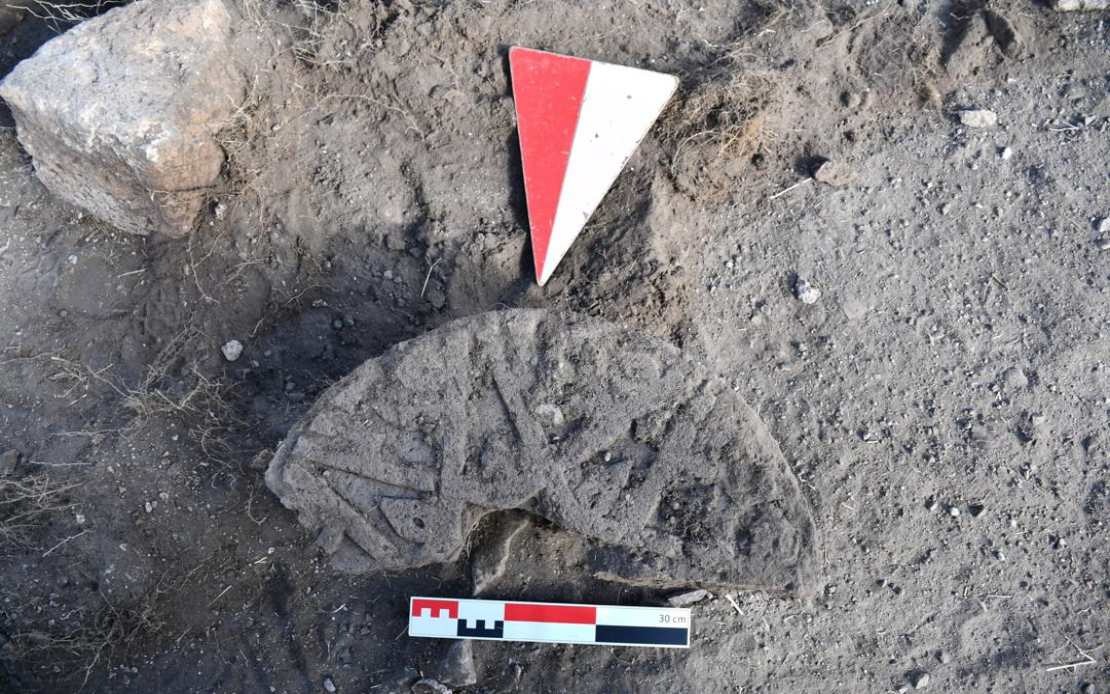
Turkish authorities have announced a significant archaeological find at the ancient site of Ani in eastern Türkiye: a stone artefact bearing multiple inscriptions of Prophet Muhammad's name. Culture and Tourism Minister Mehmet Nuri Ersoy shared details of the discovery on social media, indicating that the inscriptions appear in Kufic script, the angular style characteristic of early Islamic calligraphy that predates the more familiar rounded Arabic script. The artifact represents an important addition to understanding the religious and cultural dimensions of the region during the medieval Islamic period.
The inscribed name appears six times across the stone surface, with three of these instances forming part of an intricate decorative composition. According to Ersoy's account, the three inscriptions are skillfully carved into an ornamental band that encircles an eight-pointed star, a geometric pattern frequently employed in Islamic artistic traditions. This arrangement suggests the stone was created as a deliberate work of religious and artistic significance rather than as a casual or utilitarian object, pointing to the craftsmanship and devotional intent of its original creators.
Scholars believe the artifact originated from a Seljuk tomb tower, indicating its use in funerary architecture during the medieval Islamic period. The discovery came during systematic excavations at a Seljuk cemetery that has been the focus of archaeological study since 2021. This ongoing project has systematically uncovered layers of the site's history, with the recent find representing one of its most notable results to date. The cemetery itself represents a valuable window into burial practices, religious beliefs, and daily life during the Seljuk period.
Ani itself carries enormous historical weight in the broader narrative of the Eastern Mediterranean and Middle East. Situated in Kars province on the Turkish-Armenian border, this ancient city served as a vital junction along the legendary Silk Road, the network of trade routes connecting East and West. During the tenth and eleventh centuries, Ani functioned as the capital of the Bagratid Armenian kingdom, when it flourished as a centre of commerce, culture, and Christian learning. The city's strategic location meant it repeatedly changed hands, experiencing rule under Byzantine, Seljuk, and Ottoman powers across successive centuries.
The layering of different civilisations at Ani has created a palimpsest of architectural styles and cultural expressions. Earlier Armenian structures coexist with later Islamic additions, creating a complex archaeological landscape that requires careful interpretation and study. Each period of occupation left its mark through building techniques, artistic conventions, and religious monuments, making the site essentially a three-dimensional history book of the region. The recent discovery of Islamic inscriptions adds another chapter to this narrative, demonstrating the religious and cultural synthesis that occurred when new populations arrived in established centres.
International recognition came to Ani when it received designation as a UNESCO World Heritage Site in 2016. This acknowledgment reflected the site's outstanding universal value and its significance for understanding human cultural development. The UNESCO designation brought increased scholarly attention and resources to the site, enabling more systematic excavation and preservation efforts. For Malaysian and Southeast Asian audiences, Ani's importance lies partly in how it exemplifies the interconnectedness of medieval Asian trade networks—networks that extended through Central Asia and beyond, touching regions that eventually connected with Southeast Asian ports and kingdoms.
The discovery of the inscribed stone carries implications beyond its immediate archaeological value. In a region marked by historical complexities and contemporary sensitivities, the presence of Islamic inscriptions at Ani underscores the religious diversity and cultural layering that characterised medieval Anatolia. The artifact demonstrates that Islamic communities existed alongside Armenian Christian populations, leaving their own marks on the landscape. Understanding this coexistence through archaeological evidence provides a counterpoint to more reductive historical narratives that emphasise conflict over cultural exchange.
For heritage preservation efforts across the Muslim world and particularly in Southeast Asia, Ani's trajectory offers lessons about managing shared historical sites. The preservation of artefacts bearing Islamic religious content, whether discovered in Türkiye, Southeast Asia, or elsewhere, requires approaches sensitive to both scholarly rigour and religious significance. Museums and heritage institutions throughout the region increasingly grapple with similar challenges when displaying objects inscribed with Quranic verses or Prophet Muhammad's name, requiring careful consideration of conservation, interpretation, and community engagement.
The methodical excavation program at Ani's Seljuk cemetery illustrates how patient, systematic archaeological work yields discoveries. Rather than relying on chance finds, the ongoing project since 2021 represents a coordinated effort to understand a specific period and population. This approach has proven effective in uncovering not merely objects but contexts—information about how people were buried, what they valued enough to take into the afterlife, and what artistic and religious expressions mattered to them. Each season of excavation potentially adds nuance to existing historical understanding.
The Kufic script inscriptions deserve particular attention, as this writing system holds special significance in Islamic history and culture. Kufic script represents one of the earliest standardised forms of Arabic writing, employed widely from the seventh through twelfth centuries. Texts written in Kufic carry associations with the Islamic golden age and early Quranic manuscripts. The deliberate choice to carve Prophet Muhammad's name in Kufic script on a funerary monument indicates the creator's awareness of tradition and commitment to classical Islamic aesthetics, suggesting Ani maintained connections with broader Islamic cultural centres despite its distant geographical location.
The eastern Anatolian location of Ani adds geographical context to understanding Islamic cultural expression in medieval times. Kars province sits at the intersection of multiple cultural and political spheres, having been contested and controlled by various powers. Yet despite strategic vulnerabilities, cities like Ani sustained vibrant multicommunal societies where different religious and ethnic groups coexisted and influenced each other artistically and intellectually. The inscribed stone represents a fragment of this lost world, offering tangible evidence of how Islamic and Armenian cultures intersected in the urban fabric of medieval Anatolia.

