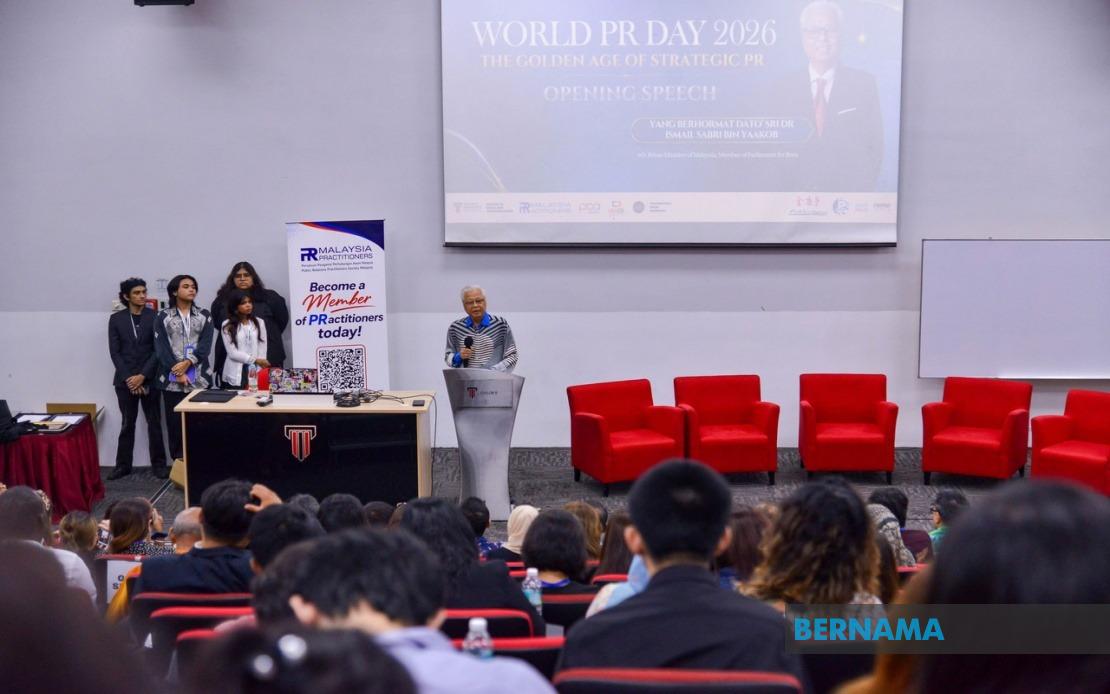
The landscape of organisational success has fundamentally shifted, according to former Prime Minister Datuk Seri Dr Ismail Sabri Yaakob, who argued that modern institutions can no longer rely solely on financial performance and operational achievements to maintain legitimacy. Speaking at the World PR Day 2026 launch at Taylor's University in Subang Jaya on July 16, Ismail Sabri presented a compelling thesis: the defining competitive advantage in the 21st century lies not in what organisations accomplish, but in their capacity to communicate those accomplishments—and crucially, their failures—with unwavering honesty and transparency.
The distinction between yesterday's and today's corporate environments, he suggested, mirrors the broader economic transformation Asia has experienced. Where the previous century prioritised production capacity and market share, contemporary organisations operate within an ecosystem where reputation and public confidence function as irreplaceable assets. In this context, the ability to maintain a social licence to operate depends fundamentally on demonstrating consistent alignment between stated values and actual conduct. This represents a challenging paradigm for both government and private sector leaders, particularly in Malaysia's rapidly evolving media landscape where institutional credibility has become increasingly contested.
Ismail Sabri drew extensively on his tenure as Prime Minister during the COVID-19 pandemic to illustrate this principle in practice. The relentless cycle of policy adjustments necessitated by an unprecedented public health emergency created an extraordinary communications challenge: explaining frequent modifications to standard operating procedures without undermining public confidence in government decision-making. His response—engaging directly with journalists on an almost daily basis to provide detailed, comprehensible explanations of epidemiological reasoning behind policy shifts—exemplified his conviction that transparency and accessibility during crisis periods strengthen rather than weaken institutional trust. This experience, he indicated, fundamentally altered his understanding of communication strategy from a peripheral function to a core pillar of effective governance.
The evolution of public relations as a discipline features prominently in his assessment of contemporary institutional challenges. Rather than occupying a subordinate position limited to message dissemination, modern PR practitioners have assumed strategic responsibilities encompassing narrative formation and reputational architecture. This expanded remit reflects the reality that how institutions communicate has become inseparable from what they ultimately achieve. The messenger, message, and medium now constitute integrated elements of organisational success rather than sequential stages in a traditional communications chain.
Yet Ismail Sabri's vision of integrity-driven communication confronts a paradoxical challenge: technological advancement simultaneously enables more effective communication while creating unprecedented obstacles to information credibility. The proliferation of artificial intelligence, deepfake technology, and algorithmically-amplified misinformation has fragmented the informational commons that underpins trust. Citizens navigating this landscape face mounting difficulty distinguishing authoritative information from sophisticated fabrication, a problem with particular implications for Malaysia's diverse, multilingual population where false narratives can rapidly metastasise across linguistic and cultural communities.
Recognising these systemic challenges, Ismail Sabri advocated for PR professionals to develop sophisticated proficiency with artificial intelligence tools—not to manipulate public sentiment, but to monitor and interpret genuine shifts in public opinion with greater precision. This recommendation reflects a nuanced understanding that technology itself is morally neutral; its trajectory depends entirely on the ethical frameworks guiding its application. PR practitioners equipped to harness AI for sentiment analysis while remaining grounded in humanistic values may thereby contribute to more responsive, accountable institutions.
The former Premier extended qualified support for government initiatives to establish an AI Governance Bill, framing legislative oversight of artificial intelligence not as restrictive bureaucracy but as necessary guardrails protecting democratic discourse. Digital ethics frameworks become essential when the tools for manufacturing credible-appearing falsehoods have become democratised and economically accessible to malevolent actors. In this context, regulatory measures targeting deepfake technology and false information dissemination represent defensive investments in information ecosystem integrity rather than government overreach.
For Malaysian and Southeast Asian organisations operating in increasingly globalised markets, Ismail Sabri's framework carries particular weight. Regional businesses operating across multiple jurisdictions with varying regulatory environments and media maturity levels face compounded complexity in maintaining consistent, integrity-driven communications. The reputational cost of communication failures—whether through inept crisis management, perceived opacity, or inconsistency between corporate statements and observable conduct—amplifies across social media platforms, international media coverage, and investor networks with unprecedented velocity.
The intersection of trust-based competition and digital transformation creates both existential risk and strategic opportunity for Malaysian institutions. Organisations that cultivate authentic, consistent communication practices anchored in demonstrated integrity may distinguish themselves in crowded competitive landscapes precisely because such authenticity has become increasingly rare. Conversely, institutions that attempt to exploit information asymmetries or manipulate public perception through misleading narratives face accelerating reputational collapse once detection inevitably occurs—and in the digital age, exposure typically follows detection within hours rather than weeks.
Ismail Sabri's emphasis on integrity as foundational to effective communication ultimately reflects a conviction that short-term tactical gains through deception exact unsustainable long-term costs. In an era where stakeholder expectations span environmental responsibility, social equity, corporate governance transparency, and authentic engagement on contentious issues, the communication strategy that resonates builds progressively deeper trust through demonstrated consistency. This philosophy challenges organisations to align operational decisions with public commitments rather than treating communication as a means to justify decisions made through opaque processes.
The implications for Malaysian public administration warrant particular consideration. Government institutions managing sensitive portfolios—from economic policy through healthcare to security matters—confront heightened public scepticism that reflects both legitimate accountability concerns and occasionally manufactured outrage amplified by coordinated misinformation campaigns. Applying Ismail Sabri's framework suggests that government communicators should prioritise clear, accessible explanation of policy reasoning, explicit acknowledgment of uncertainty where it exists, and willingness to acknowledge and correct errors. Such transparency, paradoxically, often strengthens institutional credibility more effectively than defensive deflection or information restrictions.
As Malaysia navigates complex transitions spanning economic restructuring, technological integration, and demographic change, the institutions best positioned to maintain public confidence and stakeholder support will likely be those embracing Ismail Sabri's core insight: that communication grounded in integrity represents not a constraint on strategic flexibility but rather the most reliable foundation for sustainable institutional legitimacy. The measure of organisational excellence in coming decades will increasingly depend less on the sophistication of messaging than on the authenticity of the values those messages reflect.

