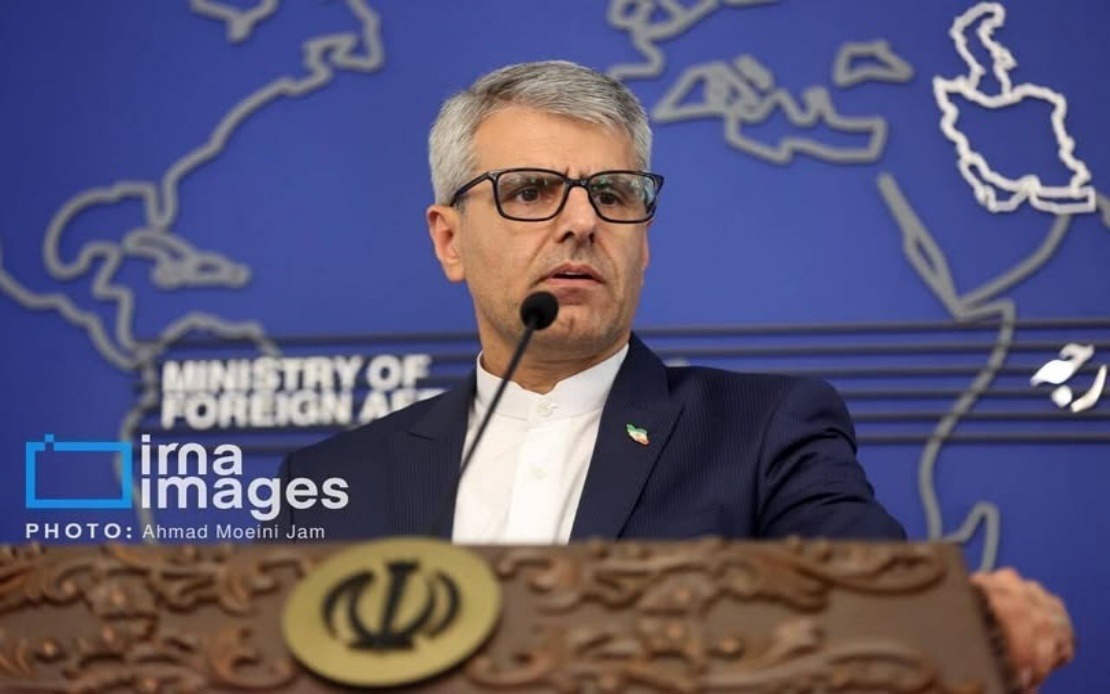
Iran has stepped up pressure on the United States to enforce a binding schedule for Israeli forces to vacate occupied Lebanese territories, marking a hardening of Tehran's negotiating stance in the wider Middle Eastern conflict. Speaking at a briefing in Istanbul on Sunday, Foreign Ministry spokesman Esmaeil Baqaei declared that ending Israeli military operations in Lebanon and the complete withdrawal of occupying forces from all Lebanese land constitute non-negotiable prerequisites for any durable accord aimed at restoring regional equilibrium. The intervention reflects Tehran's determination to leverage its recent agreements with Washington—including an April ceasefire understanding and a June 18 memorandum—to reshape the trajectory of the Lebanon conflict.
Baqaei's remarks underscore how Lebanon has become entwined with Iran's broader regional security calculations and its relationship with Washington. In his statement, the Foreign Ministry spokesman elevated the protection of Lebanese sovereignty and territorial integrity to the status of a cornerstone principle that cannot be compromised in any settlement. He further insisted that safeguarding what he characterised as the dignity and security of all Lebanese people represents an essential ingredient for any accord to prove viable over time. These demands signal that Tehran views the Lebanese question not as a peripheral concern but as intrinsically linked to Iran's own strategic interests and its credibility among regional allies.
The emphasis on an "unconditional" withdrawal carries particular weight in the context of protracted Middle Eastern negotiations, where conditional arrangements have historically unravelled. Baqaei specifically called for Washington to fulfil its obligations under the June memorandum and deploy whatever leverage necessary to compel Israel to cease military operations targeting Lebanese territories comprehensively. This formulation places direct responsibility on the United States to act as enforcer rather than merely as mediator, reflecting perhaps a frustration in Tehran with the pace and substance of implementation thus far. The demand for a swift determination of withdrawal timelines suggests Iranian impatience with open-ended diplomacy.
Parallel to these public statements, Iran's Parliament Speaker and chief negotiator Mohammad Bagher Qalibaf conveyed similar messaging through a phone conversation with Lebanese Parliament Speaker Nabih Berri. Qalibaf affirmed that Tehran remains engaged in "seriously pursuing" an end to hostilities in Lebanon, language designed to signal commitment while maintaining negotiating flexibility. According to Iranian media accounts of the exchange, Qalibaf identified the Lebanon conflict as one of the principal topics addressed during recent talks between Iranian and American delegations in Switzerland, emphasising its prominence on Tehran's diplomatic agenda.
The resolution of the Lebanon question has emerged as a defining feature of what Iran refers to as the Islamabad memorandum—the broader 14-point understanding that resulted from weeks of military escalations and diplomatic wrangling across the region. Qalibaf indicated that ending the Lebanon war and restoring the country's sovereignty and territorial integrity constitute the opening and central clause of this framework agreement. This structural positioning suggests that Iran regards successful implementation on Lebanon as a prerequisite for progress on other contentious issues embedded within the memorandum.
When Iran raised objections regarding alleged violations of the Lebanon provisions, negotiators agreed to establish a conflict-control unit comprising representatives from Iran, the United States, and Lebanon specifically tasked with monitoring implementation. This tri-partite mechanism appears designed to translate diplomatic commitments into concrete supervisory mechanisms, with each party having a stake in ensuring the others honour their undertakings. The creation of such oversight mechanisms typically signals that initial understandings lack sufficient confidence to proceed without structured verification.
Qalibaf articulated Iran's immediate objectives with clarity: ending the war in Lebanon, facilitating the return of displaced populations to their homes, terminating occupation, and securing the withdrawal of what Iranian officials consistently term the Zionist regime from Lebanese territory. This constellation of goals reflects both humanitarian concerns and strategic calculations about the regional balance of power. The focus on displaced persons appeals to broader Arab sympathies while grounding Iranian demands in ostensibly humanitarian rather than purely geopolitical terms. For Malaysian readers and others in the non-aligned world, this rhetorical framing matters considerably in how the dispute is perceived beyond the region.
The broader context involves months of escalating military tensions punctuated by diplomatic breakthroughs that remain fragile and conditional. The April ceasefire understanding and the subsequent June 18 memorandum represent attempts to de-escalate but have not generated the sustained trust necessary for comprehensive settlement. Iran's repeated insertion of Lebanon-related demands into these successive agreements suggests either that previous understandings lacked enforcement mechanisms or that circumstances on the ground have continued to deteriorate despite diplomatic progress.
For Southeast Asian observers, the Iran-US negotiation dynamics carry implications for regional stability more broadly. Any successful model for managing great power tensions through structured agreements could offer lessons for managing disputes in contested waters or between rival claimants elsewhere. Conversely, the apparent difficulty in implementing even agreed-upon frameworks in the Middle East illustrates the challenges inherent in converting diplomatic language into binding behavioral change. Iran's insistence on establishing a three-party monitoring mechanism may prove instructive for regional arrangements in Asia.
The positioning of Lebanon as a litmus test for the entire memorandum suggests that Iranian negotiators view the issue as a bellwether for American commitment and Israeli compliance with broader understandings. Should Washington prove unable or unwilling to enforce Israeli withdrawal according to a specified timetable, Iran would have grounds to claim that the entire 14-point framework lacks credibility. This dynamic creates a potential breaking point for the entire agreement architecture, with Lebanon effectively serving as the critical test case.
Moving forward, the demand for a swift determination of withdrawal timelines will likely become a focal point in ongoing US-Iran discussions and Israeli-American negotiations. The intransigence of all three parties on their respective core demands—Iran insisting on unconditional Israeli withdrawal, Israel maintaining security prerogatives, and America attempting to broker a sustainable compromise—suggests that achieving consensus on specific timelines will present formidable obstacles. The creation of the conflict-control unit offers one mechanism for managing such disputes, but whether it possesses sufficient authority and resources remains to be seen.
The Iranian statements also reveal a calculated effort to internationalise the Lebanon issue by framing it not as a bilateral Israeli-Hezbollah matter but as a regional question requiring structured international management. By invoking American responsibility and Lebanese sovereignty while positioning itself as a concerned neighbour, Iran attempts to shift the narrative away from discussions of Iranian military support for Lebanese factions toward a more abstract emphasis on territorial integrity and self-determination. This reframing seeks to claim the moral high ground in regional discourse.

