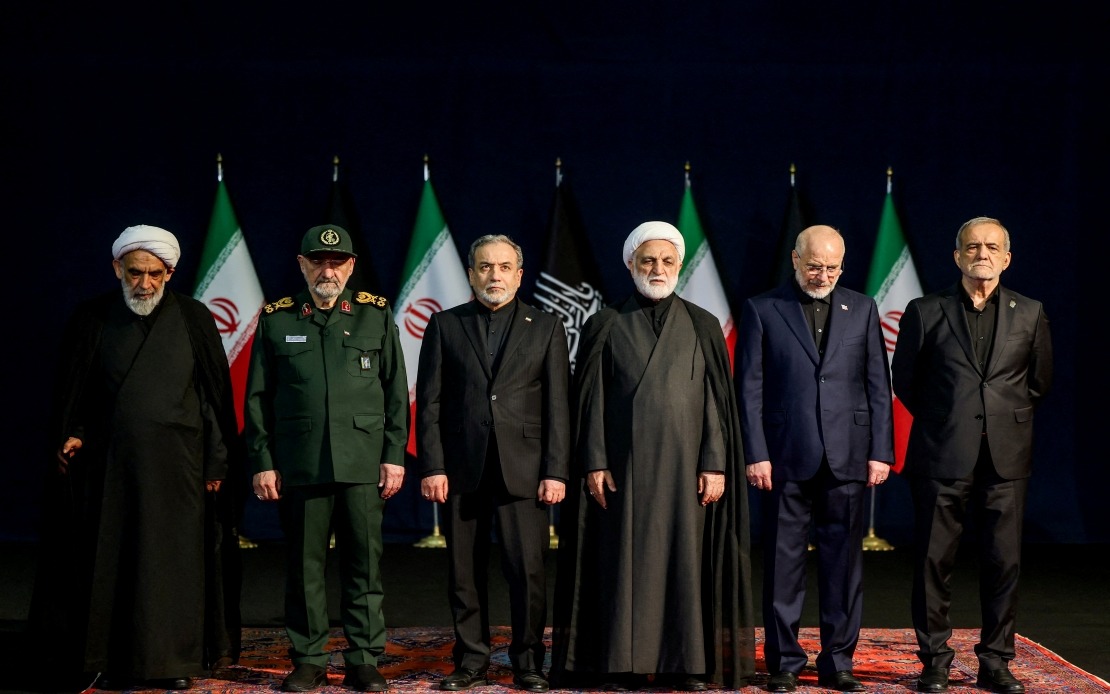
Iran's leadership and international dignitaries converged on Tehran on Friday to pay formal tributes to the country's deceased Supreme Leader Ayatollah Ali Khamenei at an elaborate state ceremony, marking a significant moment in Iranian political transition and regional diplomacy. The occasion brought together a carefully curated gathering that underscored both Iran's internal power consolidation and its strategic relationships across the Middle East and beyond, reflecting the geopolitical weight that succession in Tehran carries for the wider region.
The ceremony unfolded throughout the day at Imam Khomeini's Mosalla prayer hall situated in central Tehran, drawing the nation's most powerful figures. Iran's President Masoud Pezeshkian appeared alongside the Speaker of Parliament Mohammad Baqer Qalibaf, the Judiciary Chief Gholamhossein Mohseni-Ejei, and Sadeq Amoli Larijani, who heads the Expediency Discernment Council. This gathering of Iran's institutional leadership demonstrated a unified front during a period that traditionally presents vulnerabilities in authoritarian systems—the succession moment.
The international attendance list revealed the extent to which Khamenei's death reverberated across Iran's sphere of influence. Pakistan's Prime Minister Shehbaz Sharif journeyed to Tehran with Field Marshal Syed Asim Munir, the Chief of Army Staff, signalling Pakistan's commitment to maintaining ties with Iran despite complex bilateral relations. Armenian Prime Minister Nikol Pashinyan and Georgian President Mikheil Kavelashvili travelled from the Caucasus, while Iraq's President Nizar Amedi and the President of Iraq's Kurdistan Region Nechirvan Barzani attended alongside Tajik President Emomali Rahmon. Senior delegations from both China and Russia, Iran's most strategically important partners, were also present, though specific names were not disclosed in initial reports.
The breadth of this gathering illuminates Iran's positioning as a significant regional actor whose internal transitions matter to states across the Middle East, Central Asia, and the broader international system. For Malaysian observers, the attendance of China and Russia alongside Middle Eastern states demonstrates how Iran occupies a unique intersection of regional and global power dynamics. The presence of these delegations suggests continuity in Iran's foreign relationships despite the leadership transition, a factor that influences stability calculations across the Gulf and beyond.
Beyond political officials, the ceremony also accommodated religious scholars, tribal leaders, and other figures from Iran's layered institutional hierarchy. This inclusivity reflects the importance of building consensus around the succession process within Iran's complex religio-political system, where legitimacy requires acknowledgment from multiple power centres rather than deriving solely from formal state structures.
Khamenei's death on February 28 resulted from what Iranian authorities attributed to a joint United States and Israeli military strike in Tehran, an event that immediately elevated regional tensions and prompted swift decisions about succession. Rather than allow an extended period of uncertainty, Iran's leadership acted decisively in March to appoint Mojtaba Khamenei, the late Supreme Leader's son, as his successor. This continuation of leadership within the same family, while not unprecedented in revolutionary systems, nevertheless represented a significant choice about institutional identity and continuity.
The extended funeral arrangements, scheduled to continue through July 9, encompassed multiple locations of symbolic importance: processions in Tehran, Qom, and Mashhad—three cities central to Iran's Shia religious identity—with additional commemorative rites planned in Iraq, reflecting Iran's spiritual influence within Iraq's Shia population. Iranian authorities implemented public closures and airspace restrictions in Tehran and Mashhad during key dates, with Thursday formally designated as a national day of mourning. Such measures underscore both the ceremonial gravity surrounding the succession and the potential security sensitivities accompanying any gathering of prominent international figures in Tehran.
For Southeast Asian observers, particularly those in Malaysia with substantial trading relationships with Iran, the succession process carries implications for predictability and continuity in bilateral engagement. Iran's strategic importance to global oil markets and its role in regional conflicts that affect energy prices and security architecture make its internal stability a matter of indirect concern to nations far from the Middle East. The apparent smooth transition to Mojtaba Khamenei, reinforced by the international acknowledgment demonstrated through this high-level attendance, suggests that Iran's leadership seeks to project stability during a transition period.
The attendance of Pakistan's senior military and civilian leadership warrants particular attention given Pakistan's delicate balancing act between its relationships with Saudi Arabia and Iran, the region's two primary competing powers. Shehbaz Sharif's personal appearance alongside the Chief of Army Staff suggests Islamabad's desire to maintain working relationships across the Iranian political transition. Similarly, the presence of the Iraqi president and the Kurdistan Regional Government's leader indicates that despite the complex sectarian dynamics within Iraq and its neighbourhood, key stakeholders recognise the necessity of engaging with Iran's new leadership structure.
The ceremony ultimately functioned as both a genuine religious and state tribute and a carefully orchestrated demonstration of continuity and legitimacy for Iran's new Supreme Leader. The international delegations, arriving from countries with vastly different political systems and ideological orientations, implicitly acknowledged Iran's position as a state with whom accommodation remains necessary despite policy disagreements. For regional stability and Malaysia's interests in maintaining predictable relationships with Middle Eastern partners, the apparent cohesion among Iran's domestic power structures and the international acceptance of its leadership transition suggest a period of reduced uncertainty in the coming months, though longer-term implications will depend on how Mojtaba Khamenei consolidates authority and charts the nation's strategic course.

