Malaysia has launched the International Regulatory Conference 2026 as a pivotal moment for the country to calibrate its approach to digital governance, bringing together regional and international stakeholders to address the intersection of rapid technological change, artificial intelligence proliferation, and the mounting complexities of protecting vulnerable internet users. The two-day gathering, hosted by the Malaysian Communications and Multimedia Commission in Kuala Lumpur, operates under the overarching theme 'Shaping the Next Digital Era: Regulation, Resilience and Trust,' reflecting a deliberate strategy to position Malaysia as a thoughtful regulator navigating the tension between innovation and safeguarding.
Communications Minister Datuk Seri Fahmi Fadzil will formally open the conference, signalling the high political priority accorded to digital regulatory matters in the country's broader governance agenda. The formal proceedings commence with MCMC Commission member Derek John Fernandez delivering the keynote address, establishing the intellectual foundation for discussions that will span child protection, data rights, quantum technology, and artificial intelligence ethics across the two-day schedule.
The conference's opening substantive session tackles online safety through an examination of platform accountability and child protection in digital environments where traditional safeguards often prove inadequate. Moderated by MCMC deputy managing director Eneng Faridah Iskandar, this dialogue brings together the Human Rights Commission of Malaysia's children's commissioner Dr Farah Nini Dusuki, United Nations Children's Fund Malaysia's child protection chief Saskia Blume, and Australian High Commissioner Danielle Heinecke to examine how digital platforms can embed safety mechanisms from their design phase rather than retrofitting protections after harm occurs. This approach reflects a fundamental shift in thinking about online safety—moving from reactive enforcement toward proactive architectural safeguards that acknowledge children's particular vulnerabilities in spaces designed primarily for adult engagement.
A parallel session explores data sovereignty and consumer privacy as Malaysia accelerates its transition toward a genuine digital economy where data represents both economic opportunity and privacy risk. This discussion, stewarded by MCMC's chief of National Sovereign AI Cloud Che Juhan Che Mat, features perspectives from telecommunications and technology sectors including Maxis, T&G Digital, and Ericsson, alongside security specialists. The inclusion of corporate voices alongside regulatory perspectives reflects recognition that Malaysia's regulatory framework cannot succeed through government mandate alone—industry commitment to privacy standards and data stewardship proves essential for meaningful implementation.
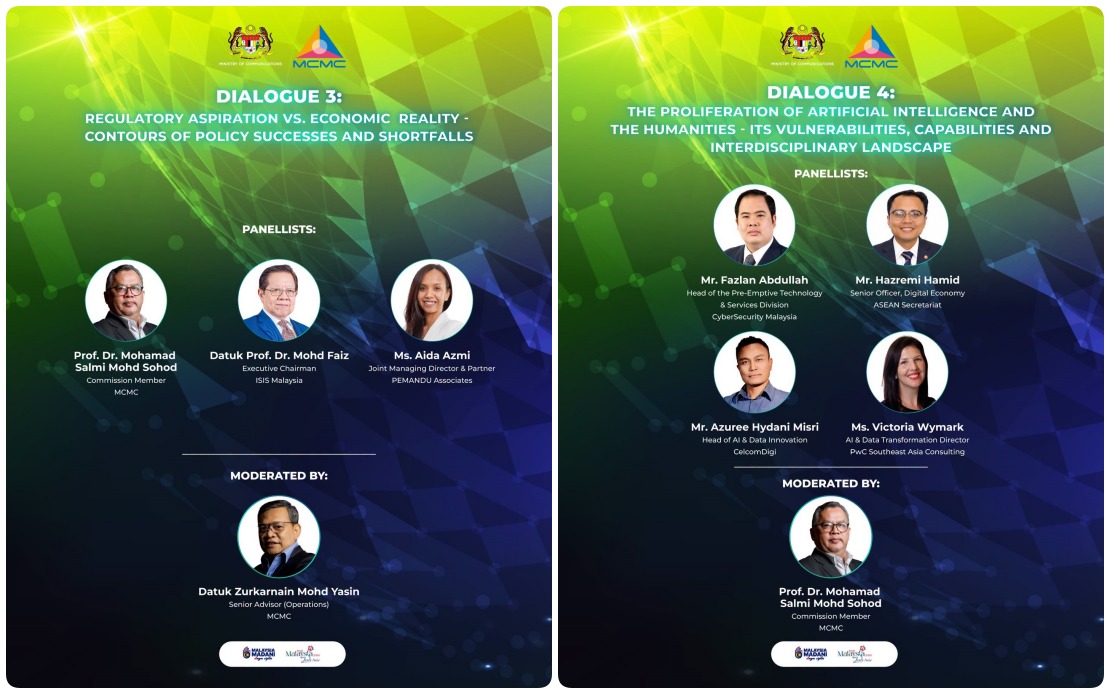
The afternoon discourse examines the persistent friction between regulatory ambition and economic reality, acknowledging that overly restrictive frameworks risk driving innovation and digital services offshore while insufficient regulation leaves Malaysians vulnerable to exploitation and harm. Think tanks including the Institute of Strategic and International Studies Malaysia and PEMANDU Associates contribute analysis drawn from years of monitoring policy implementation globally, offering evidence-based guidance on which regulatory interventions achieve intended outcomes and which impose costs without corresponding benefits. This pragmatic orientation distinguishes Malaysia's approach from purely ideological positions either romanticising technology or demonising it.
The first day concludes with examination of artificial intelligence's societal implications through a multidisciplinary lens that moves beyond technology toward understanding AI's effects on human agency, knowledge production, and social relationships. Bringing together voices from the ASEAN Secretariat, PwC Southeast Asia, Malaysian universities, and cybersecurity specialists, this session acknowledges that effective AI governance requires input from humanities and social sciences disciplines alongside engineering expertise. This intellectual pluralism proves particularly important in Southeast Asia where cultural contexts, development priorities, and institutional capacities differ significantly from Western democracies where much AI governance thinking originated.
The conference's second day pivots toward emerging technologies that will shape Malaysia's regulatory environment in coming years, beginning with quantum computing's implications for communication architecture and cybersecurity. Sessions bring together IBM's quantum technology leadership, with Malaysian universities including Universiti Teknologi Malaysia, Universiti Malaya, and Universiti Kebangsaan Malaysia contributing academic perspectives on quantum applications and governance challenges. This forward-looking orientation reflects Malaysia's determination to participate in technological development rather than merely adapting to changes dictated by foreign technology leaders.
Robotics regulation emerges as another frontier concern, requiring cross-sector coordination among manufacturing, automotive, healthcare, and labour agencies to establish liability frameworks, safety standards, and workforce transition protections. The conference's inclusion of robotics governance alongside quantum technology and artificial intelligence demonstrates sophisticated understanding that Malaysia's regulatory challenges extend across multiple emerging technological domains simultaneously, requiring integrated rather than siloed policy development. Similarly, discussions of digital dependency and mental wellbeing acknowledge that Malaysia, like other Southeast Asian nations, faces distinctive challenges as rapidly increasing digital adoption intersects with concerns about screen addiction, misinformation exposure, and knowledge integrity erosion.
The IRC 2026 represents Malaysia's third iteration of this biennial conference since its 2024 inception, reflecting institutional commitment to building cumulative expertise in digital governance. Notably, the conference timeline coincides with implementation of the Online Safety Act 2025, which became enforceable on January 1, demonstrating how Malaysia's regulatory framework continues evolving in real-time. The ONSA represents Southeast Asia's most comprehensive statutory approach to platform accountability, content moderation, and user protection, positioning Malaysia as a potential model for regional neighbours developing their own digital governance architecture.
The gathering has attracted participants from over seven countries representing regulators, policymakers, and industry representatives, creating a forum where Malaysia can both learn from international experience and share locally-developed solutions with peers navigating similar technological disruption. Deputy Communications Minister Teo Nie Ching will formally close the conference on the second afternoon, providing opportunity for summarising emerging consensus and identifying areas requiring further policy development. This structured engagement with international peers reflects recognition that digital governance challenges transcend national boundaries—data flows, platform dominance, artificial intelligence development, and cybersecurity threats all manifest regional and global dimensions requiring coordinated responses rather than isolated national policy-making.

