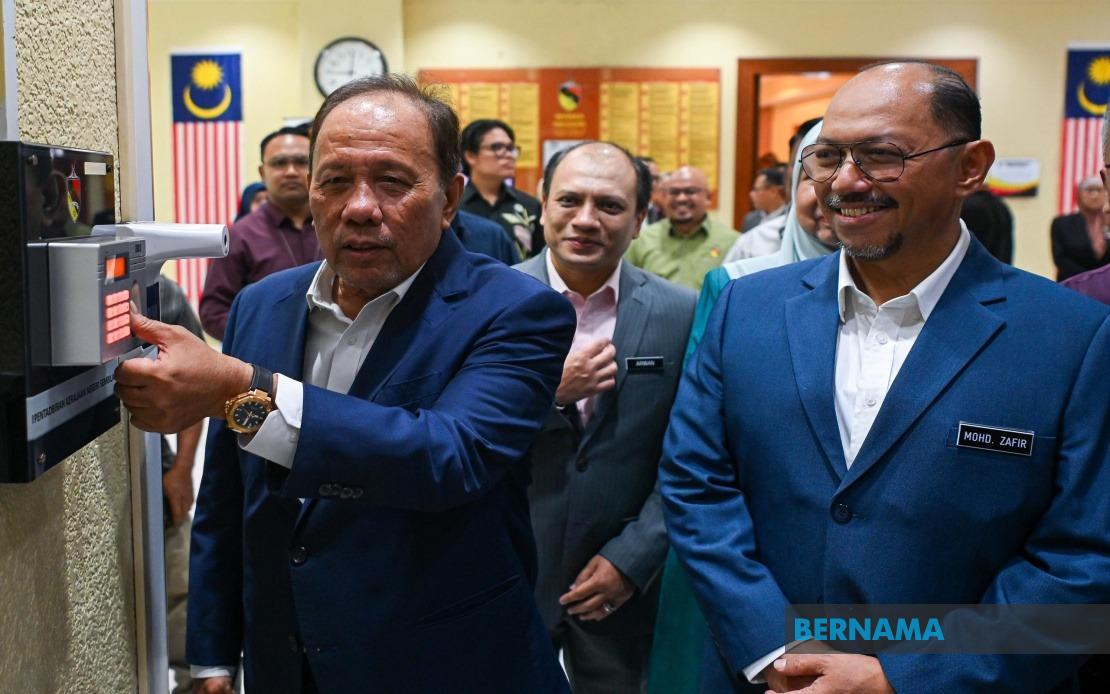
Datuk Ismail Lasim has moved to defend his appointment as Negeri Sembilan Menteri Besar, insisting that the process followed all prescribed constitutional and procedural requirements with no irregularities. The new state leader made the assertion in Seremban after beginning his official duties at Wisma Negeri, directly addressing concerns that had been publicly raised about how the appointment was handled.
The appointment process became a focal point of discussion after Tan Sri Rais Yatim, chairman of Wawasan, questioned whether proper procedures had been followed. Rais Yatim's remarks included allegations that external interference may have played a role in decisions affecting Negeri Sembilan's governance structure and constitutional framework, matters ordinarily reserved for state-level decision-making. These suggestions had sparked commentary about whether the transition of power was executed with full adherence to established norms.
Ismail, who secured the Juasseh state seat during the recent Negeri Sembilan state election, was formally sworn in as Menteri Besar before Yang Dipertuan Besar of Negeri Sembilan Tuanku Muhriz Tuanku Munawir at Istana Besar Seri Menanti the preceding Sunday. The ceremonial aspect of the appointment was completed in proper royal protocol, positioning the leadership transition within Malaysia's constitutional framework where state rulers retain significant authority over such appointments.
The electoral outcome that preceded Ismail's appointment provided a substantial mandate for state governance. Barisan Nasional emerged as the dominant coalition, winning 18 of the 36 state assembly seats in the election, while Perikatan Nasional captured seven seats. This distribution meant that either coalition individually, or potentially in concert, possessed sufficient numbers to command two-thirds majorities in the state legislature, a threshold that carries significant parliamentary power for advancing legislation and constitutional matters at the state level.
Ismail's defense of the appointment process comes amid broader conversations across Malaysia about political transitions and whether such changes reflect genuine democratic outcomes or involve behind-the-scenes negotiations that circumvent expected procedures. For Negeri Sembilan specifically, the appointment of a new Menteri Besar carries particular significance given the state's position within the national political landscape and its constitutional standing as one of Malaysia's component states with a reigning ruler.
The emphasis on proper procedure by the newly appointed Menteri Besar reflects a standard practice among leaders seeking to establish legitimacy and public confidence in their administration. By publicly affirming that constitutional protocols were observed, Ismail aims to inoculate his government against claims of illegitimacy or irregular conduct that might otherwise undermine its authority or credibility with state constituencies and federal counterparts.
The timing of Ismail's remarks also speaks to the importance of institutional confidence in Malaysia's federal structure. Negeri Sembilan, while not among the most populous states, maintains political significance within the broader Barisan Nasional coalition framework and holds strategic importance in peninsular Malaysian politics. Any appearance of procedural irregularity at the state level can reverberate through national political discourse and affect broader perceptions of governance quality.
The reference to Tan Sri Rais Yatim's Wawasan organization indicates that civil society voices continue to scrutinize state-level political appointments, reflecting the growing expectation among Malaysian observers that governance transitions should withstand public examination. This underscores a broader democratic maturation where even established institutional decisions face questioning from independent voices and commentators.
For Malaysian readers and particularly those in Negeri Sembilan, the central question underlying these discussions concerns whether political appointments and state governance follow transparent, constitutionally sound procedures or involve informal arrangements that bypass established norms. Ismail's defense directly addresses this concern, staking his administration's credibility on the assertion that his appointment reflected proper constitutional process rather than political expediency or external pressure.
Moving forward, the effectiveness of Ismail's administration will likely depend not only on the legitimacy of his appointment but also on substantive governance outcomes. The two-thirds majority available to the ruling coalition provides a workable foundation for policy implementation, though the political environment in Negeri Sembilan may require careful coalition management and attention to regional stakeholder concerns to maintain stability and public confidence in the new state government.

