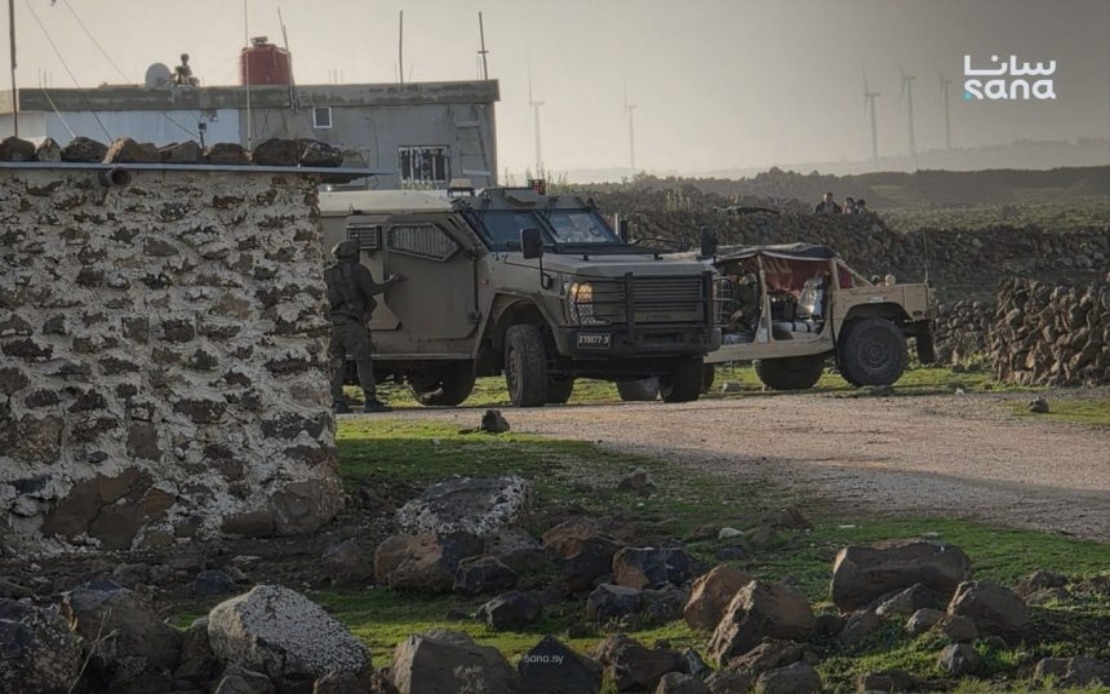
An Israeli military contingent comprising six vehicles penetrated into Syria's southwestern Quneitra province on Saturday, according to reports from the Syrian Arab News Agency (SANA). The deployment advanced toward the Kudna Dam in the central countryside of the province while unmanned aircraft provided aerial coverage of the operation. The movement represents the latest in a series of cross-border operations that have characterised Israeli military activity in southern Syria over recent months.
The Quneitra province, strategically located along the Israeli-Syrian border, has emerged as a focal point for military tensions following the dramatic geopolitical shift that swept across the region. The province's proximity to Israeli territory and its significance as a buffer zone have made it a recurring flashpoint for bilateral disputes. The Saturday incursion underscores the persistent military engagement in this contested area, despite international calls for restraint and respect for Syrian territorial integrity.
Israeli military operations in southern Syria have escalated markedly since December 2024, when the collapse of Bashar al-Assad's regime fundamentally altered the security architecture of the region. With the fall of the previous Syrian government, Israel formally announced the termination of the 1974 disengagement agreement, the longstanding international accord that had established demilitarised buffer zones and governed military positioning along the border. This declaration effectively freed Israeli forces from the constraints of the agreement and signalled a more assertive military posture in the region.
Since that pivotal moment, the frequency and scope of Israeli military activity have intensified substantially. Southern Syria has experienced recurring incursions that extend beyond mere border crossings to encompass active raids, systematic searches, civilian arrests, and the establishment of military checkpoints throughout the territory. These operations suggest a deliberate strategy to maintain security dominance over the region and establish control mechanisms over the newly destabilised Syrian landscape. The pattern of activity indicates that Israeli security planners view the post-Assad environment as requiring direct military intervention to safeguard Israeli interests.
The use of drone surveillance accompanying ground forces represents a modern approach to border security operations, combining manned and unmanned assets for comprehensive area coverage. Drones provide real-time intelligence, reconnaissance capabilities, and the potential for rapid response to perceived threats. Their deployment alongside ground vehicles indicates a coordinated military operation with multiple layers of capability, rather than a simple border patrol or limited incursion.
For Malaysia and other Southeast Asian nations with interests in regional stability, these developments carry significant implications. The violation of Syrian territorial sovereignty, regardless of the domestic political circumstances, establishes precedents for military intervention across borders that concern nations mindful of international law and the principle of non-interference. The situation demonstrates how the collapse of a government can create security vacuums that larger regional powers exploit to advance their strategic interests, a dynamic with potential relevance to other fragile states and geopolitical hotspots globally.
The international community's response to these repeated violations has been muted, reflecting the complex diplomatic environment surrounding Syria's civil conflict and international engagement. However, the systematic nature of the operations and their continuation despite international protocols suggest that Israeli security calculations outweigh diplomatic considerations in determining policy. This calculus reflects broader Middle Eastern dynamics where perceived existential security threats often override commitments to international agreements and territorial respect.
The impact on Syrian civilians and the stability of the transitional government cannot be overlooked. With Syria's state institutions already weakened by years of civil conflict and the recent regime collapse, the country faces challenges in reasserting control over its borders and territorial waters. The Israeli military operations effectively challenge the nascent Syrian authority's capacity to maintain sovereignty, creating additional obstacles to the stabilisation process that the international community hopes will unfold in the post-Assad period.
The Kudna Dam, toward which the Israeli vehicles advanced, holds economic and strategic significance for the region. Control over or access to critical infrastructure such as dams provides leverage over water resources and electrical generation capacity, matters of profound importance in the arid Middle Eastern environment. The specific targeting of this location suggests that Israeli operations are calculated to achieve objectives beyond simple security enforcement, potentially establishing presence over critical facilities that could influence regional power dynamics.
Looking forward, the trajectory of Israeli military activity in southern Syria will significantly shape the emerging regional order. If these incursions continue unchecked, they may establish a new normal of military occupation and intervention that subsequent Syrian governments must navigate. Conversely, if international pressure or changing circumstances constrain these operations, it could signal a different approach to border security and respect for sovereignty. The coming months will likely prove decisive in determining which trajectory prevails and how the international community will respond to this assertion of military dominance.

