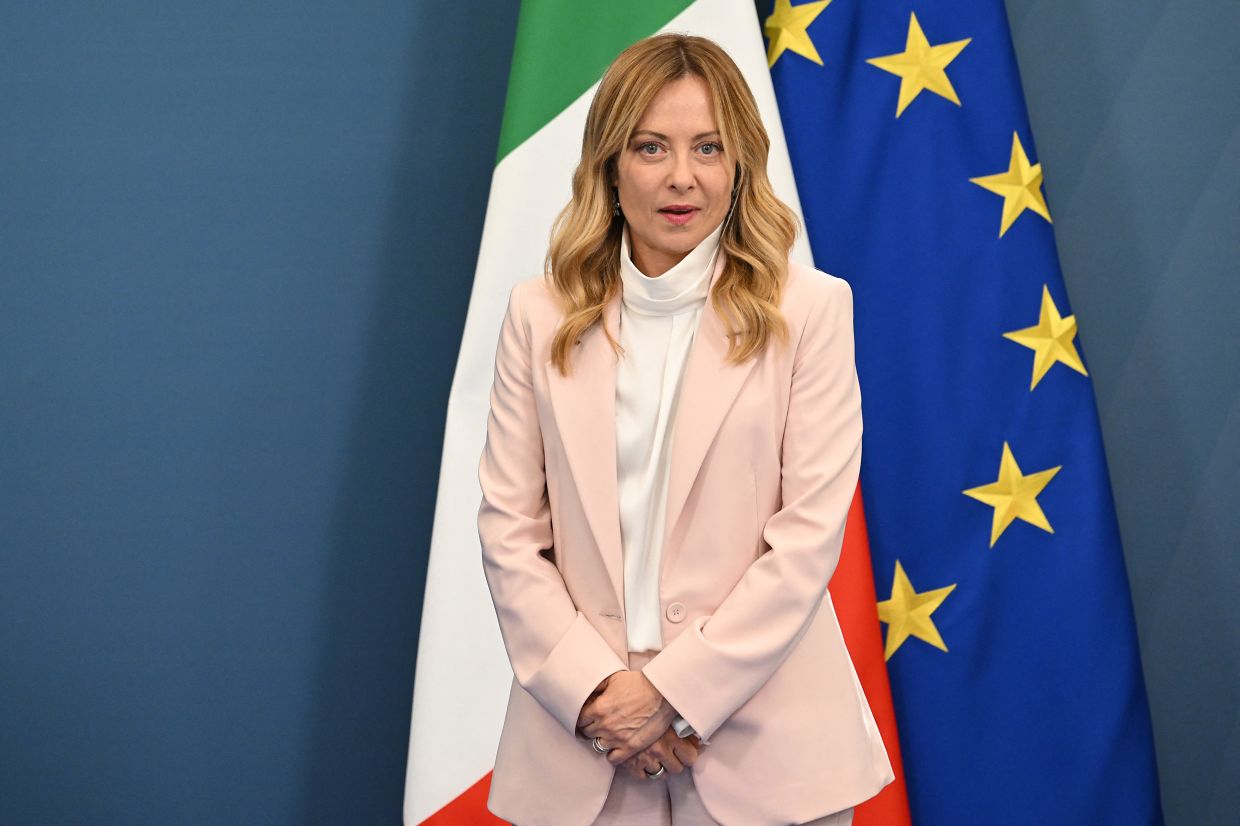
Italy's Prime Minister Giorgia Meloni has undergone a striking wardrobe transformation that reflects her metamorphosis from combative populist firebrand into an establishment leader navigating the complexities of governing Europe's third-largest economy. What she wears has become a calculated element of her political image, signalling a fundamental shift in how she presents herself to both domestic voters and the international community. The evolution from dark suits and clunky boots to pastel-coloured ensembles with flowing wide-legged trousers demonstrates how carefully curated appearance can reinforce—or reshape—political messaging, particularly for female leaders operating in a historically male-dominated sphere.
When Meloni assumed office in October 2022, her sartorial choices reflected her insurgent status. The austere dark suit and heavy black footwear represented a visual announcement of her emergence from Italy's right-wing political periphery, a deliberate aesthetic statement that aligned with her party's confrontational rhetoric and her reputation as an uncompromising voice against establishment politics. These choices echoed her past as a young activist, when she had been documented in 1996 entirely clad in black while organising right-wing youth movement members, a period when she had controversially defended Benito Mussolini—comments that have lingered over her political trajectory. The visual continuity between her activist days and her early tenure suggested a leader unbothered by convention or reassurance.
Yet as Meloni has consolidated power and positioned Italy as a pragmatic European voice rather than a destabilising force, her appearance has shifted correspondingly. Fashion experts and political analysts observe that her current preference for pastel suits and concealed heels projects what they describe as softer authority—a visual language that communicates competence and seriousness without the confrontational edge that once defined her image. Antonio Mancinelli, an instructor at Rome's Costume and Fashion Academy, notes that Meloni clearly grasps the importance of nonverbal communication through clothing in political contexts. This understanding reflects a sophisticated recognition that her audience has expanded from a niche right-wing electorate to encompass the broader Italian population and international allies who require reassurance that her government operates within democratic and institutional norms.
The timing of this sartorial evolution coincides directly with Meloni's political repositioning. Shortly after assuming office, she began adopting tailored suits in muted tones, a shift that fashion critics interpreted as signalling both elegance and seriousness while simultaneously conveying approachability—crucial qualities for a female leader seeking to appear credible on the global stage. The psychology behind lighter colours in fashion carries particular weight. Michela Bonafoni, who teaches fashion at Unicollege in Florence, explains that pastels and lighter shades suggest loyalty, tenderness and gentleness, qualities that make a leader appear more welcoming and less threatening. For Meloni, whose party emerged from post-fascist roots and whose own early career included problematic associations, such visual softening carries strategic significance in European political contexts where historical shadows loom large.
Meloni's wardrobe choices must be understood against the backdrop of her genuine political evolution, which has surprised many observers who anticipated far more radical governance. While maintaining strongly conservative domestic policies, particularly on immigration, she has surprised critics by adopting pragmatic approaches toward the European Union and positioning Italy as one of Ukraine's staunchest supporters in its conflict with Russia. She has even demonstrated willingness to publicly challenge American President Donald Trump, actions that have garnered respect from European allies who feared her election would destabilise Western institutions. This genuine moderation lends credibility to her visual rebranding—she is not simply adopting a softer aesthetic while maintaining radical positions, but rather aligning appearance with substantive policy shifts.
The political calculation underlying her fashion evolution becomes clearer when examined through the lens of audience transformation. As political analyst Riccardo Alcaro of Italy's Institute for International Affairs observes, when Meloni led a small right-wing party, she needed to relate only to a circumscribed electorate with specific ideological commitments. Now as the premier of a major European Union nation, she must project an image of credible governance capable of engaging in serious policy debates with international partners. The dark, intimidating aesthetic that once signalled her rejection of establishment norms now works against her need to be perceived as a reliable European leader. Her softer wardrobe choices therefore serve a functional diplomatic purpose, distinguishing her current role from her oppositional past.
The significance of Meloni's fashion choices carries particular weight because she leads a nation famous globally for its fashion heritage and design industry, which represents one of Italy's economic pillars. Stella Jean, an Italian-Haitian fashion designer, emphasises that when a woman representing a fashion superpower makes deliberate wardrobe choices, the stakes extend beyond typical political communication. Italian fashion carries enormous cultural weight internationally, and Meloni's decisions about what she wears inevitably become statements about Italian identity, aesthetics, and values. Her pivot toward elegant pastels and sophisticated tailoring potentially signals Italian fashion's capacity to convey refinement and approachability rather than provocation—a message that resonates beyond politics into broader cultural and commercial spheres.
Meloni's transformation also reflects broader patterns among world leaders who employ wardrobe as political messaging. Ukrainian President Volodymyr Zelenskyy has maintained military-style clothing since Russia's 2022 invasion, visually communicating his role as wartime leader and soldier-president. British Labour leader Andy Burnham deliberately wears jeans and t-shirts to project identification with working-class constituents and accessibility. Mexican President Claudia Sheinbaum incorporates Indigenous-embroidered garments to honour textile traditions and connect with indigenous communities. Yet Meloni's case carries unique complexity because her visual repositioning must simultaneously distance her from fascist historical associations while establishing credibility as a serious European leader—a double burden that male politicians generally do not face.
Remarkably, Meloni's office has declined to comment publicly about her wardrobe or whether she receives formal fashion advice, treating sartorial choices as beneath the threshold of official communication. This silence itself is telling, suggesting either that wardrobe decisions are treated as personal matters entirely separate from governance, or that openly acknowledging the strategic dimension of appearance might undermine the naturalness that makes such communications effective. The lack of transparency stands in contrast to the evident intentionality behind her aesthetic evolution, which has been observed and analysed by fashion professionals and political observers across multiple contexts.
As Meloni enters the final year of her mandate as premier, facing growing challenges from rival right-wing politicians seeking to position themselves as more authentically aligned with earlier versions of her ideology, her softer aesthetic serves as a visual marker of the distance she has travelled from her origins. The competition for leadership within Italy's right-wing political space may highlight contradictions between her moderated governance and the more radical positions some within her coalition continue to advocate. Regardless of what she wears, however, those tensions will persist. Her wardrobe choices cannot obscure the genuine political evolution she has undergone, nor resolve the fundamental question of whether her transformation represents authentic ideological development or strategic repositioning. What her appearance has accomplished is to provide visual language that supports her preferred narrative—that she has matured from an outsider into a capable, pragmatic leader worthy of continued trust.

