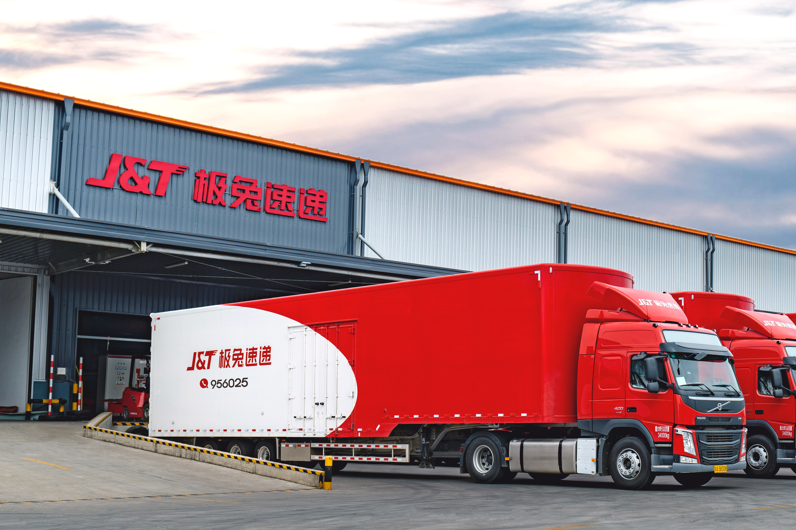
Hong Kong-listed logistics giant J&T Global Express Ltd has reached a pivotal moment in its operational history, becoming the first time its average daily parcel volume has exceeded 100 million units, reflecting the company's aggressive pivot toward international markets and deepening integration across Southeast Asia's rapidly expanding digital economy. The milestone caps a transformative second quarter during which the firm processed 9.18 billion parcels across its global network, demonstrating both the scale of its operations and the accelerating demand for last-mile delivery services throughout the region.
The company's overall quarterly performance underscores the persistent appetite for express logistics across Asia-Pacific, with total parcel volumes climbing 24.2 percent compared to the same period last year. More significantly, however, parcels handled outside China—traditionally the company's home market—surged 66.9 percent to reach 2.97 billion units, now representing nearly one-third of J&T's global throughput. This structural shift signals a fundamental rebalancing of the company's revenue streams away from China's increasingly saturated market and toward higher-growth corridors where e-commerce adoption remains in earlier stages.
Southeast Asia has emerged as the primary beneficiary of J&T's international expansion strategy, with the region's second-quarter parcel volume reaching 2.76 billion units—a striking 63.2 percent jump year-on-year. The sheer velocity of this growth, well above global averages and even outpacing China's domestic expansion, reflects both the structural opportunity presented by rising digital consumption across the region's burgeoning middle class and J&T's successful market penetration. Daily average volumes in Southeast Asia reached 30.3 million parcels during the quarter, positioning the region as the company's second-largest operational hub after mainland China. For the first half of 2026, cumulative Southeast Asian volumes reached 5.52 billion, up 71.2 percent annually, suggesting momentum has only accelerated since the Q2 period.
Infrastructural investment has matched operational ambition, with J&T expanding its sorting centre footprint across Southeast Asia significantly. As of June 30, the company operated 127 sorting centres throughout the region, an increase of six facilities from year-end 2025, while simultaneously deploying 75 automated sorting lines—11 more than at the start of the year. This capital deployment reflects management's confidence in sustained demand and their commitment to building redundancy and efficiency into the network to support peak-period volumes and reduce handling times. The automation investments particularly matter for regional competitiveness, as they compress operational costs and enable faster throughput, critical differentiators in an increasingly crowded express delivery market.
China remains J&T's largest market by absolute volume, though its growth trajectory has moderated considerably relative to overseas operations. Domestic parcel volumes reached 6.21 billion in Q2, representing a comparatively modest 10.6 percent year-on-year increase, with daily average volumes stabilising at 68.2 million units. This apparent deceleration reflects not weakness but rather market maturation; China's express delivery sector has experienced several years of explosive growth and now operates at scale, making percentage gains naturally smaller. Nevertheless, J&T has continued modernising its Chinese network, adding eight automated sorting lines during the first half of 2026 to bring the total to 346, underscoring management's focus on operational excellence and margin preservation rather than volume chasing in a fiercely competitive domestic landscape.
International expansion extends well beyond Southeast Asia, with J&T establishing footholds in emerging high-growth markets including Latin America and the Middle East. Combined second-quarter volumes from these regions jumped a staggering 136.5 percent year-on-year to 211 million parcels, though from a smaller base than Southeast Asia. The acceleration reflects both organic network buildout and J&T's strategic deepening of partnerships with major e-commerce platforms seeking reliable cross-border logistics capabilities. As regional e-commerce ecosystems mature and consumers increasingly purchase from merchants across geographical boundaries, specialised cross-border logistics providers like J&T gain disproportionate advantage over purely domestic competitors.
The company's strategic positioning has attracted institutional investor attention, with Morgan Stanley recently upgrading J&T Express to overweight rating, signalling confidence in the firm's trajectory relative to domestic and regional competitors. The investment bank highlighted J&T's differential exposure to high-growth markets, particularly Southeast Asia and South America, as a key competitive advantage. Morgan Stanley's analysis suggests that while peers remain heavily weighted toward saturated markets or face different growth constraints, J&T's global footprint and established operations across emerging e-commerce corridors position it to capture disproportionate shares of incremental volume growth over the coming years.
For Malaysian stakeholders and Southeast Asian observers, J&T's milestone carries particular significance. The region's e-commerce market remains substantially smaller per capita than China's or developed economies, yet growth rates consistently exceed those markets by substantial margins. As logistics infrastructure improves and last-mile costs decline—both outcomes of J&T's investment strategy—e-commerce adoption typically accelerates, creating a virtuous cycle. Malaysian consumers and businesses should expect increasingly competitive pricing and service standards as international operators like J&T intensify regional competition, potentially benefiting shippers while pressuring smaller, purely domestic courier services.
The broader strategic implication points toward gradual consolidation within Southeast Asian logistics, with globally-scaled operators investing heavily to achieve network effects and operational leverage that purely regional players struggle to match. J&T's capital deployment across sorting centres and automation positions it well in this competitive dynamic, though regulatory environments, labour costs, and evolving consumer preferences regarding delivery speed and sustainability will ultimately determine which operators emerge as regional leaders through the remainder of this decade.

