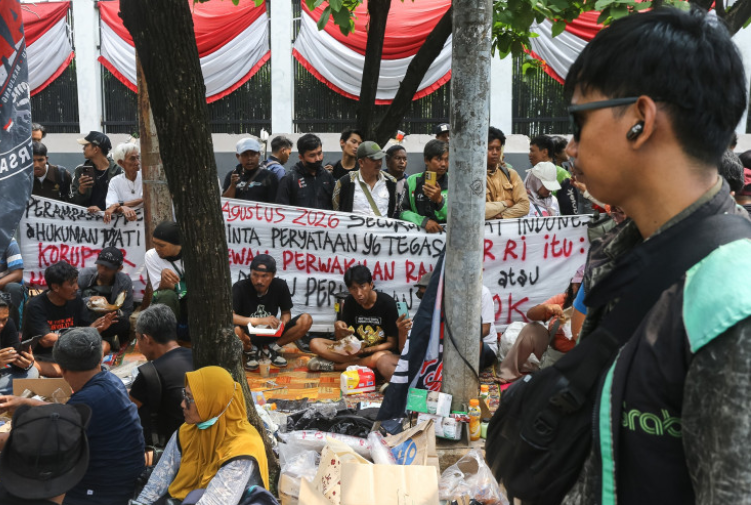
Demonstrators representing various anti-corruption coalitions flooded the Senayan Legislative Complex in central Jakarta on Thursday, amplifying calls for sweeping legislative reform aimed at combating graft and improving living standards. Among their principal demands was rapid parliamentary approval of an asset forfeiture bill—legislation that would empower authorities to seize assets believed or proven to originate from criminal activity even without a prior conviction. The crowd also pressed for capital punishment of corrupt officials and interventions to reduce the cost of essential goods, reflecting broader public frustration with governance and economic pressures.
The United Pati People's Alliance, an activist network from Central Java, formed the vanguard of the demonstration, having coordinated a weeks-long mobilization effort to bus supporters into the capital. The group's resolve proved difficult to shake despite apparent attempts to obstruct their movement. Police halted several buses en route to Jakarta, while Bank Mandiri, a state-controlled institution, temporarily froze the account of AMPB coordinator Supriyono—a decision that provoked public backlash and triggered calls for a financial boycott of the lender. Far from discouraging participation, such interference appeared to reinforce the protesters' conviction that institutional barriers stood in the way of accountability.
Undeterred by these obstacles, movement organizers mobilized five additional coaches to transport fresh contingents to the capital, leveraging grassroots donations to circumvent official obstruction. This resourcefulness underscores the ground-level determination driving the campaign beyond the Pati base. As Wednesday afternoon unfolded, Supriyono announced the arrivals to assembled journalists, signalling that the protest would expand substantially beyond initial estimates.
Authorities prepared extensively for the demonstration, instituting traffic controls across vulnerable zones and positioning dozens of uniformed personnel throughout the legislative precinct. Police sealed both directions of Jalan Gatot Subroto extending from Senayan Park toward the parliament building itself. Jakarta Police spokesperson Sr. Comr. Budi Hermanto projected at least 500 active participants, though acknowledged the potential for larger numbers as aligned groups from beyond Pati committed to joining. In public statements, law enforcement struck a cautiously permissive tone, pledging to facilitate peaceful demonstration while maintaining public order and enabling routine commercial and educational activities to proceed without disruption.
The asset forfeiture legislation at the centre of Thursday's demands carries profound implications for Indonesia's anti-corruption framework, yet remains shadowed by legitimate legal concerns. Initially drafted in 2008, the bill languished through successive parliamentary cycles before the House of Representatives formally commenced deliberation in January. The proposed mechanism would permit state seizure of suspected criminal proceeds prior to judicial conviction—a departure from conventional due-process norms that could accelerate asset recovery but equally risks enabling weaponised prosecution or extortion against political adversaries. International legal experts and domestic commentators have flagged these dangers, questioning whether safeguards embedded within the draft sufficiently protect against abuse.
Underscoring the momentum, Gerindra Party lawmaker Habiburokhman, who chairs House Commission III handling legal affairs, assured visiting Pati residents on Monday that parliamentary passage would occur within eight weeks—roughly by December. This accelerated timeline reflects unusual political consensus around corruption as a public priority, signalling lawmakers' recognition that popular grievance has reached a threshold demanding legislative response. The commitment carries weight given Indonesia's track record of indefinitely postponing controversial measures.
President Prabowo Subianto's administration has positioned itself supportively, with Government Communications Agency director Muhammad Qodari declaring executive backing for the bill's expedited passage. Qodari's framing—that responsibility now rested entirely with parliament—deployed familiar rhetoric positioning the presidency as reform-minded while concentrating pressure upon legislative chambers. This dynamic reflects recurring patterns in Indonesian politics wherein executives champion popular demands while the legislature absorbs criticism for procedural delay.
The timing of Thursday's protest illuminates broader currents within Indonesian civil society and governance. Public anger over corruption persists as a politically potent force capable of mobilising constituencies across geographic and demographic boundaries. Yet the simultaneous demands for death sentences and reduced commodity prices hint at diffuse grievances channelled through an anti-corruption narrative—a reminder that popular movements often compress multiple policy objectives into singular parliamentary pushes. For Southeast Asian observers, the scene demonstrated that Indonesia's democratic infrastructure, despite institutional fragility, retains capacity to process mass mobilization and legislative responsiveness, distinguishing it from several regional neighbours.
The asset forfeiture bill, should parliament complete it by year's end, would represent a significant doctrinal shift in Indonesian criminal procedure. Comparative experience from jurisdictions including the United States and Canada demonstrates that such statutes can accelerate asset recovery but simultaneously create incentives for prosecutorial overreach absent robust judicial oversight. The challenge for Indonesian lawmakers resides in calibrating the measure to achieve anti-corruption objectives whilst incorporating procedural protections—judicial review, transparency requirements, proportionality thresholds—sufficient to constrain exploitation. Thursday's protesters appeared predominantly focused upon legislative velocity rather than substantive design, reflecting the political imperative to demonstrate responsiveness to street pressure whilst leaving technical refinements to parliamentary drafting committees.

