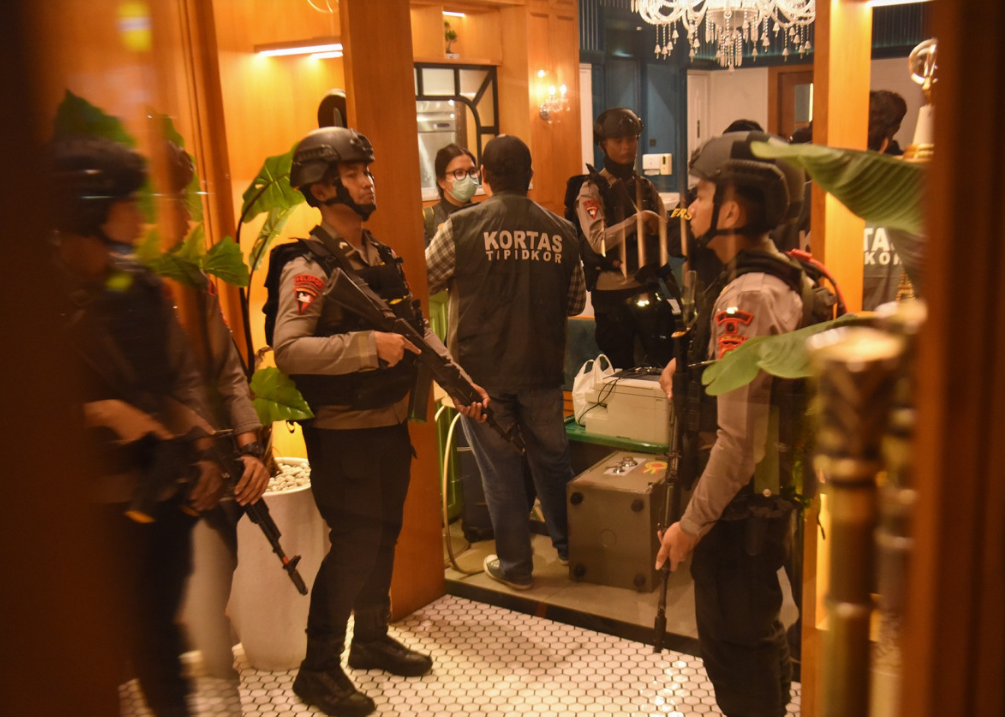
Diners at de'Clan Signature, an upscale restaurant tucked away in the Cipete neighbourhood of South Jakarta, got an unexpected glimpse of law enforcement in action on Wednesday afternoon (July 8) when armed police units converged on the establishment. Officers from the Jakarta Metropolitan Police and the National Police's special corruption division, flanked by Mobile Brigade personnel dressed in tactical gear and carrying assault rifles, systematically made their way to a concealed safe behind a cabinet in the dining area. The operation marked the beginning of what would become one of Indonesia's most significant law-enforcement scandals in recent memory.
The safe at de'Clan Signature contained documents and currency in multiple denominations totalling millions of dollars, shocking patrons and staff alike. Without pausing momentum, the enforcement team moved to an adjoining money changer business called Koin Money Changer, where another secure vault yielded hundreds of thousands of dollars more in Indonesian rupiah notes. These twin discoveries would prove to be merely the opening act of a much larger investigation that would stretch across the capital and into the surrounding regions.
Throughout Wednesday and into the early morning hours of Thursday, police teams fanned out across numerous locations in and around Jakarta, methodically collecting mobile phones, photographs, documents, and financial records. The scale of the operation reflected the seriousness with which authorities were pursuing the investigation, yet the most dramatic finding awaited at a residential property in the Sentul hills, a leafy suburban enclave approximately one hour's drive south of the capital. At this upscale residence, police discovered seven suitcases packed with 74 kilograms of gold bars alongside cash in various foreign currencies, bringing the total estimated value of all seized assets to US$26.3 million.
The Sentul property belongs to Febrie Adriansyah, who until recently held the position of deputy attorney general specializing in special crimes—one of the most sensitive posts within Indonesia's justice system. Adriansyah tendered his resignation over the weekend following the raids, effectively stepping down from his powerful position. Although investigators subsequently named him as a suspect in both corruption and money-laundering cases, he has not been detained pending further legal proceedings. Adriansyah has acknowledged ownership of the Sentul house but categorically denies that the discovered assets belong to him, instead insisting that clarification regarding their origin would emerge through the formal legal process.
Images of the seized gold bars and cash bundles, carefully arranged and displayed by authorities for media documentation, quickly became the dominant visual narrative of the scandal, underscoring the staggering scale of the alleged wrongdoing. The glittering rows of bullion and thick stacks of currency in orange and red denominations captured public imagination across the country, symbolizing concerns about endemic corruption within high-ranking institutions. For many Indonesians, these photographs represented yet another example of the gap between the nation's anti-corruption rhetoric and the reality of how wealth flows through its justice system.
The investigation extended beyond the initial Cipete and Sentul locations as police executed searches at approximately ten additional sites across greater Jakarta. These included a residential unit at Pacific Place, an exclusive apartment complex located near the Jakarta Stock Exchange, as well as multiple corporate offices scattered throughout the city. The breadth of the operation suggested investigators were pursuing a broader network potentially involving multiple individuals and entities. Among these locations was a South Jakarta residence in the Gandaria area connected to Don Ritto, a lawyer who had also been identified as a suspect in the investigation. According to local media reports, Ritto has been taken into custody, distinguishing his status from Adriansyah's conditional release pending trial.
Ritto's legal practice apparently intersected with business interests connected to both the raided restaurant and money changer establishment, as documented in corporate registration records reviewed by Indonesian journalists. This nexus suggested a coordinated system potentially designed to obscure financial flows and convert potentially illicit funds into tangible assets and legitimate-appearing business operations. The interconnections between the various raided locations pointed toward a sophisticated arrangement rather than isolated wrongdoing by a single official, raising questions about how such a network could function for extended periods without detection.
As Monday afternoon progressed, speculation intensified across Jakarta's political and legal circles regarding what the next investigative steps might entail and, more fundamentally, what the entire episode revealed about Indonesia's anti-corruption apparatus. Some observers argued that the discovery and seizure of such substantial assets demonstrated that institutional safeguards were functioning as intended, with police and prosecutors successfully identifying and interdicting alleged criminal activity. Others, however, pointed to this scandal as merely the latest in an unbroken chain of high-profile corruption cases, suggesting instead that systemic vulnerabilities continued to enable malfeasance at the highest levels of government.
Prominent legal scholar Mahfud MD, a former Chief Justice of Indonesia's Constitutional Court and former coordinating minister responsible for political, legal, and security affairs, publicly raised concerns about the procedural handling of the case. Speaking through his YouTube channel, Mahfud questioned the legal foundation for transferring investigative authority over Adriansyah's case from the police to the Attorney General's Office, arguing that such a transfer lacked statutory support under Indonesia's criminal procedure code. He cautioned that this irregularity could expose prosecutors to pretrial motions that might undermine the entire case, potentially allowing suspects to escape accountability on purely technical grounds. Mahfud advocated instead for Indonesia's Corruption Eradication Commission, an independent state institution specifically designed to handle such matters, to assume primary investigative responsibility, a move he contended would provide greater legal robustness and public confidence.

