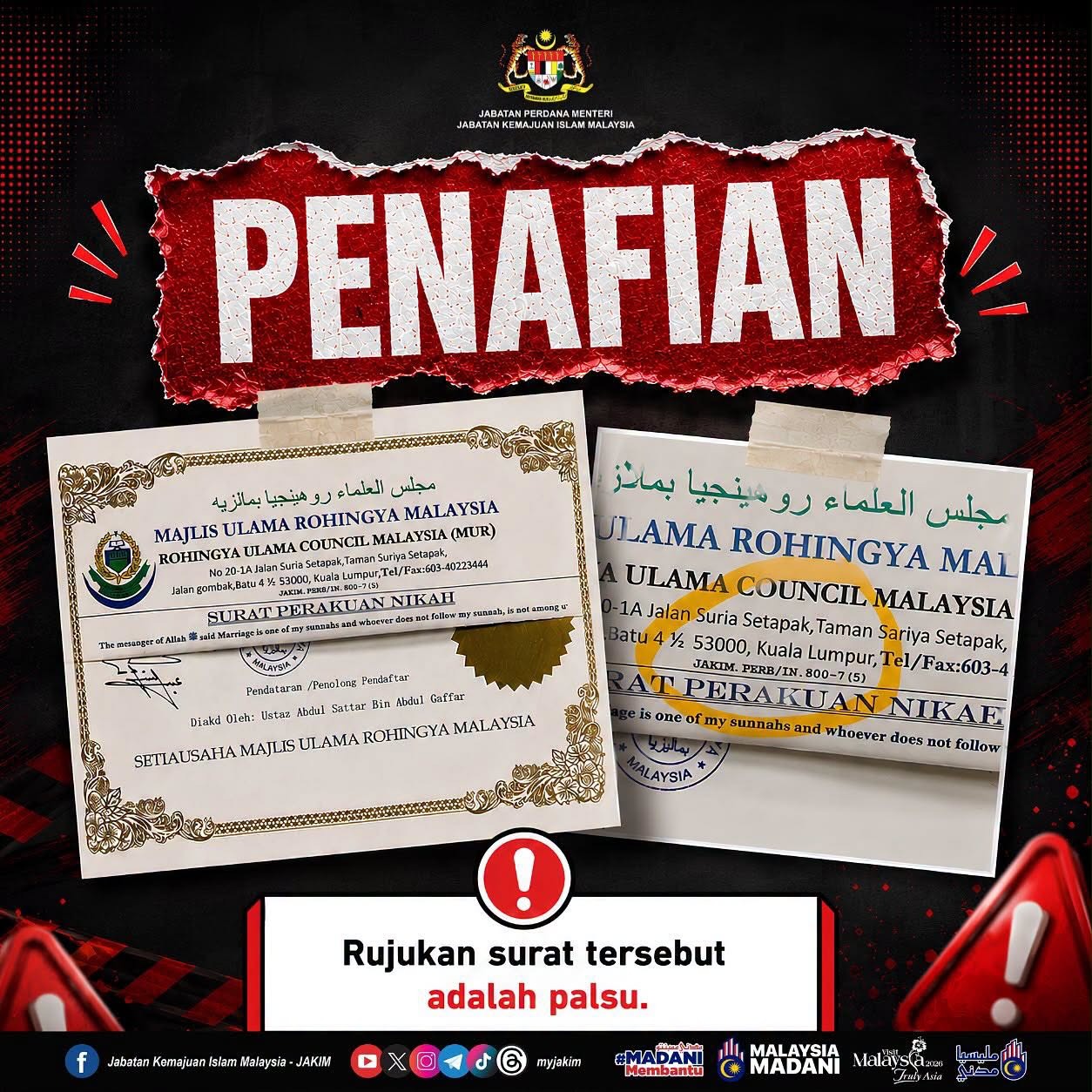
Malaysia's Department of Islamic Development (JAKIM) has moved to stamp out a widespread deception after confirming that a marriage-related letter circulating online is entirely fraudulent and bears no legitimate connection to the government agency. The department issued a statement through its official Facebook channel on July 15, revealing that checks had established the document was neither recognised nor produced by any Islamic religious authority operating in Malaysia. The finding comes as authorities seek to protect the public from what appears to be an organised attempt to exploit religious processes for undisclosed purposes.
The problematic document, which has gained significant traction across social media platforms, purports to come from the Malaysia Rohingya Ulama Council and claims official recognition from JAKIM to oversee marriage-related administrative functions. Prominently displayed on the letter is the reference number "JAKIM.PERH/LN.800-7(5)", which was designed to lend an air of legitimacy and governmental endorsement to what turned out to be an elaborate forgery. The document's circulation highlights the vulnerability of religious institutional credibility in an era when digital manipulation has become increasingly sophisticated and difficult for ordinary Malaysians to detect without expert guidance.
JAKIM's statement contained an unambiguous denial that would eliminate any lingering doubt about the letter's authenticity. The authority made clear that neither JAKIM itself nor any of the state-based Islamic religious councils and departments across Malaysia had ever appointed the organisation mentioned in the letter to manage, certify, or handle any marriage-related administrative matters. This categorical rejection underscores the seriousness with which Malaysia's Islamic governance structures take fraudulent claims of institutional affiliation, particularly when such claims could influence personal life decisions of citizens and residents.
The discovery of this counterfeit document raises significant questions about what motives might drive individuals to fabricate official-seeming materials in the religious sphere. The specificity of the fake reference number and the apparent professionalism of the letter's presentation suggest this was not a casual or opportunistic fraud, but rather a calculated effort to deceive. For Malaysians navigating questions of marriage registration and religious compliance, such deceptions can create genuine confusion about proper procedures and legitimate authorities, potentially leading to arrangements that lack proper legal or religious standing.
In response to the growing concern, JAKIM has issued guidance for the public on how to protect themselves against similar fraudulent documents. Citizens are now advised to independently verify the authenticity of any suspicious religious documentation by directly consulting JAKIM or the appropriate state Islamic religious authority before proceeding on the assumption that such documents are genuine. This preventive measure reflects an acknowledgment that proactive public education represents an essential component of defending institutional integrity in the digital age, where forged documents can reach tens of thousands of people within hours.
Dr Zulkifli Hasan, the Minister in the Prime Minister's Department (Religious Affairs), signalled that the government would initiate a formal investigation into the matter once more complete information had been gathered. The ministerial involvement indicates that authorities view this incident as sufficiently serious to warrant attention at the highest levels of religious governance, suggesting that there may be broader implications or connections yet to be uncovered. The prospect of an official investigation also demonstrates the government's commitment to pursuing those responsible for creating and distributing such fraudulent materials.
The Malaysia Rohingya Ulama Council, mentioned in the forged letter, has presumably become unwilling publicity in this fraud, as its name was appropriated without authorisation to lend credibility to the fake document. This raises important questions about how such councils and religious bodies can better protect their institutional reputations and prevent their names from being weaponised by fraudsters. The incident illustrates the challenges facing legitimate religious organisations in maintaining their standing when bad actors exploit the trust and respect that such bodies have built within their communities.
For Malaysian Muslims and residents relying on formal religious documentation for significant life events, this incident serves as a cautionary tale about the necessity of verification. Marriage in Malaysia operates under distinct frameworks depending on whether individuals are Muslim or non-Muslim, and each framework involves specific registration and documentary requirements. The circulation of fraudulent religious letters could potentially disrupt people's understanding of these requirements or encourage them to rely on documents that would not be legally recognised should questions arise later concerning the validity of their marriages.
The broader context within Malaysia's regulatory environment for religious affairs has always placed substantial emphasis on documentation and formal recognition as proof of legitimate authority. This structural reality, while designed to prevent unauthorised religious practice and protect public welfare, also creates opportunities for sophisticated fraudsters who understand which reference numbers and formatting conventions carry institutional credibility. JAKIM's rapid and public response in this case represents best practice in crisis communication, moving quickly to correct misinformation before it becomes so deeply embedded in public consciousness that subsequent corrections become ineffective.
Looking forward, this incident will likely prompt conversations among Malaysian Islamic authorities about strengthening the verification mechanisms available to the general public and enhancing the security features embedded in official documentation. Digital authentication, enhanced reference number systems, and more accessible verification channels could all play roles in making it harder for fraudsters to succeed in future attempts. The episode also underscores the importance of media literacy and critical consumption of online materials, particularly when dealing with documents that claim official status or that carry implications for significant personal decisions.

