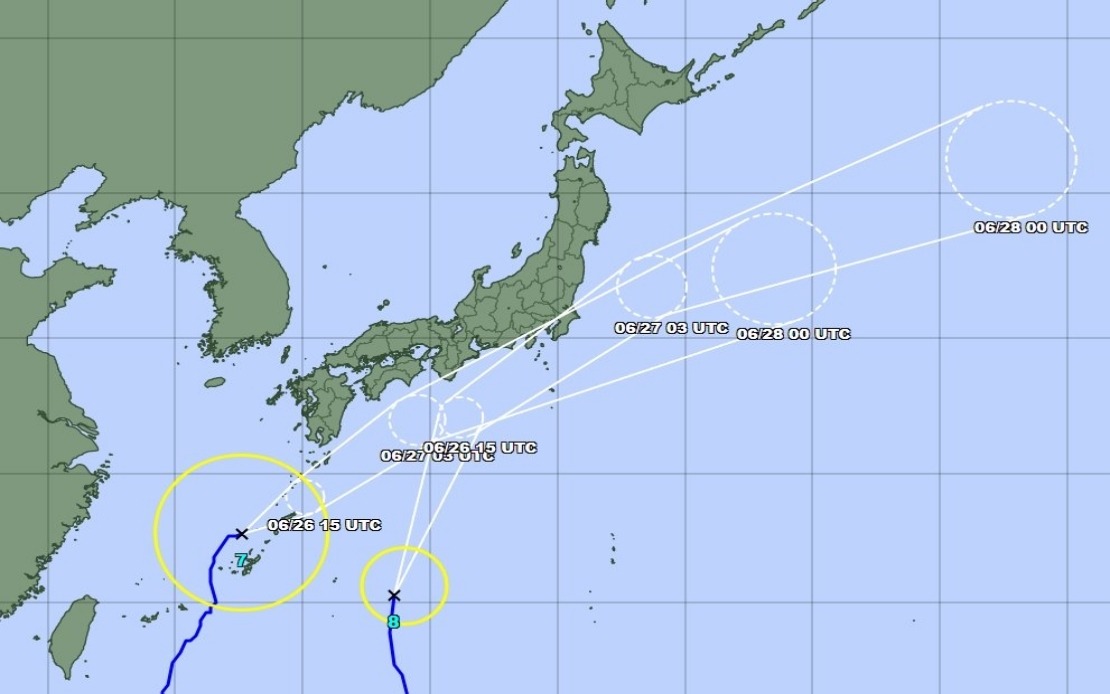
Japan's weather authorities issued urgent alerts on Friday as the nation braced for a dangerous twin typhoon scenario set to unfold over the weekend. The Japan Meteorological Agency flagged Typhoon Higos approaching from the Pacific Ocean with an anticipated landfall expected on Saturday, while simultaneously tracking Typhoon Mekkhala, which had already begun affecting the Amami region in Kagoshima Prefecture in southwestern Japan. This dual system threat posed compound risks of landslides, flooding, and severe weather disruption across large swathes of the archipelago.
The convergence of both storm systems created a complex meteorological challenge for disaster management officials. Typhoon Mekkhala moved toward the Kanto region at 15 kilometres per hour off Okinawa's Kume Island as of Friday morning, while Higos tracked northward along the southern coast. Though forecasters anticipated both systems would gradually weaken into extratropical cyclones after making landfall, the timing and intensity of rainfall from their simultaneous approach demanded heightened public vigilance and coordinated emergency response.
By Friday morning, the cumulative impact of heavy rainfall already battering western and eastern regions had prompted evacuation orders affecting more than 2 million residents across 13 prefectures in the Kinki and Kyushu regions. This staggering figure underscored the severity officials attributed to the unfolding situation. The Fire and Disaster Management Agency activated these precautionary measures even before the primary typhoons made direct contact, reflecting lessons learned from previous typhoon seasons when delayed evacuations cost lives.
Rainfall totals recorded prior to the weekend arrival of both typhoons demonstrated the moisture already in circulation. Goto, Nagasaki Prefecture, accumulated 600 millimetres of rain between Tuesday and Friday morning alone. Meanwhile, Aso, Kumamoto Prefecture, and Ureshino, Saga Prefecture, each recorded over 500 millimetres during the same period. These substantial accumulations, occurring days before the peak storm arrival, indicated saturated ground conditions that would amplify landslide risks once additional rainfall commenced.
The situation escalated dramatically in Seika, Kyoto Prefecture, where authorities issued the highest level 5 emergency safety alert for specific areas following an actual landslide incident that occurred Friday morning. This concrete evidence of slope failure underscored the real and present danger posed by further precipitation. Landslides represent one of the most unpredictable and destructive consequences of extreme rainfall in mountainous and hilly Japanese terrain, often striking with little warning and severing transportation routes or destroying homes in their path.
Projections for Friday evening through Saturday indicated intensifying rainfall as Typhoon Higos advanced northward and Mekkhala moved toward the Kanto region. The Tokai and Kanto regions faced the most severe forecasted impact, with meteorologists warning that precipitation would continue escalating through Saturday. The agency specifically predicted up to 300 millimetres of rain in the Tokai region by noon Saturday, while the Kanto-Koshin region would receive approximately 150 millimetres. These predicted volumes, combined with already-saturated soil, created optimal conditions for widespread flooding and additional slope failures.
Okinawa Prefecture also faced the prospect of strong storms as the typhoon systems approached and transited through nearby waters. The prefecture's exposure to tropical cyclones makes such events relatively commonplace, yet the simultaneous threat from two systems remained unusual and required heightened preparedness. The rapid movement of Typhoon Mekkhala at 15 kilometres per hour provided a compressed window for residents to complete evacuation and preparation measures.
The dual-typhoon scenario presented unique challenges for Japan's emergency management infrastructure. Rather than managing a single storm system's progression across the nation, authorities confronted overlapping areas of concern, with rainfall from both systems potentially combining to exceed individual forecast totals. This complexity required real-time reassessment of evacuation zones and resource deployment strategies to maximize protection across multiple threat zones simultaneously.
For Malaysia and broader Southeast Asian observers, Japan's experience offers instructive parallels. The region's own exposure to tropical cyclones, monsoon systems, and extreme rainfall events creates similar vulnerabilities regarding landslides and flooding. Japan's well-resourced meteorological infrastructure and aggressive evacuation protocols provide a model for disaster preparedness, though implementation challenges vary significantly across Southeast Asian nations with different capacity levels, terrain configurations, and population densities.
The approaching weekend represented a critical test of Japan's disaster response systems at a moment when multiple prefectures simultaneously faced severe weather threats. Success in managing the situation would depend on sustained public compliance with evacuation orders, effective interagency coordination, and accurate forecast updates as the systems evolved. The coming 48 hours would determine whether the mitigation efforts undertaken across affected regions successfully prevented the worst outcomes from two converging tropical cyclones.

