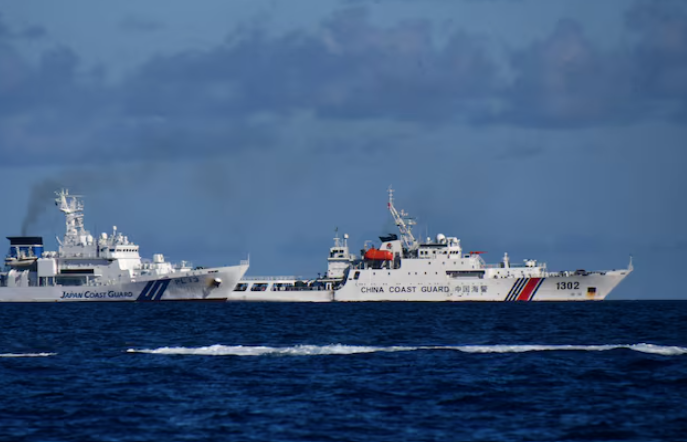
Japan's coast guard moved to eject two Chinese coast guard vessels from waters it administers near the disputed Senkaku Islands on Tuesday, the latest episode in a decades-long territorial confrontation that has intensified considerably following controversial remarks by Tokyo's leadership. The Chinese ships were detected approaching a Japanese fishing vessel engaged in legitimate operations in the zone, prompting an intervention by Japanese maritime authorities who successfully compelled the foreign vessels to withdraw from what Japan considers its territorial waters by 9.20am local time.
The Senkaku Islands, referred to as the Diaoyu by Beijing, sit in strategically important waters between Taiwan and Okinawa and have emerged as a persistent flashpoint in East China Sea geopolitics. Both nations maintain overlapping territorial claims to the island chain, and the surrounding waters are believed to contain potentially significant hydrocarbon reserves alongside important fishing grounds. While Chinese coast guard deployments in the vicinity have become a recurring phenomenon over the past several decades, direct approaches to Japanese fishing vessels remain comparatively uncommon, lending particular significance to Tuesday's incident.
Japan's coast guard characterised the incursion as a violation of international maritime law and deployed vessels to provide protection for the Japanese fishing boat during the confrontation. The statement issued by authorities indicated that four Chinese ships had been operating in the surrounding area prior to the two vessels entering what Japan regards as its territorial waters, suggesting a coordinated operation rather than an isolated incident. The coast guard pledged to maintain vigilant enforcement of its territorial claims whilst adhering to both international conventions and domestic legal frameworks governing maritime activities.
The escalation reflects deteriorating bilateral relations that have accelerated markedly since November, when Japanese Prime Minister Sanae Takaichi made remarks regarding potential military intervention should Taiwan come under attack. Her comments, which suggested Japan might assist in Taiwan's defence against military aggression, triggered a sharp rebuke from Beijing, which regards Taiwan as a renegade province and has consistently refused to renounce the use of force to assert sovereignty. China responded by condemning Takaichi's statements and subsequently discouraged Chinese citizens from visiting Japan whilst implementing trade restrictions targeting certain Japanese enterprises.
China's deployment of coast guard vessels in disputed waters represents a broader pattern of assertiveness across the East China Sea, where Beijing has systematically challenged Japan's administrative control through persistent maritime presence. These operations serve multiple strategic objectives: establishing de facto control through consistent occupation, gathering intelligence on Japanese military and civilian maritime activities, and demonstrating China's resolve to contest Tokyo's territorial interpretation. The frequency of such deployments has increased in recent years, creating an environment of chronic instability where minor incidents carry potential for dangerous escalation.
The last comparable incursion occurred on June 10, when Chinese vessels entered areas Japan considers part of its territorial domain, though that incident did not involve direct interference with Japanese fishing operations. The progression from simple presence to active approach of civilian vessels suggests an evolution in China's tactics, potentially testing Japanese resolve and seeking to establish precedents for greater assertiveness. Such incremental boundary-pushing represents a calculated strategy common in maritime disputes, where nations gradually expand operational zones to normalise previously unacceptable behaviour.
The broader context of Taiwan-related tensions has injected additional volatility into the Senkaku dispute. Takaichi's November statements, whilst echoing established Japanese policy frameworks, were articulated with particular clarity at a sensitive moment in regional affairs. Beijing interpreted the remarks as explicit commitment to military intervention on Taiwan's behalf, fundamentally altering the strategic calculus and prompting China to escalate political and economic pressure on Tokyo. The resulting atmosphere of heightened friction creates conditions where maritime incidents, once contained through diplomatic channels, now carry loaded political significance.
For Southeast Asian observers, the Senkaku confrontation illustrates broader patterns of great power competition destabilising the region. The East China Sea dispute sits adjacent to similarly contested areas in Southeast Asia, including the South China Sea, where multiple nations maintain overlapping territorial claims. Japan's experience defending its territorial interests against persistent Chinese maritime pressure offers instructive lessons for other regional actors facing comparable challenges. The incident demonstrates how systematic coast guard deployments can constitute effective instruments of coercive diplomacy, placing smaller economies under continuous pressure through non-military means that complicate decisive response options.
Japan's commitment to maintaining calm whilst responding resolutely reflects a delicate balancing act that Tokyo must sustain. Excessive passivity risks normalising Chinese intrusions and establishing adverse precedents, yet overly aggressive responses could trigger dangerous escalation spirals. The coast guard's approach of firmly but mechanically enforcing legal boundaries whilst avoiding confrontational rhetoric represents a tested framework for managing such tensions. However, the effectiveness of this approach depends partly on Chinese willingness to respect such unwritten rules of engagement, and recent patterns suggest Beijing may be testing those limits.
The economic dimensions of China's response to Takaichi's Taiwan comments—including travel discouragement and selective trade restrictions—demonstrate how maritime disputes intersect with broader instruments of state power. Japanese exporters face pressure from reduced Chinese tourism and business activity, creating internal Japanese political incentives to moderate Taiwan-related rhetoric. This weaponisation of economic relationships amplifies the stakes surrounding territorial disagreements and illustrates how regional powers leverage interdependence to achieve political objectives.
Looking forward, the trajectory of Senkaku tensions depends on multiple variables including Taiwan's strategic situation, broader US-China-Japan alignment dynamics, and the political sustainability of China's coercive approach. Should tensions over Taiwan intensify, spillover effects could readily translate to increased pressure on Japan's maritime claims. Conversely, any de-escalation in cross-strait affairs might reduce pressure on secondary disputes. Japanese policymakers must navigate these complexities whilst maintaining credible deterrence and avoiding actions that Beijing might characterise as justifying expanded Chinese assertiveness.

