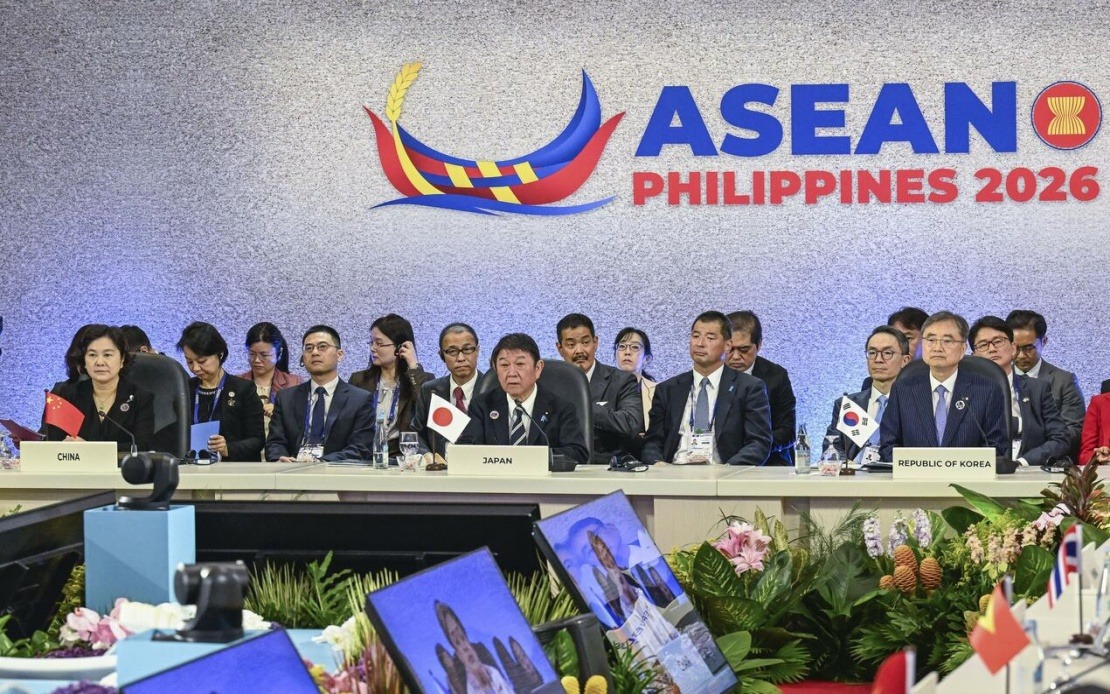
Japan has signalled its intent to deepen collaboration with Southeast Asian nations, China, and South Korea on two critical fronts: securing reliable energy supplies and dismantling international digital fraud networks. The commitment came during Thursday's gathering of foreign ministers from the ASEAN-plus-three grouping in Manila, where Japanese Foreign Minister Toshimitsu Motegi outlined Tokyo's strategic priorities for the region alongside his counterparts from across East Asia.
Motegi's remarks underscored Japan's recognition that the combined economic weight of the nine nations in the ASEAN-plus-three framework now represents more than a quarter of global gross domestic product, positioning the group as an indispensable anchor for regional prosperity and stability. This economic clout carries corresponding responsibility, he suggested, particularly as geopolitical tensions and energy supply disruptions threaten the region's development trajectory. His emphasis on the bloc's centrality reflects Tokyo's broader foreign policy doctrine, which seeks to position Japan as a stabilising force rather than a passive observer in regional affairs.
At the core of Japan's agenda lies support for ASEAN's own strategic vision, known as the ASEAN Outlook on the Indo-Pacific, or AOIP. Adopted by the ten-member association to safeguard maritime peace, freedom of navigation, and economic opportunity across the Indo-Pacific, the AOIP resonates with Japan's own doctrine of a free and open Indo-Pacific, a concept that Prime Minister Fumio Kishida has championed since taking office. By pledging coordination with China and South Korea to advance the initiative through the ASEAN-plus-three framework, Motegi signalled that Tokyo sees common ground among the larger regional powers on fundamental principles, despite persistent bilateral tensions.
Energy security has emerged as an increasingly pressing concern across the region, particularly following recent instability in West Asia and the broader challenges posed by the global energy transition. Meeting participants highlighted the necessity of fortifying energy supply chains and diversifying sources to insulate Southeast Asia from external shocks. For Malaysia and other ASEAN members heavily dependent on energy imports, Japan's willingness to cooperate on these networks offers tangible benefits. Tokyo brings technological expertise in renewable energy, liquefied natural gas infrastructure, and grid modernisation, areas where Japan has built considerable advantages through decades of managing its own energy constraints.
The battle against online fraud, meanwhile, reflects an often-overlooked dimension of transnational crime that has inflicted substantial damage across Southeast Asia. Criminal syndicates operating sophisticated scam networks from bases in Myanmar, Cambodia, and Laos have victimised thousands of citizens across the region, generating billions in losses and creating a shadow governance problem that conventional law enforcement struggles to address. Japan's interest in cooperative measures suggests Tokyo recognises that digital crime transcends borders and demands coordinated intelligence-sharing, regulatory harmonisation, and joint investigation protocols.
China's representation at the meeting by Vice Foreign Minister Hua Chunying, rather than Foreign Minister Wang Yi, drew subtle attention to Beijing's diplomatic priorities, though the vice minister's participation still signified China's commitment to the ASEAN-plus-three framework. Despite bilateral tensions between Tokyo and Beijing, particularly regarding the South China Sea and Taiwan, both nations have maintained institutional engagement through multilateral channels. This meeting demonstrated that pragmatic cooperation on functional issues—energy and crime prevention—can proceed even when strategic rivalry simmers below the surface.
The ASEAN-plus-three framework itself carries historical significance as a product of the 1997 Asian financial crisis, born from the recognition that regional cooperation could mitigate the impact of future shocks. Over two decades later, the mechanism has evolved into a venue for addressing challenges that transcend traditional diplomacy. The last summit-level gathering occurred in Malaysia in October, indicating that the foreign ministers' meeting serves as an important interim touchpoint for advancing the grouping's agenda.
Motegi's subsequent engagement with British Foreign Secretary Ed Miliband added another layer to Japan's diplomatic choreography. His expression of hope that Japan and Britain would deepen cooperation under the United Kingdom's newly elected government, led by Prime Minister Andy Burnham, reflected Tokyo's broader strategy of strengthening ties with like-minded democracies outside the immediate region. This bilateral dimension sits comfortably within Japan's larger framework of building coalitions to advance free and open Indo-Pacific principles, linking regional cooperation with global partnerships.
For Malaysian observers and policymakers, the significance of this diplomatic moment lies in its demonstration of Japan's continued engagement with Southeast Asia despite competing pressures elsewhere. As the region navigates economic slowdown, supply chain fragmentation, and renewed great power competition, Japan's willingness to collaborate on energy security offers concrete opportunities for infrastructure investment and technology transfer. Similarly, the emphasis on combating online scams addresses a threat that has undermined public confidence in digital finance and cross-border commerce, areas critical to ASEAN's digital economy ambitions.
The ASEAN-plus-three framework ultimately represents an attempt to balance multilateral cooperation with the reality of competing interests among its members. Japan's latest pledges on energy and digital security reflect a pragmatic approach to regional engagement: identifying functional domains where cooperation serves mutual interests while sidestepping more contentious geopolitical issues. As regional tensions persist and global supply chains remain volatile, such practical collaboration may prove more resilient than grand strategic visions.

