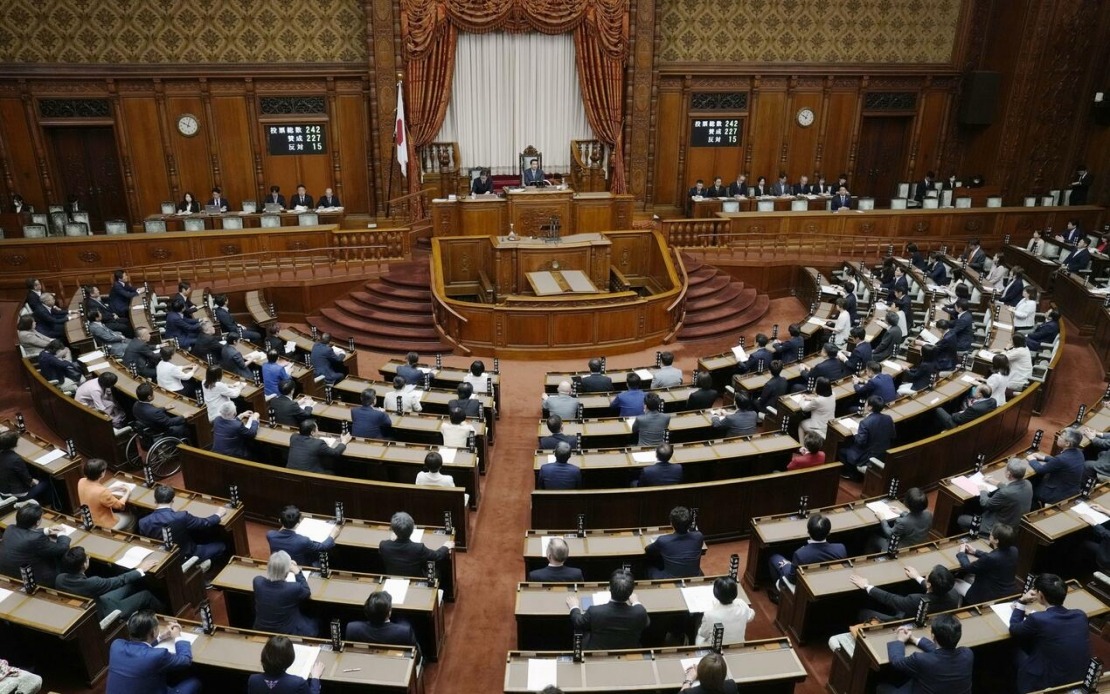
Japan's parliament has taken a significant step toward modernising its defence infrastructure by approving legislation that will fundamentally restructure the Air Self-Defence Force and elevate the nation's space-based security capabilities. The House of Councillors vote on Friday marks a watershed moment in how Tokyo approaches emerging military domains, particularly as regional tensions and technological competition reshape the strategic landscape across Asia-Pacific. The renamed force, which will incorporate "space" into its official designation, reflects Japan's acknowledgement that contemporary security threats extend far beyond traditional aerial domains and that satellite systems have become integral to national defence.
The restructuring will culminate in the establishment of a new space operations group scheduled to commence operations during the fiscal year concluding in March 2027. This dedicated unit will operate under the command of a lieutenant general and focus specifically on expanding Japan's space domain awareness and satellite surveillance capabilities. The move addresses a recognised capability gap in Japan's ability to monitor activities across the vast Pacific and Indian Ocean regions, where strategic competition has intensified markedly. By centralising space operations under senior military leadership, Tokyo aims to enhance coordination between different branches of the Self-Defence Forces and improve response times to potential security challenges.
Defence Minister Shinjiro Koizumi emphasised during a press conference that space infrastructure permeates virtually every aspect of modern civilian life, making its protection a fundamental national priority. He highlighted how satellite navigation systems guide transportation networks, smartphone mapping applications facilitate daily movement, and weather forecasting systems depend entirely on orbital infrastructure. This framing represents a strategic pivot: by connecting space defence explicitly to civilian welfare and economic prosperity, the government builds political consensus for substantial investments in military space capabilities. The minister stressed that systematic institutional development within the Self-Defence Forces would be necessary to ensure these organisations can effectively execute their missions within this newly recognised domain.
Beyond space-focused restructuring, the legislation addresses a critical shortage affecting Japan's armed forces: recruitment and retention. The approved measures include enhanced post-retirement benefits for Self-Defence Force personnel, whose mandatory retirement ages typically occur significantly earlier than in standard civil service positions. This benefits enhancement responds to a persistent challenge that has become increasingly acute as Japan faces demographic headwinds and younger generations show declining interest in military careers. By improving retirement security, policymakers hope to attract higher-quality recruits and retain experienced personnel whose expertise proves invaluable in managing complex defence systems.
The parliamentary approval simultaneously authorises the appointment of a second senior vice defence minister, a structural change that carries important implications for governance during crises. This additional senior ministerial position will distribute responsibility more evenly during contingencies and large-scale natural disasters, situations where the defence establishment assumes expanded civilian coordination roles. The appointment is expected to occur as early as summer, indicating the government's desire to operationalise this change quickly. The position also facilitates expanded high-level defence exchanges with the United States and other security partners, reflecting Japan's strategy of strengthening alliance relationships through enhanced diplomatic and institutional capacity.
Regional dynamics feature prominently in understanding the timing and scope of these defence reforms. The legislation includes provisions to upgrade the Ground Self-Defence Force's 15th Brigade, currently based in Naha, Okinawa Prefecture, to the status of a full division. This elevation reflects Japan's growing concern about its southwestern remote island territories, which have attracted increasing Chinese maritime activity in recent years. The Senkaku Islands dispute and broader Chinese naval expansion have prompted Tokyo to substantially strengthen military presence and capabilities across Okinawa and the wider southwestern archipelago. Elevating the 15th Brigade to divisional status signals a long-term commitment to maintaining robust defensive posture in these strategically critical areas.
For Southeast Asian observers, Japan's defence modernisation carries particular significance. As regional powers including Malaysia monitor shifts in great power competition, Japan's institutional investments in space capabilities and force structure improvements indicate how middle powers are adapting to an era of intensified strategic competition. Japan's focus on satellite surveillance and space domain awareness reflects recognition that monitoring vast maritime areas and tracking potential security threats requires technologies that transcend traditional military domains. The regional implications suggest that other Southeast Asian nations may face mounting pressure to develop or acquire comparable capabilities to maintain situational awareness in increasingly congested and contested spaces.
The defence restructuring also reflects Japan's broader strategy of deepening security cooperation with established allies while maintaining technological edge in emerging domains. By formally institutionalising space operations and strengthening command structures, Japan positions itself as a credible partner for advanced security partnerships in Asia-Pacific. The upgrades to personnel benefits and ministerial capacity simultaneously signal that Tokyo intends to sustain these elevated defence commitments over extended periods, not merely as temporary responses to immediate threats but as permanent structural features of national security architecture.
The timeline for implementation extends through fiscal year 2027, providing three years for complex organisational changes and capability development. This deliberately measured pace allows the Self-Defence Forces adequate opportunity to recruit and train personnel specifically for space operations while developing necessary institutional relationships across military branches. The extended timeline also permits diplomatic coordination with security partners, particularly the United States, whose space surveillance capabilities and technological expertise will likely prove essential to Japan's space operations group. As these reforms take shape, they will establish Japan as a significant regional actor in space-based security, potentially influencing how other Asia-Pacific nations approach similar challenges in an increasingly contested orbital environment.

