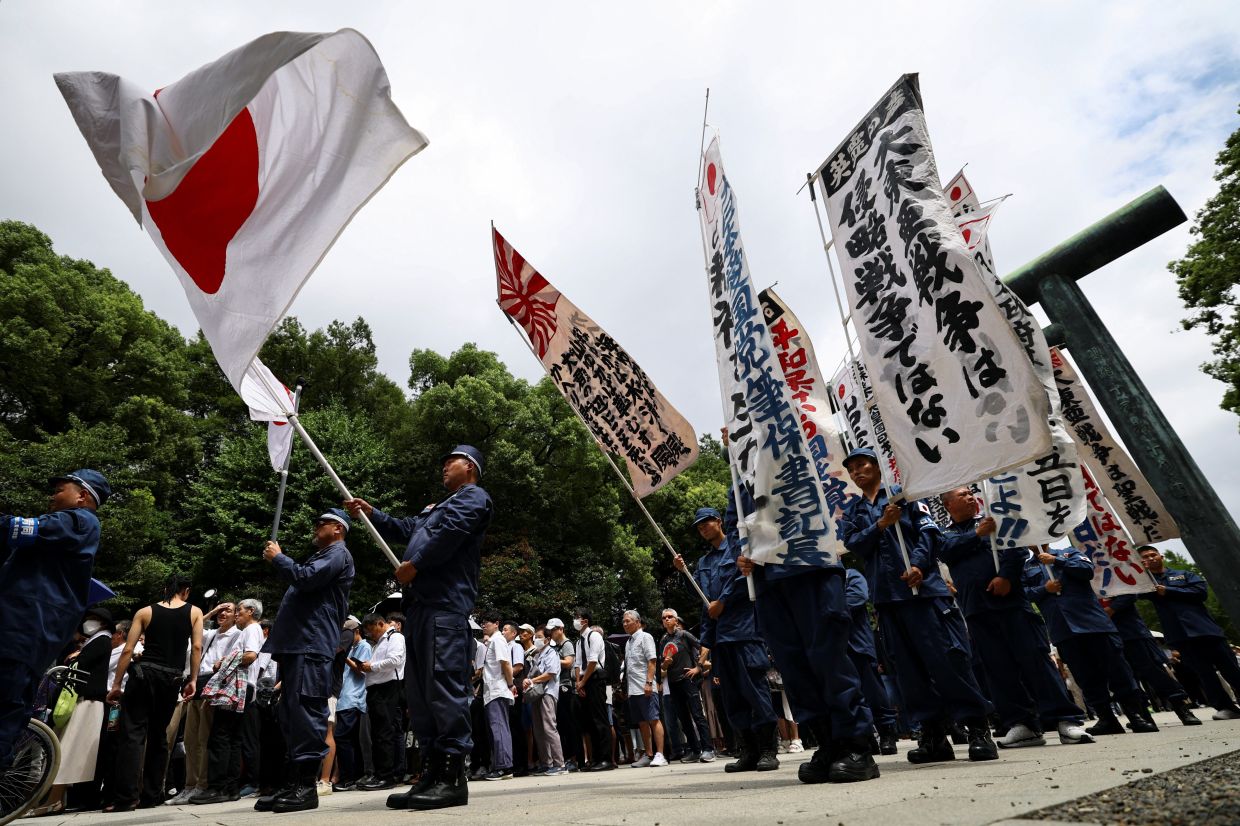
Japan's Defence Minister Shinjiro Koizumi paid respects at the Yasukuni Shrine on Saturday, August 15, marking the 81st anniversary of the nation's surrender in World War II, even as Prime Minister Sanae Takaichi conspicuously avoided the site. The symbolism of the defence minister's visit, contrasted with the prime minister's absence, reflects the delicate political calculations Tokyo must make when navigating its complex relationships with neighbouring countries that view the shrine as emblematic of unresolved historical grievances.
The Yasukuni Shrine, which enshrines approximately 2.5 million war dead, has become one of Asia's most contentious historical flashpoints. While most of those honoured are ordinary soldiers, the shrine's enshrinement of convicted war criminals from Imperial Japan's 1930s and 1940s campaigns across Asia has rendered it a persistent source of diplomatic friction. For Beijing, Seoul, and Pyongyang, the shrine represents not merely a religious site but a symbol of what they perceive as Japan's reluctance to fully acknowledge the atrocities committed by its imperial military during the occupation and invasion of much of East and Southeast Asia. The annual August 15 observance draws crowds of visitors, including a modest contingent dressed in military-style uniforms, alongside politicians seeking to demonstrate their patriotism and connection to national memory.
Takaichi's decision to remain absent from the shrine, despite being a regular visitor before assuming the prime ministership in October, represents a calculated diplomatic choice. There had been speculation within Japanese political circles that she might follow the precedent set by her mentor, former Prime Minister Shinzo Abe, who visited the shrine in December 2013. That visit provoked severe backlash from China and South Korea and triggered an unusually sharp criticism from the United States, Japan's closest security ally. Instead of attending in person, Takaichi dispatched an offering to the shrine, maintaining a form of ritual respect while avoiding the international diplomatic firestorm that an in-person visit would likely ignite. This middle ground approach reflects the tension between Japan's domestic political base and the country's regional standing.
Koizumi's visit as defence minister, by contrast, will almost certainly draw criticism from East Asia's major powers. While Japanese defence ministers have previously visited Yasukuni—most recently Minoru Kihara in 2024—the timing and prominence of Koizumi's attendance sends a signal about Japan's current political direction. As a long-standing advocate for visits to the shrine, even during his tenure as a government minister, Koizumi's presence on this symbolically weighted anniversary underscores the growing assertiveness of Japan's defence establishment and the broader rightward drift of Tokyo's security posture.
The geopolitical context surrounding this year's commemoration is substantially more fraught than previous anniversaries. Takaichi has already strained relations with Beijing through her November suggestion that Japan would intervene militarily should conflict erupt over Taiwan. Such language directly challenges China's core strategic interests, as Beijing considers Taiwan an integral part of its territory and has explicitly threatened military action to forcibly integrate the self-governed island of over 23 million people into the People's Republic. In response, China has escalated economic countermeasures, including warnings to its citizens against travelling to Japan and the imposition of trade restrictions. Simultaneously, Beijing has intensified its military posturing, conducting frequent patrols around disputed maritime territories in the East China Sea.
China's defence ministry responded to the August 15 anniversary by issuing stern warnings through Senior Colonel Chen Xi, a spokesperson, who explicitly condemned what he characterised as Japanese "neo-militarism." The Chinese position demands that Japan "earnestly reflect" on its historical crimes, properly acknowledge and atone for wartime conduct, respect the post-war international order, and cease what Beijing views as dangerous remilitarisation efforts. This rhetorical escalation reflects Beijing's deep anxiety about Japan's accelerating military buildup and its gradual abandonment of the pacifist constitutional constraints that have governed defence policy since 1945. China and Russia's ambassadors to Japan reinforced this messaging through a joint statement commemorating their nations' sacrifices during the Second World War, framing the present moment as one where historical memory remains politically salient.
Takaichi's government has indeed undertaken substantial initiatives to strengthen Japan's military capabilities, moves that align with her reputation as a China hawk prior to her elevation to the prime ministership. These defence enhancements represent a strategic pivot for a nation that had maintained strict pacifism as a constitutional principle for nearly eight decades. The timing of these military modernisation efforts, combined with increasingly assertive political rhetoric regarding potential regional conflicts, has alarmed neighbouring capitals and complicated Japan's diplomatic standing. While relations between Tokyo and Seoul have improved in recent years—a thaw reflected in January's musical and sports exchanges between Takaichi and South Korean President Lee Jae Myung—the broader regional climate remains tense and suspicious.
The Yasukuni Shrine itself attempted to manage the political dimensions of this year's August 15 observance by requesting visitors refrain from wearing military-style uniforms, citing a desire for peaceful worship conditions. The appeal, though framed as guidance rather than enforced policy, reflected the shrine's awareness that such imagery carries inflammatory implications for international observers and foreign governments monitoring Japan's political developments. Staff indicated they would provide "guidance" to attendees unaware of the expectations, though the shrine emphasised that non-compliance would not result in forced removal. An AFP correspondent estimated that approximately 20 to 30 visitors wore military-style uniforms despite the appeal, suggesting that some Japanese citizens continue to resist attempts at self-regulation on this sensitive commemorative occasion.
The broader strategic picture extends beyond Tokyo's internal political dynamics. On Thursday, Russian President Vladimir Putin visited the Kuril Islands in Russia's Far East for the first time, prompting sharp protests from Japan, which also asserts territorial claims to these disputed islands. This move underscores how historical disputes and unresolved territorial questions continue to complicate contemporary geopolitics across Northeast Asia. For Southeast Asian observers and policymakers, the tensions visible in these Japanese commemorations and diplomatic responses reflect the broader strategic instability affecting the entire region, with implications for trade routes, security architectures, and the delicate balance of great-power competition.
For Malaysia and other ASEAN nations, Japan's domestic political trajectory and its management of historical narratives carry significance beyond bilateral relations. Japan remains a major economic partner and security interlocutor for the region, and any escalation of tensions between Tokyo and Beijing or Seoul could reverberate through regional stability mechanisms and economic networks. The contrast between Takaichi's strategic choice to avoid Yasukuni while her defence minister attended represents not merely a domestic political calculation but a broader signal about how Tokyo intends to navigate its future regional role as it shifts away from strict pacifism toward more active defence posturing.

