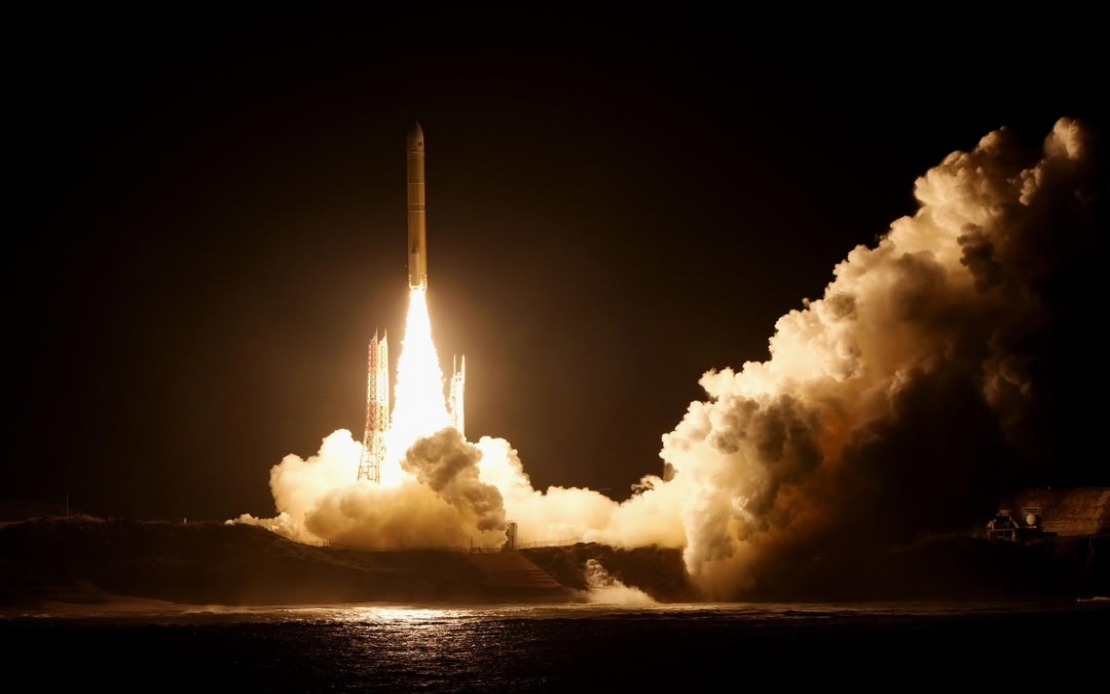
Japan's space programme achieved a significant milestone on Tuesday when the Japan Aerospace Exploration Agency successfully launched its H3 rocket carrying the Michibiki No. 7 positioning satellite into orbit. The lift-off from the Tanegashima Space Centre on the southwestern island of Tanegashima represents the second consecutive successful deployment of Japan's flagship rocket, providing reassurance about the programme's trajectory following a costly setback at the end of last year.
The H3 rocket No. 9 carried the Michibiki No. 7 satellite as part of Japan's broader effort to establish an independent positioning network. The Quasi-Zenith Satellite System, of which Michibiki forms the backbone, supplies location data essential for smartphone applications and vehicle navigation systems across Japan. With five satellites already operational, the deployment brings the constellation closer to its goal of seven operational units, which would enable the country to offer complete coverage without dependence on international systems such as the American Global Positioning System.
The launch schedule experienced several delays before the successful lift-off. Originally planned for Friday, the mission was postponed to Monday as a passing typhoon threatened the launch site. Unfavourable weather conditions persisted, forcing another postponement of 24 hours. While such delays are routine in space operations, they underscored the challenges of coordinating complex space missions with unpredictable natural conditions in Japan's island geography.
The December 2023 failure involving the H3 No. 8 rocket had cast uncertainty over the entire programme. On that occasion, the agency failed to place the Michibiki No. 5 satellite into the correct orbit, representing a significant technical setback for Japan's space infrastructure. The failure cascaded through the programme timeline, pushing back the scheduled February launch of the Michibiki No. 7 satellite by several months. This kind of delay reverberates through space agency budgets and strategic planning, affecting not only Japan but regional space cooperation agreements across Asia.
For Southeast Asia and the broader region, Japan's progress on its positioning satellite network carries strategic implications. Nations throughout the region rely heavily on GPS and other foreign-owned positioning systems for critical infrastructure, from telecommunications to power grids. Japan's development of an independent system demonstrates technological capability and reduces dependence on external systems that could be affected by geopolitical tensions. Several Southeast Asian countries, including Malaysia, maintain close technology and research partnerships with Japan and may eventually benefit from or integrate with complementary positioning systems.
The H3 rocket programme represents Japan's transition beyond its highly successful H2A launch vehicle, which dominated Japanese space activities for over two decades. The H2A established an enviable record for reliability, earning Japan a strong reputation in the international commercial launch market. The shift to H3 aims to reduce costs while maintaining performance standards, reflecting the competitive pressures in global space launch services where companies like SpaceX have reshaped market economics. However, the mixed early performance of H3—with one failure, one success, and now a second success—demonstrates the inherent risks of introducing new launch systems, even for experienced space agencies.
JAXA's rapid response to the December setback proved decisive. Rather than extended investigation and redesign, the agency identified and addressed the technical issue, returning to flight operations within months. The June launch of the H3 No. 9 rocket, which deployed multiple miniature satellites, provided valuable operational experience and engineering validation before the higher-stakes Michibiki mission. This progressive testing approach represents sound aerospace engineering practice, allowing incremental confidence-building before deploying critical satellites worth tens of millions of dollars.
The Michibiki constellation holds particular importance for Japan's national security and economic interests. Unlike GPS, which is controlled by the United States military, Japan's system provides indigenous positioning capability that cannot be switched off or degraded by foreign powers. This strategic autonomy matters increasingly as geopolitical competition intensifies across East and Southeast Asia. The system also offers superior accuracy in Japan's dense urban environments and mountainous terrain, where signal reflections complicate GPS performance. These technical advantages position Japan as a potential provider of positioning services to other nations seeking alternatives to American or Chinese systems.
Regional observers note that Japan's space programme advances alongside similar efforts elsewhere in Asia. India operates its NavIC system, China maintains its BeiDou network, and the European Union operates Galileo. The proliferation of indigenous positioning systems reflects both technological capability and strategic thinking about critical infrastructure independence. For Malaysia and other Southeast Asian nations, the emergence of diverse positioning options offers flexibility and reduces vulnerability to disruptions in any single system.
Looking ahead, JAXA must sustain the momentum demonstrated by the recent successes while completing the full seven-satellite Michibiki constellation. Each launch carries both technical and programmatic risk, requiring sustained engineering excellence and adequate funding. The programme's success ultimately depends on maintaining reliable launch operations, spacecraft performance, and ground control systems. Japan's space community will face pressure to demonstrate that recent successes reflect genuine mastery of the H3 system rather than fortunate outcomes.
The successful deployment of Michibiki No. 7 validates Japan's commitment to self-sufficiency in space operations and positioning technology. As the region increasingly recognises the strategic importance of space capabilities, Japan's progress demonstrates that technologically advanced Asian nations can independently develop and operate sophisticated space systems. The coming launches will determine whether Japan can complete its constellation reliably, establishing a proven alternative to established global positioning networks and strengthening Japan's role as a space technology leader in Asia.

