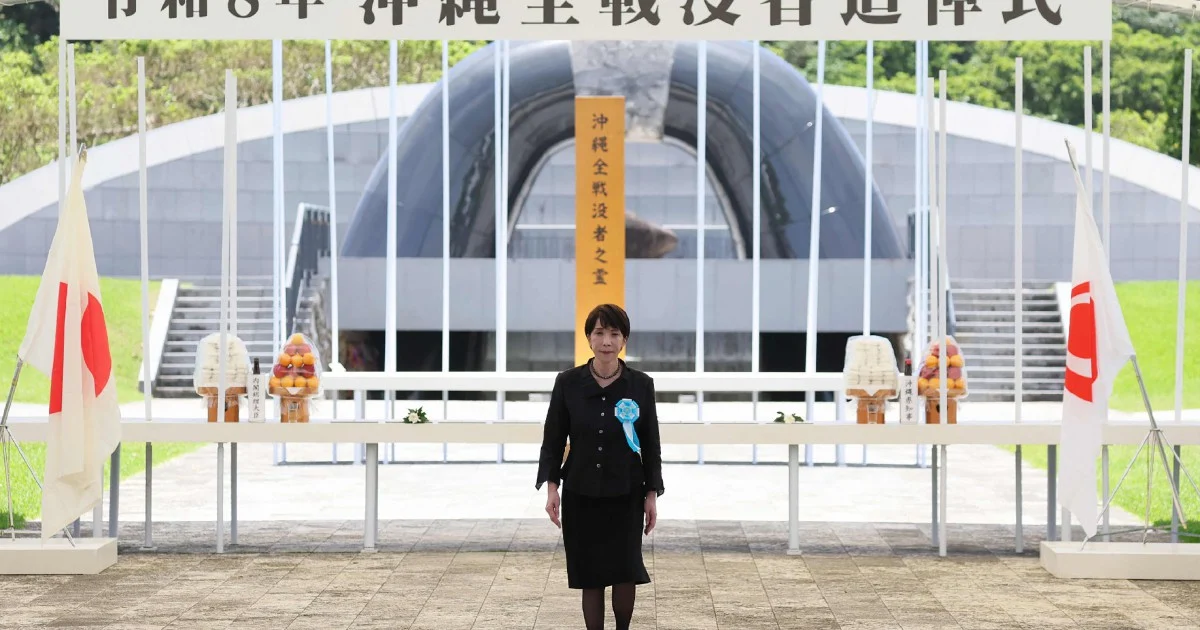
Japanese Prime Minister Sanae Takaichi faced heated opposition from demonstrators at a World War II memorial ceremony, with television footage capturing the tense exchange between the leader and angry protesters objecting to Japan's shifting defence posture. The incident underscores deepening divisions within Japanese society over the government's increasingly assertive military strategy, a marked departure from the restraint that has characterised the nation's security approach for more than seven decades.
Takaichi's premiership represents a new chapter in Japan's geopolitical positioning, with the administration actively pursuing policies that expand Tokyo's military capabilities and international security commitments. The hecklers at the memorial site were voicing concerns held by segments of the Japanese public who remain wedded to constitutional pacifism and worry that contemporary political leadership is dismantling the safeguards embedded in the country's post-war legal framework. This generational and ideological fault line has become increasingly visible as Japan navigates regional security challenges and evolving strategic partnerships.
The memorial event itself carries symbolic weight in Japan's national consciousness, serving as a site where the nation's military past is solemnly acknowledged and reflected upon. For many Japanese citizens, particularly older generations who remember the war's devastation, these commemorations are sacred spaces where the commitment to peaceful development should be reaffirmed rather than questioned. The decision to proceed with visible military-focused rhetoric and policy announcements at such venues has proven contentious, with critics arguing it signals a troubling recalibration of national values.
Japan's pacifist Constitution, adopted in 1947 under Allied occupation, explicitly renounces war and severely constrains military development. Article 9 of this foundational document has long been treated as inviolable by successive governments, though interpretations have gradually expanded over the decades. Recent administrations, including Takaichi's, have been testing the boundaries of what this article permits, arguing that contemporary threats necessitate enhanced defence capabilities. This reinterpretation of constitutional limits has proven divisive, with constitutional scholars, left-wing politicians, and peace activists mounting sustained opposition.
The regional security environment has undoubtedly influenced Tokyo's strategic recalculation. China's military modernisation, North Korea's nuclear and missile programmes, and Russia's military assertiveness in the Asia-Pacific region have created genuine security concerns for Japan. Defence spending has risen substantially in recent years, and Tokyo has deepened security cooperation with allies including the United States, Australia, and India through frameworks like the Quad. These developments reflect legitimate defence needs but have also triggered anxieties among those who fear militarisation will undermine Japan's distinctive peace-oriented identity.
Sanae Takaichi herself represents a conservative wing of Japanese politics that has long questioned the pacifist consensus. Her leadership signals that this ideological perspective now holds significant influence in Tokyo's corridors of power. Unlike predecessors who occasionally reined in hawkish impulses, Takaichi appears less constrained by traditional taboos around military expansion. Her willingness to publicly articulate and pursue military strengthening, rather than obscuring such moves behind cautious language, marks a notable shift in how Japanese leadership frames national defence.
The incident at the memorial reveals how contentious these issues have become in the public sphere. Heckling at official ceremonies was once virtually unthinkable in Japan's consensus-oriented political culture, suggesting that public tolerance for the military reorientation has frayed. Younger Japanese, shaped by different historical circumstances, may view stronger defence capabilities as pragmatic necessities. Conversely, older citizens and peace activists remain vigilant against what they perceive as creeping militarism, seeing echoes of pre-war nationalism in contemporary policy directions.
International observers closely monitor Japan's military evolution given the nation's economic importance, technological sophistication, and geopolitical location. Southeast Asian nations have particular interest in how Tokyo navigates this transition, given regional concerns about military escalation and arms races. Japan's potential military expansion could influence regional security dynamics, affect trade relationships, and reshape alliance structures throughout Asia-Pacific. Malaysia and other ASEAN members watch carefully to assess whether Japan's military growth will enhance regional stability or introduce new tensions.
The memorial hecklings are unlikely to slow the government's policy agenda, as Takaichi commands parliamentary majorities and public opinion remains somewhat divided on defence questions. However, the visible public dissent indicates that consensus is fracturing. Future commemorative events may see similar confrontations unless the administration finds ways to acknowledge legitimate peace aspirations while pursuing security modernisation. The tension reflects a fundamental question Japan must resolve: whether enhanced military strength and traditional pacifism can coexist, or whether one must ultimately prevail.

