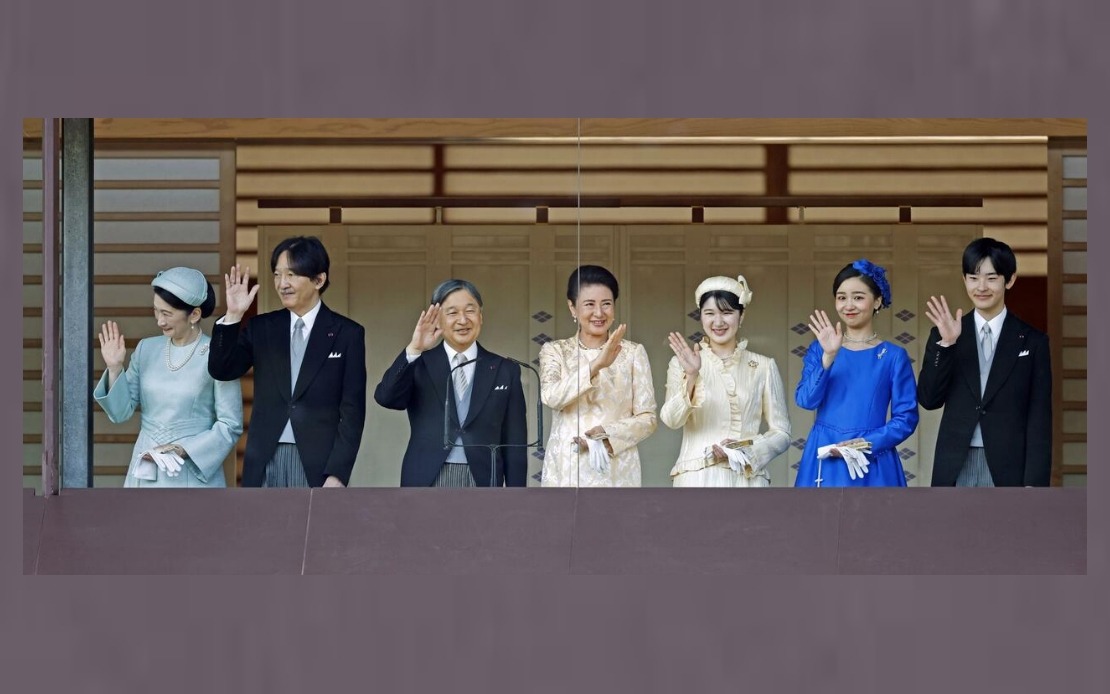
Japan's parliament on Friday gave its backing to sweeping reforms of the Imperial House Law, marking the first substantive revision to legislation governing succession in the world's oldest hereditary monarchy. The move addresses mounting concerns about the future stability of the imperial institution as the royal family dwindles in size, yet deliberately stops short of permitting female succession—a decision that has invited sharp criticism from legislators and stands at odds with overwhelming public sentiment.
The legislative package introduces two concrete changes designed to ease the succession challenge without fundamentally departing from centuries of patrilineal tradition. Under the revised framework, unmarried male descendants aged 15 and above from eleven former branch families that were stripped of imperial status following World War II may now be adopted into the current imperial household. This provision opens a pathway for potentially dozens of individuals with male-line imperial ancestry to rejoin the institution, effectively expanding the pool of eligible male heirs. Additionally, the reforms permit female imperial members to retain their status and titles after marrying non-royal commoners, a symbolic concession that nonetheless leaves them ineligible for the throne itself.
The timing of these revisions reflects a genuine crisis within Japan's imperial structure. Emperor Naruhito's household currently boasts only three male heirs, a precarious situation that has animated political debate for years. The reintroduction of former branch family members as potential throne candidates represents a practical solution to this demographic squeeze, resurrecting an approach that has long been theoretically possible but was long deemed culturally and legally unfeasible. The adopted males and their descendants would, in theory, have legitimate claims to the Chrysanthemum Throne, provided they descend through the male line.
Prime Minister Sanae Takaichi, who became Japan's first female premier, championed these reforms as a priority for her administration. However, her government explicitly rejected recommendations to enable female or maternal-line succession, despite mounting international attention on this question. The conservative Liberal Democratic Party, which leads the ruling coalition alongside the Japan Innovation Party, successfully resisted pressure to modernize the succession rules more radically. Opposition parties have accused the government of rushing the legislative process without adequate parliamentary scrutiny, suggesting that backroom negotiations prioritized speed and consensus-building over genuine public deliberation.
The legislative consensus underpinning the reforms involved input from thirteen parliamentary parties and groups, yet this broad agreement notably failed to resolve the succession question itself. Instead, the government pursued a narrow technical solution—restoring branch family members—that preserves the male-line requirement codified in the 1947 Imperial House Law. That original statute, enacted during postwar American occupation, removed fifty-one branch family members from the imperial registry and established the fundamental principle that the throne "shall be succeeded to by a male offspring in the male line belonging to the Imperial Lineage." The new law leaves this foundational principle entirely unaltered.
The historical context illuminates why this issue remains so contentious in Japanese politics. The 1947 law itself represented a dramatic reduction in the imperial family's size, from a much larger institution before World War II. The postwar regulations reflected both occupation-era reform impulses and conservative desires to streamline the monarchy in an era of reduced government spending. The branch families eliminated at that time retained their aristocratic status and cultural prestige even as they lost imperial standing. They have since produced numerous prominent individuals, and their male descendants now represent a reservoir of potential heirs with unquestionable genealogical credentials.
Yet the public discourse surrounding these reforms reveals a significant disconnect between legislative caution and popular attitudes. A Kyodo News poll conducted in May found that 83 per cent of Japanese respondents supported permitting female emperors, while only 13.1 per cent opposed the idea. This landslide sentiment reflects changing social attitudes toward gender roles and institutional adaptation, particularly among younger Japanese who view female succession as an obvious modernizing step. The government's decision to ignore this public preference raises questions about the extent to which parliamentary debate was genuinely responsive to constituent wishes or merely performed consensus-building while predetermined outcomes prevailed.
For Southeast Asian observers, Japan's approach to imperial reform offers instructive lessons about institutional conservatism and the challenges of balancing tradition with contemporary expectations. Several Southeast Asian monarchies face similar questions about succession, female participation in governance, and the relationship between hereditary legitimacy and modern democratic values. Japan's choice to pursue technical adjustments rather than fundamental reform suggests that even economically advanced democracies with strong civic participation may privilege symbolic continuity over demographic necessity and popular opinion.
The long-term implications of Japan's revised law remain uncertain. If unmarried male descendants of branch families are successfully adopted and integrated into imperial life, the immediate succession crisis may ease substantially. However, if none of these adopted individuals produces male heirs, or if the cultural and legal obstacles to their adoption prove more formidable than anticipated, the same question will resurface within a generation. By explicitly rejecting female succession now, Japan has essentially decided to revisit this debate later, possibly under more pressure and with less opportunity for deliberate legislative craftsmanship.
International observers have noted the tension between Japan's formal legal conservatism and its status as a major democracy with progressive values in many policy domains. The imperial institution occupies a unique constitutional position in Japan, defined by Article 1 of the 1947 Constitution as the embodiment of national sovereignty. Any change to succession rules necessarily implicates fundamental questions about Japanese identity and constitutional authority, which partly explains the cautious approach. Yet this reverence for constitutional formalism and historical precedent has itself become a point of generational and ideological dispute, with younger legislators and citizens more willing to contemplate substantive innovation.
The reforms were approved by the House of Councillors after months of deliberation, completing the parliamentary process required under Japan's bicameral system. The government framed these changes as both preserving imperial tradition and ensuring institutional sustainability, arguing that restoring branch family connections honors historical relationships while avoiding radical constitutional reinterpretation. Critics contend that this framing obscures a fundamentally conservative outcome that postpones rather than resolves the underlying succession challenge. What remains clear is that Japan's imperial succession question—shaped by postwar American occupation, Cold War-era constitutional entrenchment, and contemporary demographic trends—will likely resurface as a pressing political issue within years, absent unforeseen developments in the imperial household.

