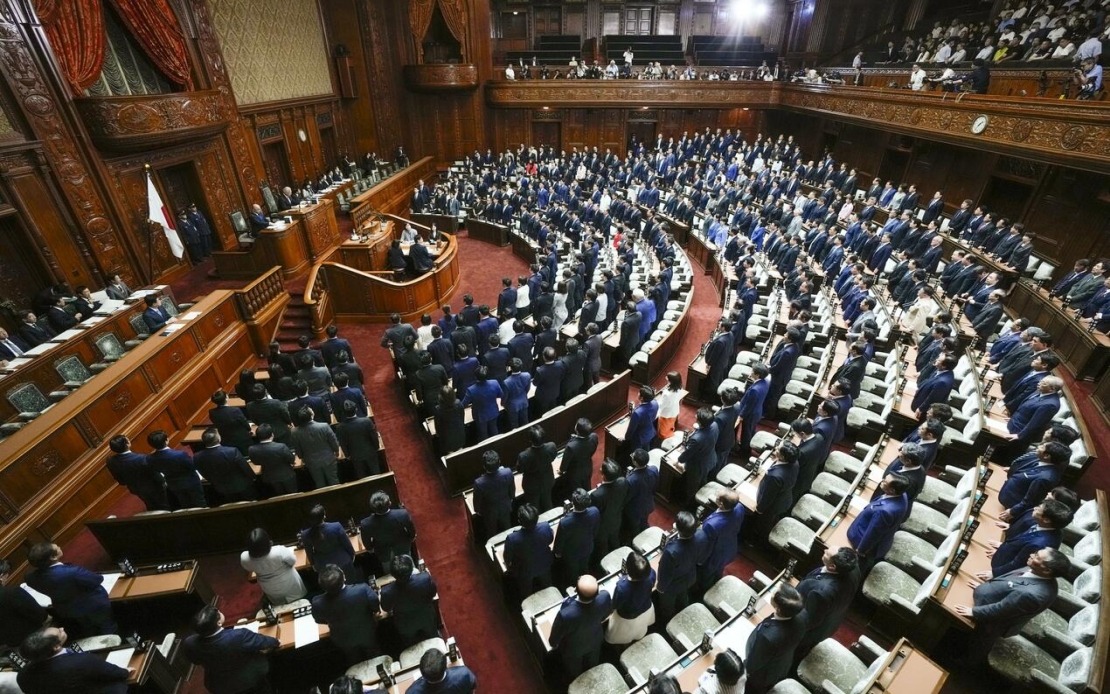
Japan's House of Representatives has endorsed a sweeping revision to the Imperial House Law in accelerated proceedings on Friday, marking the first substantial overhaul of the statute governing the imperial succession since its adoption in 1947. The swift passage represents a pivotal moment for the country's constitutional monarchy, as lawmakers grapple with the increasingly precarious situation created by the declining pool of eligible imperial heirs. Prime Minister Sanae Takaichi's coalition government, which holds commanding majorities in the lower chamber, successfully navigated the legislation through the chamber despite parliamentary turbulence that had stalled proceedings for weeks.
The legislative breakthrough came after extended parliamentary deadlock that had prevented substantive debate from commencing until late July. Tensions between the ruling alliance of the Liberal Democratic Party and Japan Innovation Party and opposition forces had frozen the Diet's proceedings since late June, as opposition lawmakers boycotted deliberations over what they characterised as the government's high-handed approach to multiple contentious bills. The gridlock finally eased after the ruling coalition agreed to substantial concessions, including abandoning efforts to force through electoral redistricting legislation during the current parliamentary session. This compromise cleared the path for the imperial succession measure to be formally discussed and voted upon.
The legislation addresses Japan's mounting succession dilemma through two primary mechanisms. First, it permits the imperial household to formally adopt males aged fifteen and above who trace their descent through the male line to former emperors, drawing from eleven imperial branch families that lost their official status during the post-war period. Second, and significantly, the bill allows female imperial family members to retain their imperial status following marriage to non-imperial citizens, a meaningful departure from the existing framework that automatically strips women of their imperial designation upon such unions. These provisions target the core structural challenges that have produced a dangerous shortage of potential heirs to the Chrysanthemum Throne.
Yet the legislation incorporates a crucial limitation that has drawn criticism from reformist advocates. While permitting adoptees themselves from the branch families to enter the imperial household, the bill explicitly bars these adopted individuals from ascending to the throne. However, it does extend succession eligibility to their male descendants born after adoption into the imperial family, creating a pathway for future generations of adopted-line individuals to potentially become emperor. This compromise position reflects attempts to balance progressive succession reform with preservation of traditions emphasising unbroken patrilineal descent from the imperial line.
The constitutional framework governing the imperial succession has remained essentially unaltered since 1947, creating mounting pressures as demographic realities have shifted dramatically. Under prevailing law, only males possessing an emperor on their father's side qualify for succession to the throne, while female members automatically relinquish their imperial status upon marriage to commoners. Consequently, both the absolute number of imperial family members and the cohort of constitutionally eligible successors have contracted significantly over recent decades, prompting serious concerns among policymakers about the institution's long-term viability. The current emperor, Naruhito, has only one son, limiting the direct male line to a precarious configuration of potential heirs.
Notably, the bill declines to embrace certain succession reforms that have achieved substantial public backing. The legislation explicitly sidelines proposals to permit female succession to the throne or to extend succession eligibility to imperial descendants through maternal lineages, both concepts that opinion polls have shown command majority support among the Japanese population. By maintaining the exclusive focus on adoptive arrangements and female retention of imperial status rather than female succession rights, the government's approach reflects persistent institutional conservatism regarding fundamental alterations to imperial succession principles. This deliberate omission signals that the most transformative constitutional possibilities remain diplomatically fraught within Japan's political establishment.
The bill's architecture emerged from consultative processes conducted by the speakers and vice speakers of both chambers, who solicited input from all thirteen parliamentary parties and political groupings. This ostensibly inclusive approach aimed to produce consensus legislation capable of securing broad backing and avoiding the partisan rancour that has characterised imperial succession debates in previous years. Nevertheless, the final legislation incorporated provisions absent from the original inter-party proposal, particularly the provision enabling sons of adopted family members to become emperor, a modification that provoked condemnation from opposition political organisations who characterised it as unilateral expansion of the bill's scope beyond the collaborative framework.
Enactment of imperial succession reforms constitutes a core commitment within the coalition agreement forged between the Liberal Democratic Party under Takaichi and the Japan Innovation Party in October, an arrangement that directly facilitated Takaichi's election as Japan's first female premier just days after the coalition's formation. The imperial legislation thus carries substantial political significance beyond its immediate constitutional implications, functioning as tangible evidence of the coalition's capacity to deliver on major policy commitments. For Malaysia and other Southeast Asian nations observing Japan's institutional evolution, the reform demonstrates how traditional monarchical systems can adapt to contemporary demographic and social circumstances while navigating complex domestic political constraints.
With lower house approval secured, the government now targets passage through the House of Councillors before the current parliamentary session concludes on July 17, though this compressed timeline presents execution challenges. The ruling coalition's commanding majorities in both chambers provide mathematical certainty of eventual enactment, yet the compressed schedule and recent parliamentary antagonisms create potential complications. The government has negotiated to hold one-on-one debate sessions between Prime Minister Takaichi and opposition leaders on Wednesday afternoon, the first such high-profile exchange since May, suggesting ongoing efforts to maintain functional parliamentary relations even as contentious legislation advances.
For international observers and policymakers throughout the Asia-Pacific region, Japan's imperial succession restructuring illustrates the delicate equilibrium required when modernising ancient institutional frameworks. The reform acknowledges pressing practical necessities while preserving core symbolic elements valued by traditionalists, an approach that Southeast Asian monarchies increasingly face as they navigate comparable tensions between preserving hereditary prestige and acknowledging contemporary demographic and social realities. Whether Japan's measured approach to succession reform ultimately resolves the imperial institution's viability challenges or merely postpones more fundamental decisions regarding female succession remains a significant question as the legislation advances toward certain enactment.

