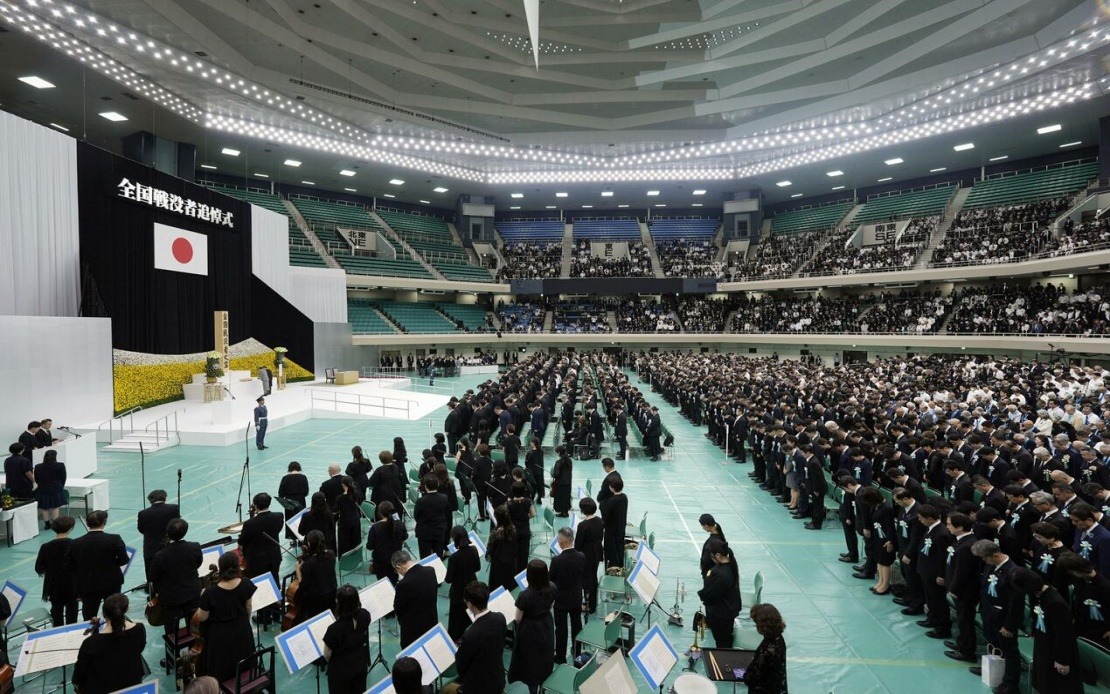
Japan observed the 81st anniversary of its World War II surrender on Saturday with a government ceremony in Tokyo, but the commemorative event highlighted a deepening ideological fissure within the country's political leadership over how to remember the conflict. Prime Minister Sanae Takaichi, who took office last October, delivered remarks emphasizing Japan's commitment to peace while deliberately omitting the language of "remorse" that has become increasingly contentious in recent Japanese politics. Her carefully calibrated speech underscores the tensions between those seeking to move beyond Japan's wartime narrative and those insisting that acknowledgement of historical wrongs remains essential to the nation's moral standing.
Emperor Naruhito and Empress Masako participated in the official state ceremony, which honoured the approximately 2.3 million military personnel and roughly 800,000 civilians who perished during the war that concluded in 1945. The imperial presence lends gravitas to the annual observance, yet the distinction between the emperor's remarks and the prime minister's pronouncements has become increasingly significant. While Naruhito, following long-standing imperial tradition, explicitly expressed "deep remorse" in his address—language he repeats annually—Takaichi's speech conspicuously avoided such formulations, signalling a meaningful recalibration of how the government frames Japan's historical responsibility.
Takaichi's rhetorical choices represent a notable departure from her immediate predecessor, Shigeru Ishiba, who served as prime minister until her own election last autumn. Ishiba, regarded as a relative moderate within the conservative Liberal Democratic Party, had pledged at last year's ceremony to uphold Japan's "remorse" regarding the war and to maintain a "resolute pledge to renounce war." His invocation of remorse marked a significant moment: Ishiba became the first Japanese leader in thirteen years to employ such language at the August 15 ceremony, suggesting a potential reversal of a troubling trend toward historical revisionism that had gained traction during previous administrations. Takaichi's decision not to follow his example, despite the ceremony's ceremonial continuity, indicates that this rhetorical opening may have been fleeting rather than marking a sustained policy orientation.
The ideological trajectory becomes clearer when examined through the lens of the late Shinzo Abe, Takaichi's acknowledged political mentor who served as prime minister twice, most recently from December 2012 onwards. Before Abe's initial ascension to office, successive Japanese prime ministers had consistently acknowledged the nation's wartime aggression—particularly its imperial expansion across Asia, including devastation inflicted upon China and the Korean Peninsula—and had expressed formal contrition. Abe's influence began reshaping this consensus, gradually diminishing explicit references to Japanese aggression and remorse from the official commemorative narrative. Under his long shadow, the historical consensus that had prevailed from the post-war period through the early 2010s began fragmenting along ideological lines.
In her Saturday address, Takaichi stated that Japan "has consistently walked the path of a nation that values peace and made all possible efforts for world peace and prosperity," language that pivots the narrative toward Japan's contemporary identity rather than its historical actions. She further pledged that Japan would "remain committed to this resolute pledge, passing it down across generations," yet by divorcing this commitment from explicit acknowledgement of what specifically requires remorse, the statement becomes more abstract. This rhetorical manoeuvre allows her to affirm Japan's pacifist commitment while avoiding the politically contentious terrain of wartime responsibility—a calculation that reflects her hawkish reputation on security matters and her alignment with nationalist currents within the Liberal Democratic Party.
The timing of this anniversary, occurring amid broader shifts in Japanese defence policy, renders the language choices particularly consequential for regional stability and historical reconciliation. Japan is currently experiencing a significant recalibration of its security posture, characterized by sharp increases in defence spending and the easing of longstanding restrictions on defence equipment exports. These material shifts in military capability and strategic orientation occur against a backdrop of heightened regional tensions, particularly concerning developments in West Asia and China's assertiveness in its periphery. When the government simultaneously retreats from acknowledging historical responsibility, Southeast Asian and other regional observers—particularly those nations that experienced Japanese occupation or aggression—may interpret this as signalling a shift not merely in rhetoric but in Japan's fundamental approach to its regional role.
The contrast between imperial and governmental statements warrants careful attention from international observers, particularly in Malaysia and neighbouring countries with complex historical memories of Japanese occupation. The emperor's consistent expression of remorse, maintained year after year regardless of which prime minister occupies office, suggests an institutional commitment to historical accountability rooted in the imperial institution itself. This stands in subtle but unmistakable tension with the executive branch's evolving unwillingness to employ similar language. For Malaysian readers, many of whose ancestors experienced Japanese occupation between 1942 and 1945, this divergence carries meaning: it suggests that Japan's imperial tradition may preserve certain historical sensibilities that its elected political leadership is progressively abandoning.
The ceremony itself maintained its structural continuity, with a solemn moment of silence observed at noon—the precise time when the late Emperor Hirohito announced Japan's surrender through radio broadcast in 1945. This ritual punctuality ensures that the act of capitulation remains annually commemorated, yet the surrounding interpretive frameworks in which that moment is embedded have become increasingly contested. Emperor Naruhito's consistent reiteration that the nation must "pass down the memories of the suffering endured during and after the war" represents an insistence that historical memory itself—including uncomfortable dimensions—requires active preservation and transmission across generational cohorts. His formulation emphasizes continuity and pedagogical responsibility, whereas Takaichi's emphasis on Japan's contemporary peace orientation looks forward rather than backward.
The political economy of Takaichi's word choices reflects factional battles within Japan's ruling coalition that carry implications extending well beyond ceremonial nicety. Her hawkish security orientation and her mentorship under Abe position her within a political lineage that views excessive historical self-examination as potentially constraining Japan's strategic autonomy and its capacity to assert its interests in an increasingly competitive regional environment. By declining to invoke remorse, she signals alignment with this strategic reorientation while maintaining formal commitment to peace—a rhetorical balancing act that allows simultaneous investment in enhanced military capabilities and historical revisionism.
For Malaysia and other Southeast Asian nations, this anniversary carries resonance beyond Japan's internal political disputes. The region remains acutely conscious of the Pacific War's destructive impact on civilian populations, colonial infrastructure, and the broader geopolitical arrangements that emerged in 1945. When Japan's highest elected officials progressively distance themselves from language acknowledging historical responsibility, it raises questions about the durability of post-war reconciliation frameworks and whether Japan's contemporary regional relationships rest on foundations sufficiently robust to withstand renewed historical contestation. The emperor's persistence in expressing remorse suggests institutional memory and commitment to accountability, yet if that imperial prerogative becomes increasingly isolated from the cabinet's official position, the symbolic coherence of Japan's historical reckoning may erode.
Looking forward, the trajectory established by Takaichi's speech suggests that Japanese leadership will likely continue retreating from explicit acknowledgement of wartime responsibility, at least so long as the hawkish faction maintains control of the Liberal Democratic Party. This development warrants close attention from Malaysian policymakers and analysts concerned with regional stability and the maintenance of historical consensus regarding shared experiences of the Pacific War. While Japan's commitment to pacifism remains formally intact—indeed, emphasized in this ceremony—the gradual evacuation of remorse from official discourse represents a subtle but significant recalibration of how the Japanese state understands its relationship to the past and its obligations to nations that experienced the consequences of its imperial expansion.

