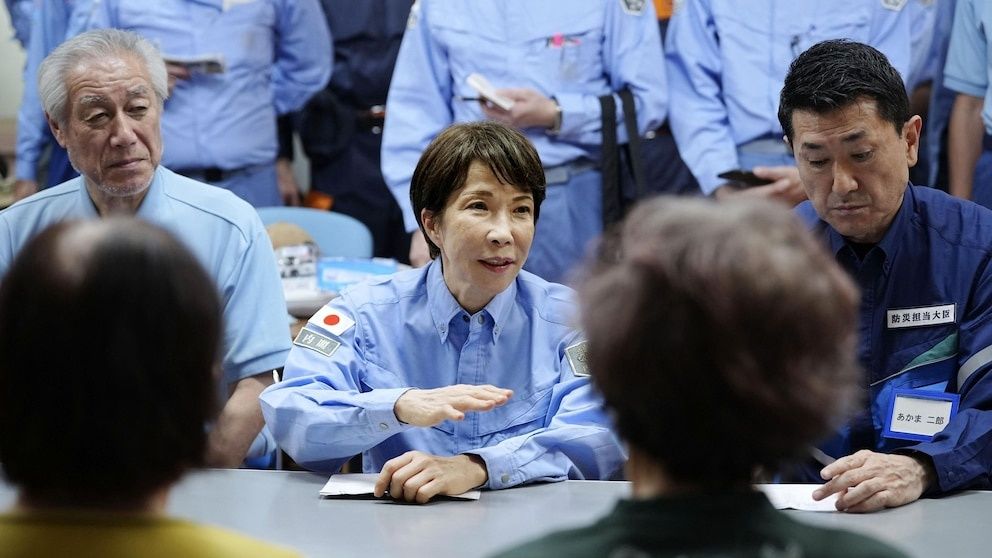
Prime Minister Sanae Takaichi conducted her first site visit to Kumamoto Prefecture on Monday following a devastating magnitude 7.1 earthquake that struck Japan's southern island of Kyushu on Tuesday, August 4, killing 38 people. The timing of her visit underscores the mounting complexity facing disaster authorities as communities confront not merely the immediate aftermath of seismic destruction but a converging set of environmental and logistical emergencies that threaten further loss of life.
The death toll reflects the multifaceted nature of the crisis unfolding in the prefecture. While 38 perished in the quake itself, at least one victim died from apparent heat stroke while sheltering in a vehicle, and another remains under investigation—a grim indicator that Japan's sweltering summer conditions are transforming the disaster recovery period into a secondary health emergency. The Japan Meteorological Agency predicted peak temperatures approaching 40 degrees Celsius (104 Fahrenheit) on Monday alone, creating acute risks for elderly evacuees and those forced to remain in inadequate shelter.
Across affected municipalities including Uki and Hikawa, visible signs of recovery have begun to emerge, with construction crews commencing assembly of temporary housing units while some private establishments repurposed their facilities to accommodate the displaced. Residents have begun the painstaking process of sorting and hauling debris—shattered furniture, damaged appliances, and structural rubble—to designated collection points, a necessary but labour-intensive task complicated by the oppressive heat. This grassroots cleanup effort masks a far more severe underlying crisis: more than 46,000 households remained without water supply, while fuel distribution networks struggled to meet demand across the region, creating conditions ripe for disease transmission and medical emergencies.
The shelter situation has deteriorated into crowded, unsanitary conditions that experts have long flagged as a predictable and preventable consequence of inadequate disaster preparedness. Over 8,500 evacuees occupied emergency facilities—hastily converted community centers, school gymnasiums, and classrooms—many of which lacked air-conditioning entirely. Others sought refuge in parked vehicles at municipal parking lots and makeshift outdoor encampments, arrangements that provide neither privacy nor reliable access to sanitation facilities. Governor Takashi Kimura highlighted in his meeting with the Prime Minister that this "abnormal heat" was inflicting additional psychological and physical strain upon residents already traumatized by the earthquake itself.
The Prime Minister's helicopter tour of affected areas drew criticism on social media when she visited one of the region's most comprehensively equipped shelters, complete with cardboard partitions, proper bedding, and climate control—a facility whose conditions bore little resemblance to the crowded, sweltering conditions where the vast majority of evacuees actually sheltered. The perception that the Prime Minister had been shown a curated, sanitized version of the humanitarian challenge rather than its true scope reflected broader anxieties about whether central government fully grasped the scale of suffering unfolding in provincial Japan.
Governor Kimura's requests to the Prime Minister reflected the desperate scope of immediate needs: he appealed for enhanced government support to fortify evacuation centers with clean water systems and adequate medical provisions, recognizing that disease outbreak among immunocompromised populations crowded into unsanitary shelters posed an imminent threat rivalling the earthquake itself. The shortage of clean water particularly threatened children, elderly residents, and those with chronic illnesses, for whom dehydration and waterborne illness could prove fatal in the current conditions. The governor stressed that current resources fell catastrophically short of meeting basic humanitarian standards.
Prime Minister Takaichi responded with a characteristically cautious commitment, pledging that the government would "quickly examine" what interventions it could provide while remaining attentive to the governor's specific requests, language that suggested careful deliberation rather than immediate mobilization. Such measured rhetoric, while diplomatically appropriate, offered little comfort to evacuees enduring third nights in poorly equipped shelters as thermometers climbed toward dangerous levels. The challenge facing national policymakers involved balancing rapid emergency response with fiscal prudence and the bureaucratic processes that typically govern disaster relief allocation.
Parallel to the humanitarian crisis, investigations into the deaths of two young employees at an Aeon Mall shopping complex revealed corporate negligence that had contributed to fatalities. Two executives from Habita, a general merchandise operator with a store inside the Kashima mall, attended the wake of 22-year-old Kurumi Otake on Sunday and apologized to her parents. The company had instructed her and a colleague to return to the collapsed structure to secure sales proceeds in the company safe—a directive that appeared to prioritize financial assets over employee safety in the immediate aftermath of the earthquake.
The sequence of events at the Aeon Mall demonstrated how corporate decision-making during disasters can transform natural catastrophes into preventable human tragedies. After approximately 3,000 shoppers had been safely evacuated to a parking area following the initial earthquake, some employees remained inside the building. A subsequent explosion, attributed by the mall operator to a natural gas leak, killed both Otake and her colleague. Five additional individuals were rescued from the rubble, while rescue workers recovered seven additional bodies from within the structure. The emotional confrontation between the company executives and Otake's grieving mother—her plea that "someone had stopped her" from returning to the doomed building—underscored the human cost of prioritizing corporate property over worker welfare.
The broader damage assessment painted a picture of comprehensive destruction across the prefecture. Kumamoto authorities documented approximately 700 homes completely destroyed and more than 11,300 buildings sustaining damage ranging from moderate to severe. The earthquake also left 114 people injured according to official tallies, figures that likely represented merely reported cases rather than the full scope of injury. These statistics, when combined with the ongoing health crisis created by heat, dehydration, and crowded unsanitary shelters, suggested the true human toll would accumulate over days and weeks of recovery rather than being fully captured in initial death tolls.
For Malaysian and Southeast Asian observers, the Kumamoto disaster offered sobering lessons about disaster preparedness in the face of climate change and densifying populations. Japan, despite possessing the world's most sophisticated earthquake prediction and building code enforcement mechanisms, remained vulnerable to compound crises where natural disaster combined with environmental extremes created secondary health emergencies. The inadequacy of shelter provisions even in a developed nation suggested that less-resourced countries throughout Southeast Asia faced exponentially greater challenges in protecting displaced populations from both immediate hazards and subsequent heat-related mortality.
The incident also illuminated how corporate cost-cutting and risk externalization onto workers remained prevalent even in Japan's regulated business environment. The decision by Habita management to send employees back into a structurally compromised building to retrieve cash demonstrated that profit imperatives could override reasonable safety protocols during crises, a dynamic likely even more pronounced in developing economies with weaker labour protections. The tragedy of Kurumi Otake served as a stark reminder that disaster mortality calculations must account not merely for deaths directly caused by seismic forces but for those resulting from systemic failures in corporate governance and emergency response protocols.

