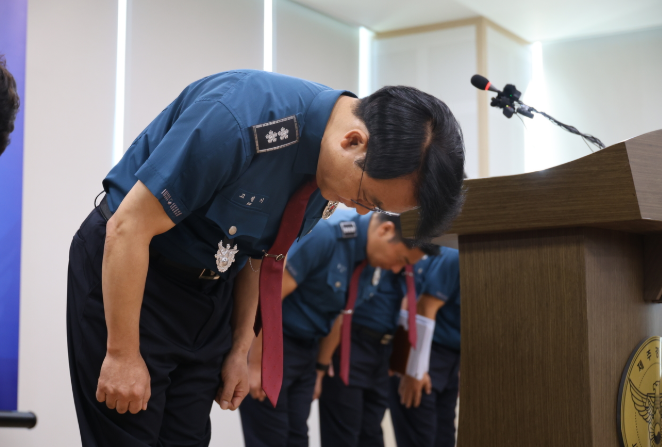
The police chief of Jeju Province, Ko Pyeong-gi, made a formal public apology on Thursday after a serious breakdown in investigative procedures resulted in the deaths of two individuals whose disappearances had been prematurely and incorrectly closed by officers. The commissioner's statement, delivered at the Jeju Provincial Police Agency, acknowledged the profound failure to protect residents and expressed remorse to both the deceased and their grieving families.
The controversy centres on a police officer surnamed Bu, who stands accused of deliberately falsifying procedural records to close investigations without conducting proper follow-up work. In the case of Jang Mi-ran, a 37-year-old woman who went missing in May, officer Bu allegedly claimed to have made contact with her and confirmed her safety, thereby closing the file on false pretences. Jang's body was subsequently discovered on Monday, revealing that the officer's assertion had no basis in fact. This deception directly prevented authorities from conducting an active search that might have altered the outcome.
The officer employed identical misconduct in handling a separate missing person case involving a man in his sixties, whose remains were found on Saturday. The pattern of behaviour—systematically falsifying contact with missing individuals to administratively conclude cases without genuine investigation—suggests a systemic problem rather than isolated lapses in judgement. Such conduct raises serious questions about accountability and oversight within Jeju's police operations, particularly regarding how officers could repeatedly employ the same fraudulent method without detection through routine supervisory channels.
During his apology, Ko acknowledged the gravity of the breach of public trust, stating that police officers carry a fundamental responsibility to safeguard the lives and security of their communities. He emphasised that the actions taken by officer Bu represented a fundamental dereliction of duty, compounded by the deliberate dishonesty involved in fabricating investigative records. The commissioner extended his apology not only to the families suffering bereavement but also to the broader Jeju community whose confidence in police institutions has been damaged by this failure.
The incident carries particular significance in South Korea, where public faith in institutional competence and accountability remains sensitive following various high-profile cases of police negligence and misconduct. Missing person investigations represent a critical function where timely, thorough police work can mean the difference between recovery and tragedy. The premature closure of cases based on false information essentially removes investigative resources from active pursuit, potentially allowing circumstances to deteriorate and opportunities for rescue to expire.
Ko pledged that investigators would conduct a comprehensive and transparent examination of the two cases to determine precisely what occurred and identify all parties responsible for the misconduct. Beyond addressing the immediate incident, he committed Jeju police to conducting a complete audit of all missing person cases handled across the island. This broader review aims to identify whether similar patterns of falsified closure procedures, administrative shortcutting, or investigative negligence exist elsewhere within the department's caseload, suggesting concerns that the problems may be more widespread than currently apparent.
The decision to undertake a full retrospective review of missing person cases represents an implicit acknowledgment that the current system failed to catch or prevent such misconduct during normal operations. Such gaps in oversight are particularly troubling when they involve investigations into disappearances, where families and victims depend entirely on police diligence. The review will likely examine whether supervisory procedures were inadequate, whether data systems lacked sufficient verification mechanisms, and whether officers faced pressures or incentives to close cases quickly rather than thoroughly.
From a regional perspective, this incident echoes broader concerns across East Asia regarding police accountability and the importance of robust institutional checks on investigative authority. South Korea has experienced increased public scrutiny of law enforcement practices in recent years, with particular attention to cases involving vulnerable missing persons. The Jeju situation demonstrates how individual officer misconduct, when combined with weak verification procedures, can undermine the entire investigative process and result in tragic outcomes that extend far beyond the immediate victims to destabilise public confidence in institutions charged with protecting citizens.
The case also raises implications for how police departments across the region manage missing person investigations and implement safeguards against data falsification. In an era where digital records form the primary documentation of police work, systems ensuring the veracity of investigative claims become essential infrastructure. Ko's commitment to transparent investigation and comprehensive case review suggests that Jeju authorities recognise the need for systemic reform extending beyond disciplining individual officers to address underlying procedural vulnerabilities that enabled the misconduct to occur and persist undetected.

