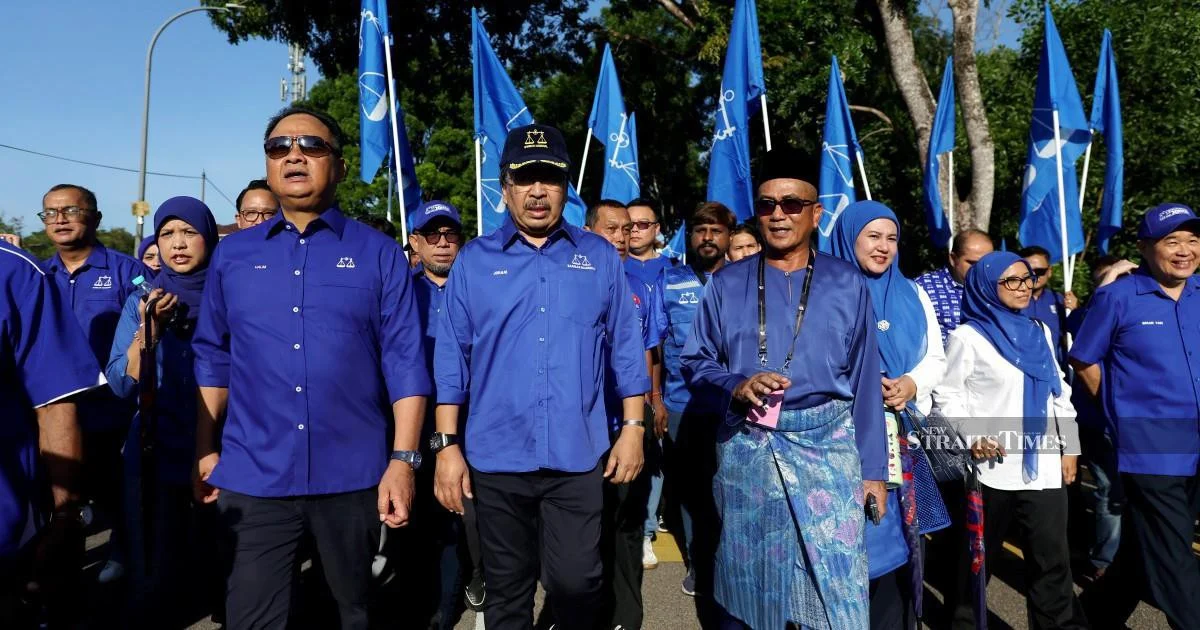
Umno vice-president Datuk Seri Johari Abdul Ghani has thrown his weight behind Barisan Nasional's campaign efforts in Johor, appearing at the Taman Pelangi Indah community hall in Johor Baru to mobilise voter support for the coalition's Tiram seat candidate. The move underscores the prominence of the upcoming state election and the significance party leadership attaches to maintaining BN dominance across key constituencies in Malaysia's second-largest state by population.
The appearance at the grassroots campaign event reflects a deliberate strategy by BN to deploy senior party figures to consolidate support in competitive constituencies. Tiram, situated in the Johor Baru district, represents a symbolically important seat for the ruling coalition, and the presence of Johari—one of Umno's most senior figures in the party hierarchy—signals the intensity with which BN is contesting the state election. Such high-level engagement typically indicates either vulnerability in a traditionally safe seat or a concerted push to expand the coalition's electoral footprint beyond existing strongholds.
Johari's role within Umno as vice-president positions him as a bridge between the party's national leadership and state-level operations. His attendance at community engagements carries particular resonance in Johor, where Umno has historically maintained deep organisational roots and voter loyalty spanning decades. The Taman Pelangi Indah neighbourhood, like many suburban communities in Johor Baru, comprises predominantly middle-class and working-class households that form the electoral backbone of BN's traditional support base.
The decision to hold campaign activities at community halls rather than larger public venues reflects the granular, door-to-door nature of Malaysian political organising. These intimate settings allow candidates and party representatives to address voter concerns directly, discuss local issues affecting residents, and reinforce personal connections that have historically driven BN's electoral success in Johor. Community halls serve as neutral gathering spaces where residents feel comfortable engaging with political figures in their own neighbourhoods.
Barisan Nasional's campaign infrastructure in Johor remains substantially more developed than that of opposition parties, with established networks of grassroots organisers, village chiefs, and community leaders who facilitate political messaging. However, recent electoral cycles have demonstrated that traditional organisational advantages do not guarantee success, particularly as younger voters increasingly seek alternative political voices and as urban constituencies become more competitive. The Tiram seat, reflecting Johor Baru's urbanised character, may present different electoral dynamics compared to rural constituencies where BN's organisational supremacy remains unchallenged.
Johari's campaigning activity must be understood within the broader context of Johor's political importance to Umno and the federal government. As the home state of multiple prime ministers and a traditional power base for Umno, Johor elections carry disproportionate symbolic weight within national politics. A significant swing against BN in the state would reverberate through Malaysian politics and potentially weaken the coalition's position heading into federal elections. Conversely, a strong BN performance in Johor would validate the current government's political standing and provide momentum for future electoral contests.
The timing of campaign mobilisation through senior party figures also reflects strategic calculations about voter sentiment and electoral momentum. By positioning high-ranking leaders in constituencies requiring reinforcement, BN aims to energise its grassroots machinery, boost candidate morale, and provide media attention to otherwise routine campaign activities. These appearances generate local news coverage and social media engagement that extends the campaign's reach beyond those physically present at the event.
For the Tiram constituency specifically, the BN candidate would benefit substantially from association with Johari's seniority and national profile. Malaysian voters often weight the stability and experience offered by established parties and leaders, particularly in elections involving state governance where administrative competence ranks highly among voter priorities. Johari's presence effectively frames the BN candidate as part of a broader, nationally-anchored political movement rather than as an isolated local figure.
The campaign event at Taman Pelangi Indah also speaks to BN's strategy of maintaining visibility and engagement in suburban and urban constituencies where opposition parties have made electoral inroads in recent years. Such constituencies increasingly feature diverse voter demographics, higher education levels, and greater exposure to alternative information sources compared to rural areas. Securing these votes requires sophisticated messaging that addresses contemporary concerns around cost of living, education quality, and economic opportunities while simultaneously defending BN's track record in governance.
Looking beyond this specific campaign appearance, Johari's participation in Tiram's contest signals BN's determination to preserve its Johor bastion ahead of a competitive electoral cycle. The state remains crucial to any coalition seeking to govern Malaysia at the federal level, and losing significant ground here would reshape national political calculations substantially. Umno's investment in deploying its vice-president for community-level campaigning demonstrates the seriousness with which the party approaches this election.
The effectiveness of such campaigns ultimately depends on translating leadership visibility into actual voter turnout and ballot support. While Johari's appearance generates immediate political interest and demonstrates party commitment to the Tiram contest, converting these campaign events into electoral victories requires sustained engagement with voters on substantive policy issues, local grievances, and tangible promises of development and improved governance. The weeks ahead will reveal whether BN's intensive campaign efforts, supported by figures like Johari, succeed in translating organisational advantages into electoral success.

