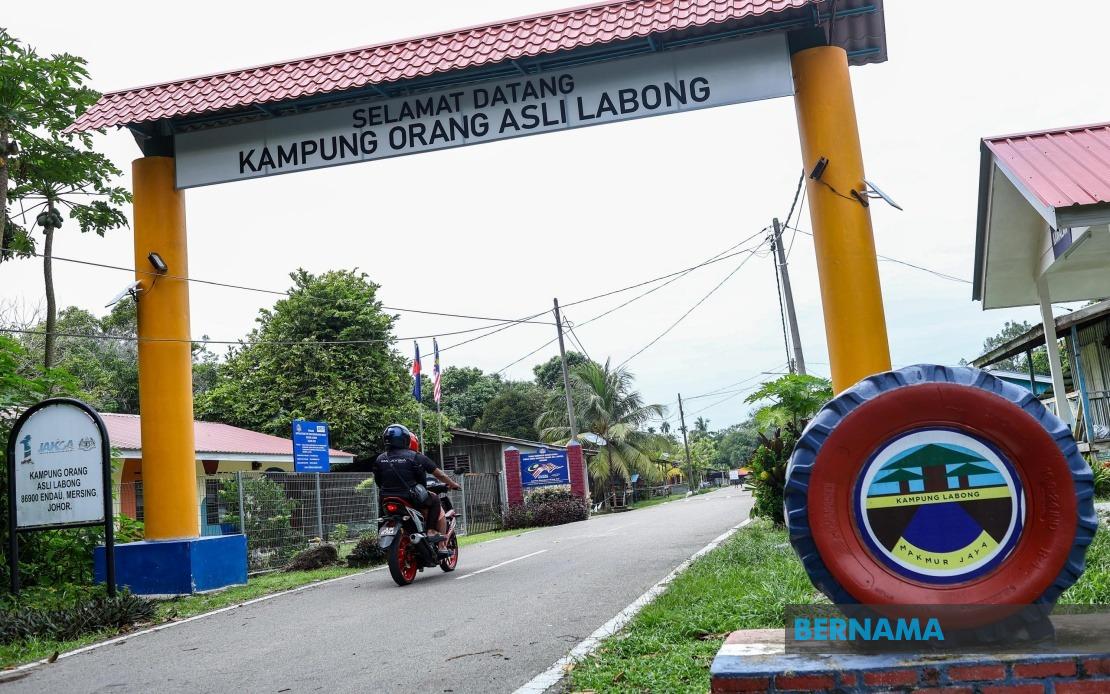
The Johor state government is demonstrating sustained commitment to uplifting Orang Asli communities through a structured partnership with the Department of Orang Asli Development (JAKOA), with residents of Kampung Orang Asli Labong in Mersing offering concrete testimony to the effectiveness of these collaborative efforts. The programmes, which span leadership capacity-building, enhanced financial support, and comprehensive welfare interventions, are producing tangible improvements in both community administration and individual livelihoods across the indigenous settlements in Malaysia's southern state.
Mabot Sela, the 80-year-old Tok Batin of Labong village, embodies the direct beneficiary of these reforms. His enhanced role as the critical conduit between his community and government machinery has been strengthened considerably through structured leadership courses delivered by JAKOA, which have furnished him with practical tools for improved village governance and community administration. These training interventions represent a deliberate shift toward building indigenous leadership capacity rather than relying solely on top-down administration, reflecting a more participatory development philosophy that recognises Orang Asli leaders as essential partners in implementing policy.
Beyond professional development, the state government's decision to augment monthly allowances for village heads and other Orang Asli leaders has delivered immediate material relief. For Mabot, the financial uplift has eased the burden of everyday expenses that often strain limited household resources, particularly expenditure on healthcare and medication—essential services that frequently compete for scarce funds in remote settlements. This intervention addresses a fundamental reality that development cannot be purely structural; it must also acknowledge the immediate economic pressures facing community leaders tasked with serving their populations.
The scope of Johor's investment in Orang Asli advancement is substantial. During the previous financial year, the state government channelled RM3.8 million into nine distinct initiatives specifically designed to empower and enhance welfare outcomes for over 18,000 Orang Asli residents scattered throughout Johor. This funding envelope supports a diversified portfolio spanning welfare assistance, educational opportunities, infrastructure improvements, and broader community development projects, indicating a comprehensive rather than piecemeal approach to addressing the multifaceted needs of indigenous populations.
However, the testimony from community members reveals that ongoing challenges persist alongside these advances. Wild elephant incursions causing crop destruction and roaming cattle herds posing traffic hazards remain recurring concerns that require sustained attention. These issues illustrate how Orang Asli communities remain embedded within contested ecosystems where human settlement, agricultural livelihoods, and wildlife conservation create competing demands on limited forest and agricultural land—a tension particularly acute in states with significant forest reserves like Johor.
Sekoi Janja, a 68-year-old resident of Labong, articulates a generational perspective on development priorities. Her observation that traditional forest-dependent livelihoods have become untenable speaks to the accelerating transformation of indigenous economies across Southeast Asia, where globalisation, land scarcity, and environmental degradation have eroded subsistence pathways that sustained Orang Asli populations for generations. Her emphasis on creating opportunities for younger community members reflects recognition that development must focus on equipping the next generation with skills and income pathways suited to contemporary economic realities rather than nostalgically preserving traditional practices.
Skills development emerges as a critical gap identified by community members themselves. Norma Lonchai, a 44-year-old trader in Labong, articulates a sophisticated understanding of development needs that extends beyond conventional welfare transfers to encompassing vocational training and income-generation opportunities. Her advocacy for programmes that build capabilities and expand earning potential reflects how Orang Asli communities are moving beyond passive recipients of state assistance toward active agents seeking to participate in broader economic opportunities. This demand for skills-focused intervention presents an important policy direction for Johor and other states managing Orang Asli affairs.
The Johor model, combining JAKOA's technical expertise with state-level financing and political commitment, offers a replicable framework for other Malaysian states navigating Orang Asli development. The emphasis on strengthening traditional leadership structures through formal training rather than replacing them with external administrative apparatus respects indigenous governance patterns while enhancing their effectiveness. This approach contrasts with earlier top-down models that often marginalised traditional leaders, instead positioning them as vital intermediaries capable of bridging indigenous and state systems.
For Malaysia's broader nation-building agenda, the Orang Asli development trajectory carries significance beyond Johor. Indigenous communities comprise approximately 0.6% of Malaysia's population but occupy substantial land territories and inhabit ecologically sensitive regions. Their integration into national development frameworks while preserving cultural identity and securing land rights remains an ongoing policy challenge. Johor's visible progress in this domain—demonstrable through improved allowances, structured training, and community acknowledgment of benefits—contributes important evidence that targeted, respectfully designed interventions can advance indigenous welfare without requiring displacement or cultural assimilation.
Looking forward, sustaining momentum will require attention to emerging community priorities. The identification of skill-building and income diversification as central concerns suggests that future phases should expand vocational training, support for small enterprises, and linkages to broader market opportunities. Infrastructure development must balance accessibility with environmental preservation, recognising that many Orang Asli settlements sit within or adjacent to forest reserves requiring conservation. Furthermore, addressing wildlife-human conflict more comprehensively—through compensation schemes, habitat management, and livelihood alternatives—could resolve recurring frustrations that undermine confidence in development initiatives.
The Kampung Orang Asli Labong experience demonstrates that Orang Asli communities are not static populations awaiting rescue through paternalistic programming but rather dynamic societies actively engaged with questions of development, opportunity, and intergenerational advancement. When government agencies like JAKOA and state authorities genuinely listen to community priorities and invest resources accordingly, indigenous Malaysians contribute meaningfully to their own advancement. The challenge for policymakers extends beyond allocating funds to ensuring that development resources translate into genuine capability-building and economic opportunity expansion that communities themselves identify as meaningful.

