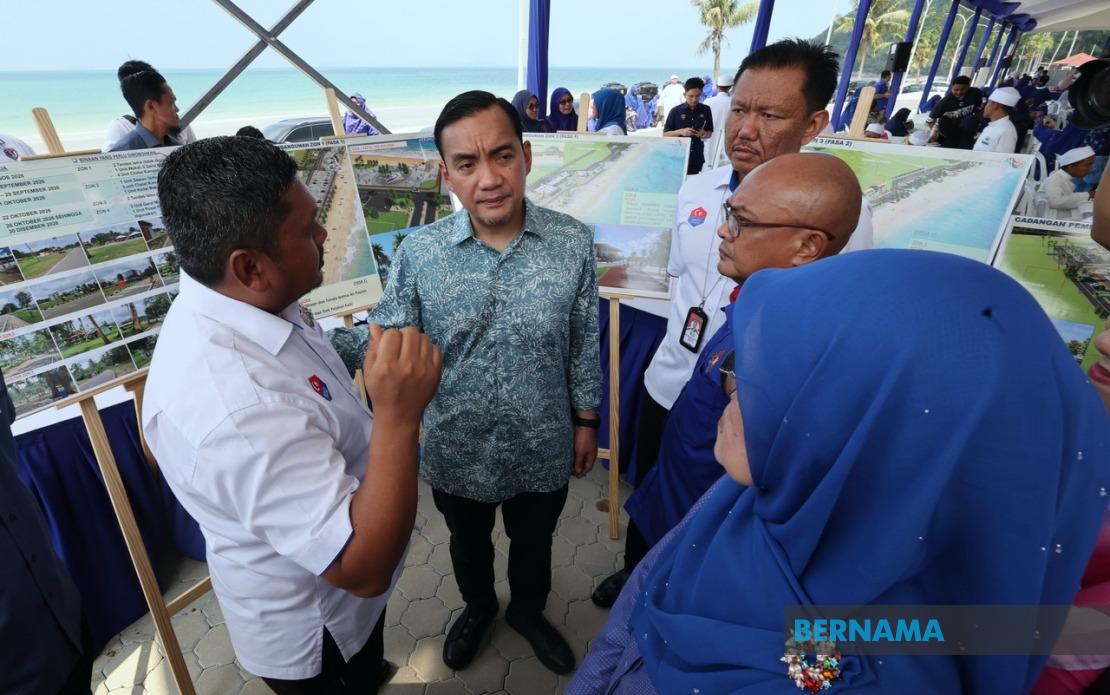
Johor's state government has committed RM1.5 million towards a comprehensive development initiative in Mersing, signalling a renewed push to extend prosperity beyond the state's more developed urban centres. Menteri Besar Datuk Onn Hafiz Ghazi unveiled the funding package at a district gathering, framing the investment as essential to ensuring that the 80,000 residents of Mersing share meaningfully in Johor's broader economic expansion and do not remain marginalised by growth concentrated in wealthier zones.
The announcement reflects a strategic recalibration within Johor's governance approach. Rather than allowing development gains to accumulate in already-prosperous areas, the state administration is attempting to replicate infrastructure and services models that have succeeded in Johor Bahru across its secondary districts. This decentralisation strategy addresses a persistent challenge facing many Malaysian states: the risk that economic progress becomes geographically uneven, with peripheral regions lagging behind metropolitan hubs and their residents lacking access to quality employment and services.
Central to this effort is the Johor Economic Transformation Plan, a multi-phased framework designed to guide the state's growth trajectory across short, medium, and long-term horizons. Rather than serving merely as a top-line economic blueprint, the JETP is explicitly oriented towards improving material conditions for ordinary citizens. Its architects emphasise that infrastructure projects, job creation initiatives, and skill-development programmes must translate into tangible opportunities for younger residents who might otherwise migrate to Selangor or Kuala Lumpur seeking better prospects. Without deliberate efforts to anchor youth within smaller districts through viable careers, Onn Hafiz argued, the state risks losing human capital to urban centres.
The RM1.5 million fund has been distributed across an eclectic array of projects reflecting the diverse needs of a rural-semi-rural district economy. Healthcare infrastructure receives the largest single allocation: RM500,000 is earmarked for upgrading the haemodialysis unit at Mersing Hospital, addressing a critical gap in kidney disease treatment facilities that affects an ageing population. This represents an acknowledgment that economic growth divorced from healthcare equity proves hollow when residents lack access to life-sustaining treatments.
Community and religious infrastructure also features prominently. RM200,000 has been designated for carpet replacement at Kampung Sri Lalang Mosque, a project that may appear modest but signals respect for the spiritual and social anchors of Mersing's Muslim-majority population. Two separate allocations of RM200,000 each address recreational capacity through futsal court construction at Taman Sri Mersing and repairs to an existing facility in Felda Nitar. Sport and recreation infrastructure, particularly at grassroots level, enhances quality of life and provides affordable outlets for youth engagement.
Distinct consideration has been given to Mersing's Orang Asli communities. Solar-powered streetlighting installations in Kampung Peta and Kampung Tanjung Tuan, totalling RM200,000, directly improve safety and quality of life in these historically underserved settlements. The allocation reflects growing acknowledgment within Malaysian governance circles that indigenous communities often experience development deficits relative to their Malay and other communities, requiring targeted intervention. Similarly, a RM100,000 grant supports upgrading facilities at the Kami Anak Felda Malaysia building in Felda Tenggaroh Timur, channelling support to former landless farmer families whose descendants remain economically vulnerable.
The government has also allocated RM80,000 for construction of a sepak takraw court in Felda Tenggaroh 6, investing in traditional Malaysian sport whilst simultaneously providing recreational infrastructure. This blend of heritage-conscious and utilitarian project selection suggests a deliberate effort to balance modernisation with cultural preservation—a nuance often missing from strictly economic development frameworks.
Beyond the immediate financial allocation, Onn Hafiz articulated several strategic long-term initiatives positioned to reshape Mersing's institutional landscape. A proposal to construct a dedicated petrol station serving personnel of the Special Forces Group at Camp Iskandar represents infrastructure that anchors military employment within the district. Plans to establish a Religious Affairs Office would formalise Mersing's administrative capacity in Islamic affairs, enhancing service delivery and institutional presence. Most significantly, the commitment to pursue a Technical and Vocational Education and Training campus under the JETP framework addresses a critical infrastructure gap in skill development.
The TVET initiative carries particular significance for Southeast Asian readers. Malaysia's broader economy has increasingly demanded vocational and technical competencies across manufacturing, services, and emerging technology sectors, yet rural and semi-urban districts often lack training infrastructure. Establishing such a campus in Mersing could redirect youth towards manufacturing and services employment within the district or broader state economy, rather than forcing migration to peninsular corridor cities. This directly addresses the demographic challenge facing regional Malaysian economies: retaining youth populations whilst diversifying beyond agricultural and traditional primary sectors.
Onn Hafiz's framing emphasised that tourism products alone cannot drive sustainable development if local residents remain economically marginalised. This statement acknowledges a recurrent criticism of Malaysian tourism-centred development strategies, which sometimes generate employment and foreign exchange without proportionally benefiting communities adjacent to tourist sites. By insisting that Mersing's development model integrate healthcare, skills training, sports facilities, and religious infrastructure, the state government suggests a maturation towards holistic development thinking rather than sector-focused approaches.
The announcement carries regional implications beyond Johor's boundaries. As Southeast Asian nations grapple with uneven spatial development and the challenge of extending growth beyond primate cities, Johor's strategic emphasis on deliberate resource allocation to secondary districts may offer a replicable model. Malaysian states with geography and population profiles resembling Johor—such as Pahang, Terengganu, and Kelantan—might observe whether Mersing's development outcomes validate or challenge the efficacy of such targeted allocations.
For Mersing specifically, the RM1.5 million package represents both substantive investment and symbolic recognition. The capital commitment itself is significant for a district of 80,000 residents, translating to approximately RM18.75 per capita—a modest figure that nonetheless reflects state-level prioritisation. The constellation of projects, spanning healthcare, infrastructure, education, and community facilities, suggests an administration aware that sustainable regional prosperity requires attention to multiple development dimensions simultaneously. Whether the initiative proves sufficient to arrest demographic decline and generate meaningful employment growth remains an open question that will unfold over subsequent months and years.

