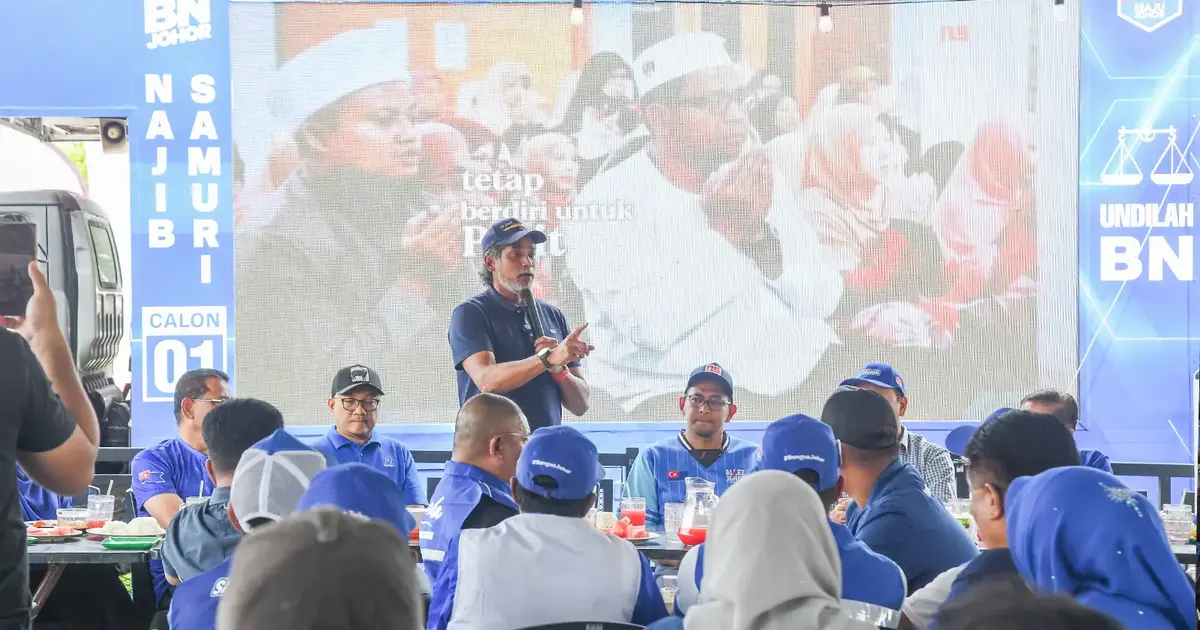
In a significant intervention into Johor's evolving political landscape, Khairy Jamaluddin has injected fresh debate protocol into discussions between the state's ruling coalition and its opposition, declaring that any public contest with Johor Barisan Nasional chairman Onn Hafiz Ghazi would require Pakatan Harapan to present a prospective menteri besar candidate of equivalent political weight and responsibility.
The statement from the former Umno Youth chief underscores the careful calibration of hierarchies within Malaysia's coalition politics, where the ranking and stature of participating figures carry profound symbolic weight. By explicitly tying any debate appearance to the presentation of a chief minister aspirant, Khairy has essentially raised the threshold for public engagement between the two opposing alliances, effectively narrowing the pool of potential opposition representatives who might command sufficient credibility and authority in such a forum.
This positioning reflects broader dynamics within Johor's political environment, where Barisan Nasional maintains significant organisational advantages and institutional incumbency. The demand for parity at the menteri besar level serves multiple purposes: it affirms the governing coalition's confidence in Onn Hafiz's standing, suggests that lower-ranking opposition figures lack comparable legitimacy, and creates practical obstacles for Pakatan Harapan should it wish to pursue public debate as a campaign tool heading toward any future state elections.
Onn Hafiz Ghazi, who chairs the Johor BN machinery, represents the dominant force in the southern state's political establishment. His position combines administrative authority with significant patronage networks accumulated through years of coalition governance. Khairy's invocation of debate equivalency essentially reaffirms this hierarchical positioning within the competitive landscape, treating the BN chairman's standing as naturally superior to any opposition alternative that might be proposed.
For Malaysian readers monitoring Johor's political trajectory, this intervention carries implications beyond simple protocol disputes. The statement reveals underlying calculations about electoral confidence and coalition psychology. When governing parties confidently issue debate conditions, they typically believe their representatives can withstand public scrutiny. Conversely, such demands can also function as pre-emptive deterrents, discouraging opposition mobilisation by raising organisational burdens and creating excuses for non-engagement.
Pakatan Harapan's capacity to field a genuinely competitive menteri besar aspirant remains contested. The opposition alliance has struggled to establish unified, high-profile state-level leadership in several constituencies, and Johor represents one of its weakest regional bases. Should opposition leaders accept Khairy's terms and present a prospective chief minister, they would simultaneously legitimise the framing that such equivalency was necessary, potentially conceding psychological ground before substantive debate begins.
The timing of this declaration also warrants consideration. Johor's political temperature has been rising incrementally, with various configurations and potential election scenarios periodically discussed. By establishing debate terms now, rather than responding reactively to opposition overtures, BN's representatives position themselves as gatekeepers and arbiters of engagement standards, controlling the conditions under which public political discourse might proceed between competing alliances.
Historically, Malaysia's state-level politics have seen both productive and acrimonious public forums. Debates between chief ministerial candidates can significantly influence electoral perception, particularly when media coverage amplifies substantive policy differences or rhetorical shortcomings. Khairy's intervention suggests BN strategists believe Onn Hafiz performs effectively in such settings and that establishing debate parameters now may preemptively structure any future public contests in his favour.
From a Southeast Asian perspective, this reflects broader patterns in Malaysian coalition democracy where positioning and structural advantages often prove as consequential as actual policy substance. The debate-equivalency demand exemplifies how governing parties leverage incumbency and institutional hierarchies to shape competition boundaries even before elections are formally called, demonstrating the intricate chess-like quality of Malaysian political maneuvering at the state level.
For opposition parties contemplating responses, the demand presents a genuine dilemma. Capitulating to debate conditions could appear weak, yet refusing engagement risks accusations of electoral fear. The most strategically sophisticated response would involve ignoring the framework entirely and pursuing alternative campaign methodologies that don't require opposition participation in BN-preferred forums, thereby denying the government the satisfaction of enforcing its debate protocols.
As Johor's political competition continues evolving, such pronouncements from established figures like Khairy will likely proliferate, each attempt representing another incremental positioning in the protracted contest for state-level supremacy. The debate question, while superficially procedural, thus functions as a proxy for deeper questions about relative coalition strength, electoral confidence, and the fundamental balance of power within Malaysia's second-largest state.

